








What Is The Commutative Property Of Addition With Formula And Examples
Do you Know What is Meant by Commutative Property in Maths?
Are you someone who loves maths? If it's a yes, you are going to love it even more and even if it’s a no, you are going to love the subject. Why? Because maths is full of magic and you are going to learn this magic now. Don’t you love magic? Don’t you want to be a magician? So, why are we waiting? Let’s start.
In English, “Commute” means to travel. Wondering why we are talking about English in a maths topic? That’s because the commutative property is also the same. Confused? Okay, let’s understand in a simple way. Commutative property in maths means that interchanging the order of the numbers does not change the result. So, the commutative property of addition states that if the order of the numbers are interchanged while doing addition, the results remain the same. Let’s have a look at the examples.
Examples of Commutative Property of Addition

Also,

So, commutative property in addition means
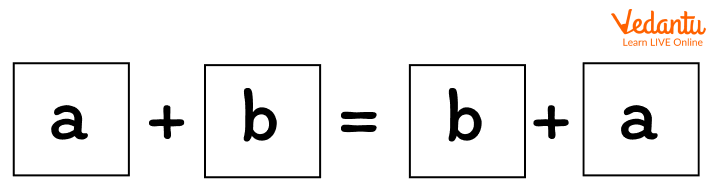
In number, it will be
3 + 2 = 2 + 3.
Rhyme on Commutative Property of Addition
Here is a rhyme to understand the commutative property of addition in a better and rhythmic way.
“When adding numbers two or more,
Change the order, you will still score!
Don’t let adding in order be the aim,
Because the sum will just be the same!”
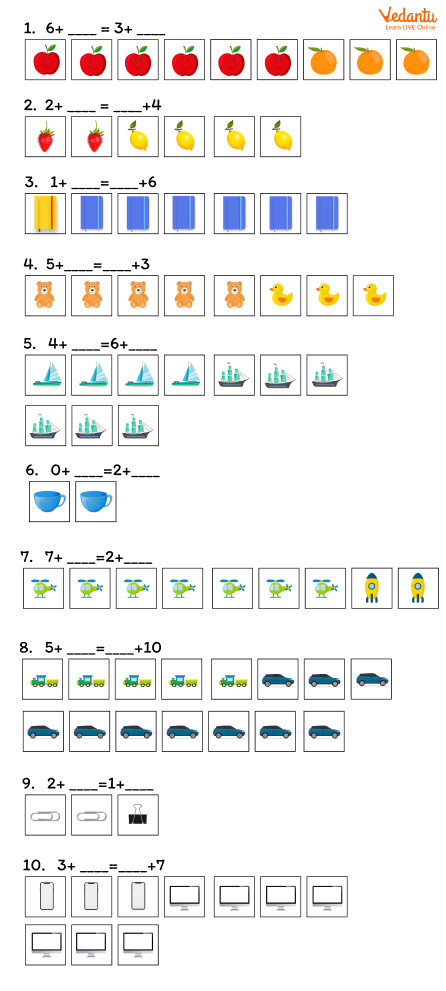
Exercise on Commutative Property of Addition
It’s time for exercise.
Solve the following:
Conclusion
So how was the magic? Did you enjoy learning it? If you have liked it, there is a lot more to explore. You can tell your parents to explore more on our website and enjoy learning. Believe me, you will never be disappointed!
FAQs on Commutative Property Of Addition Explained Clearly
1. What is the commutative property of addition?
The commutative property of addition states that changing the order of addends does not change the sum. In simple terms, a + b = b + a.
- Example: 4 + 7 = 11 and 7 + 4 = 11
- The sum remains the same even if the numbers switch places.
- This property applies to whole numbers, integers, fractions, and decimals.
2. What is the formula for the commutative property of addition?
The formula for the commutative property of addition is a + b = b + a.
- "a" and "b" represent any real numbers.
- The formula shows that order does not affect the result.
- Example: 15 + 3 = 3 + 15 = 18.
3. Can you give an example of the commutative property of addition?
An example of the commutative property of addition is 9 + 5 = 5 + 9, and both equal 14.
- First order: 9 + 5 = 14
- Reversed order: 5 + 9 = 14
- The sum remains unchanged.
4. Why is the commutative property of addition important?
The commutative property of addition is important because it makes calculations easier and more flexible.
- It allows numbers to be rearranged for mental math.
- It simplifies algebraic expressions.
- It helps in solving equations efficiently.
5. Does the commutative property apply to subtraction?
No, the commutative property does not apply to subtraction because changing the order changes the result.
- Example: 10 − 4 = 6
- But 4 − 10 = −6
- Since 6 ≠ −6, subtraction is not commutative.
6. Does the commutative property of addition work for fractions and decimals?
Yes, the commutative property of addition works for fractions and decimals because the order does not affect the sum.
- Fractions: 1/2 + 3/4 = 3/4 + 1/2
- Decimals: 2.5 + 1.3 = 1.3 + 2.5 = 3.8
- The property applies to all real numbers.
7. What is the difference between the commutative and associative properties of addition?
The commutative property changes the order of numbers, while the associative property changes the grouping of numbers.
- Commutative: a + b = b + a
- Associative: (a + b) + c = a + (b + c)
- Both properties keep the sum the same.
8. How do you use the commutative property of addition in mental math?
You use the commutative property of addition in mental math by rearranging numbers to make addition easier.
- Example: 18 + 2 + 7
- Rearrange: 18 + 2 = 20
- Then 20 + 7 = 27
9. Is addition always commutative?
Yes, addition is always commutative for all real numbers, meaning a + b = b + a holds true.
- Applies to whole numbers, integers, fractions, and decimals.
- The order of addends never changes the sum.
- This is a fundamental property of arithmetic.
10. What is a real-life example of the commutative property of addition?
A real-life example of the commutative property of addition is counting money in different orders and getting the same total.
- If you have $5 and $10, then 5 + 10 = 15
- If you count $10 first and then $5, 10 + 5 = 15
- The total amount remains $15 regardless of order.
