








How to Arrange Fractions in Ascending Order Step by Step with Examples
We can say that fraction is a number expressed as a quotient in which there are two numbers: a numerator and a denominator which are dividends. We can also say that fractions represent a part of a whole. A fraction has two parts, namely numerator, and denominator. The numerator is the number that is on the top and the denominator is the number that is at the bottom. Let's take a fraction $\dfrac{1}{8}$. In this 1 is on top so it is the numerator and 8 is at the bottom so it is the denominator. Let us understand fractions with some other examples.

Fraction Showing 1 Part of Pizza Out of 8 Parts
Now let us understand how to arrange these fractions in ascending order.
Arranging Fractions in Ascending Order
To arrange ascending order in fractions we have to convert the given fractions into like fractions if the fractions are not already in like a fraction.
Like fractions of those fractions that have the same denominator.
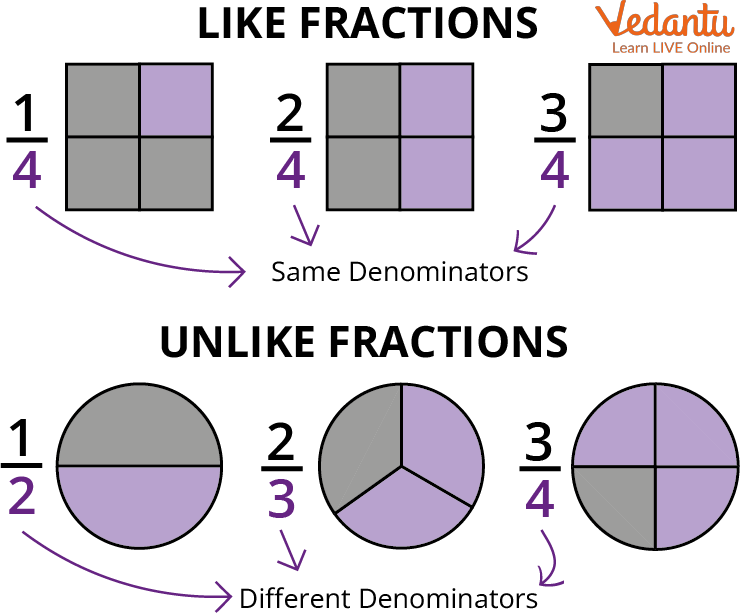
Like Fractions and Unlike Fractions.
Example: Arrange $\dfrac{14}{40}$, $\dfrac{27}{40}$, $\dfrac{3}{40}$, and $\dfrac{33}{40}$ in ascending order.
Ans: In this situation, we can say that every fraction has the same denominator which is 40 which means they are like fractions.
Now, all we have to do is focus on the numerator. Now, all we have to do is arrange these numerators in ascending order. In this case, we have four numerators - 14, 27, 3, 33
Since 3< 14< 27< 33
Therefore $\dfrac{3}{40}$ < $\dfrac{14}{40}$ < $\dfrac{27}{40}$ < $\dfrac{33}{40}$.
Let's take another example,
Example: Convent $\dfrac{1}{3}$, $\dfrac{3}{5}$, and $\dfrac{1}{2}$ in Ascending order.
Ans: These fractions are clearly unlike fractions because they have different denominators. To convert these fractions into like fractions we have to convert their denomination for this we have to take the LCM of the denominator.
In this case, we have to take LCM of 3, 5, and 2.
LCM of 3,5,2= 30
Now since the LCM of 3, 5, and 2 is 30 we have to convert the denominator of all the numbers to 30.
Now to make the fraction like fractions we have to divide the L.C.M. by the denominator of fractions, then multiply both the numerator and denominator of the fraction with the resulting number that we get after dividing L.C.M
The first number is $\dfrac{1}{3}$. To convert 3 into 30 we have to multiply 3 by 10. If we multiply 3 by 10 then we also have to multiply the numerator that is 1 with 10
$\dfrac{1}{3} \times \dfrac{10}{10} = \dfrac{10}{30}$
Continue the same step with the other numbers.
$\dfrac{3}{5} \times \dfrac{6}{6} = \dfrac{18}{30}$
$\dfrac{1}{2} \times \dfrac{15}{15} = \dfrac{15}{30}$
Once we get all the numbers into like fractions it is pretty easy to arrange these fractions in ascending order
In this case $\dfrac{10}{30}$ < $\dfrac{15}{30}$ < $\dfrac{18}{30}$
Therefore, $\dfrac{1}{3}$< $\dfrac{1}{2}$< $\dfrac{3}{5}$
Solved Examples
Now let us solve some questions.
Q1. Arrange the given fractions in ascending order $\dfrac{2}{9}$, $\dfrac{5}{9}$, $\dfrac{1}{9}$, $\dfrac{8}{9}$.
Ans. Since the given fractions are already in ascending order we just have to compare the numerators.
Now we can see that 1< 2< 5< 8
Therefore, $\dfrac{1}{9}$< $\dfrac{2}{9}$< $\dfrac{5}{9}$< $\dfrac{8}{9}$.
Q2. Arrange the given fractions in ascending order $\dfrac{3}{4}$, $\dfrac{5}{7}$, $\dfrac{9}{3}$, $\dfrac{2}{5}$
Ans. As we can see that the above fractions are unlike fractions. To convert them into like fractions we will have to take out the LCM of the denominators.
LCM of 4, 7, 3, and 5 is 420.
To convert the denominators of these fractions into 420
Now to make the fraction like fractions divide the L.C.M. by the denominator of fractions, then multiply both the numerator and denominator of the fraction with the resulting number after dividing L.C.M.
$\dfrac{420}{4}$= 105
Therefore, $\dfrac{3}{4} \times \dfrac{105}{105}$ = $\dfrac{315}{420}$
On repeating the steps:
$\dfrac{420}{7}$ = 60
$\dfrac{5}{7}$$\times$$\dfrac{60}{60}$ = $\dfrac{300}{420}$
Again $\dfrac{420}{3}$ = 140
$\dfrac{9}{3} \times \dfrac{140}{140}$ = $\dfrac{1260}{420}$
$\dfrac{420}{5}$ = 84
$\dfrac{2}{5} \times \dfrac{84}{84}$ = $\dfrac{168}{420}$
Converting the fractions into like fractions we have to compare the numerator of the like fraction
We can see that 168< 300< 315< 1260
Therefore,
$\dfrac{168}{420}$< $\dfrac{300}{420}$< $\dfrac{315}{420}$< $\dfrac{1260}{420}$ which makes $\dfrac{2}{5}$ < $\dfrac{5}{7}$ < $\dfrac{3}{4}$ < $\dfrac{9}{3}$.
Practice Questions
Q1. Arrange the following in ascending order $\dfrac{2}{5}$, $\dfrac{6}{5}$, $\dfrac{3}{4}$, $\dfrac{2}{3}$
Ans: $\dfrac{2}{5}$< $\dfrac{2}{3}$< $\dfrac{3}{4}$< $\dfrac{6}{5}$
Q2. Arrange the following in ascending order $\dfrac{7}{3}$, $\dfrac{6}{5}$, $\dfrac{6}{9}$, $\dfrac{5}{4}$
Ans: $\dfrac{6}{9}$< $\dfrac{6}{5}$< $\dfrac{5}{4}$< $\dfrac{7}{3}$
Summary
To arrange ascending order means to arrange numbers from a low value to a higher value. To arrange fractions in ascending order we should always convert the fractions into like fractions. Like fractions are those fractions you have the same denominator. A part of the whole thing is known as a fraction. Here you will understand what fraction is. You will be able to arrange a fraction in ascending order. Like fractions and unlike fractions are also explained with examples.
FAQs on Ascending Order in Fraction Explained Clearly
1. What is ascending order in fraction?
Ascending order in fraction means arranging fractions from the smallest value to the greatest value.
In ascending order:
- The fraction with the least numerical value comes first.
- The fraction with the greatest value comes last.
2. How do you arrange fractions in ascending order?
To arrange fractions in ascending order, first make their denominators the same or convert them into decimals, then compare their values.
Steps:
- Find the LCM of the denominators (if different).
- Convert each fraction into an equivalent fraction with the same denominator.
- Compare the numerators.
- Arrange from smallest to largest.
- LCM of 2, 4, 3 is 12.
- 1/2 = 6/12, 3/4 = 9/12, 2/3 = 8/12.
- Ascending order: 1/2, 2/3, 3/4.
3. How do you arrange fractions with the same denominator in ascending order?
When fractions have the same denominator, arrange them by comparing their numerators directly.
Rule: The fraction with the smaller numerator is smaller.
Example: Arrange 3/8, 1/8, 5/8.
- Compare numerators: 1, 3, 5
- Ascending order: 1/8, 3/8, 5/8
4. How do you arrange fractions with different denominators in ascending order?
To arrange fractions with different denominators in ascending order, convert them to equivalent fractions with a common denominator.
Method:
- Find the LCM of the denominators.
- Rewrite each fraction with the common denominator.
- Compare the numerators.
- LCM of 5, 10, 2 is 10.
- 2/5 = 4/10, 3/10 = 3/10, 1/2 = 5/10.
- Ascending order: 3/10, 2/5, 1/2.
5. Can you arrange mixed fractions in ascending order?
Yes, mixed fractions can be arranged in ascending order by first converting them into improper fractions.
Steps:
- Convert mixed numbers to improper fractions.
- Find a common denominator if needed.
- Compare values and arrange.
- Convert: 3/2, 7/3, 7/4.
- LCM of 2, 3, 4 is 12.
- 3/2 = 18/12, 7/4 = 21/12, 7/3 = 28/12.
- Ascending order: 1 1/2, 1 3/4, 2 1/3.
6. What is the easiest way to compare fractions for ascending order?
The easiest way to compare fractions for ascending order is to convert them into decimals and then compare their decimal values.
Example: Arrange 1/4, 2/5, 3/8.
- 1/4 = 0.25
- 2/5 = 0.40
- 3/8 = 0.375
- Ascending order: 1/4, 3/8, 2/5
7. How do you arrange like fractions in ascending order?
Like fractions are arranged in ascending order by comparing their numerators since their denominators are the same.
Definition: Like fractions have the same denominator.
Example: Arrange 7/9, 2/9, 5/9.
- Compare numerators: 2, 5, 7
- Ascending order: 2/9, 5/9, 7/9
8. How do you arrange unlike fractions in ascending order?
Unlike fractions are arranged in ascending order by first converting them to equivalent fractions with a common denominator.
Definition: Unlike fractions have different denominators.
Example: Arrange 4/7, 2/3, 5/6.
- LCM of 7, 3, 6 is 42.
- 4/7 = 24/42, 2/3 = 28/42, 5/6 = 35/42.
- Ascending order: 4/7, 2/3, 5/6.
9. What are common mistakes when arranging fractions in ascending order?
A common mistake when arranging fractions in ascending order is comparing denominators only without finding equivalent values.
Common errors:
- Assuming a larger denominator means a larger fraction.
- Not finding the LCM correctly.
- Forgetting to convert mixed numbers to improper fractions.
10. Why is finding a common denominator important when arranging fractions in ascending order?
Finding a common denominator is important because it allows accurate comparison of fractions by expressing them in the same unit parts.
When denominators are different:
- Fractions represent different-sized parts.
- Direct comparison becomes difficult.
