








Key Theorems Formulas and Solved Examples of Angle and Tangent Properties
The circle is one of the most interesting and important chapters when it comes to geometry. Being an important elementary figure in the field of geometry, circles have many properties associated with them. These properties have great theoretical importance and also have interesting applications.
In this lesson, we will learn about some interesting properties of a circle. We will cover the cyclic and tangent properties of a circle and their theorems along with angle properties of circle questions and answers.
Cyclic Properties of Circle
Property 1: The angle inscribed in a semicircle is a right angle.
The angle subtended by a semicircle measures 90 degrees. In other words, this property states that if you join the endpoints of a semicircle on a third point somewhere on the circumference of the circle, the angle inscribed would be a right angle.

Reference image for property 1
Property 2: Inscribed angles subtended by the same arc are equal.
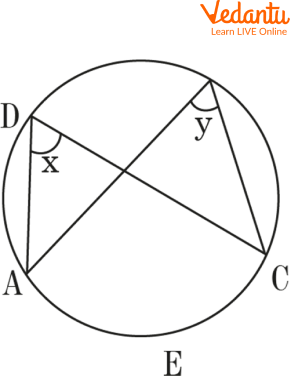
Inscribed Angles x and y
In the figure shown above, the arc AEC subtends two inscribed angles $\angle x$ and $\angle y$. Therefore, these two angles will be equal.
Property 3: Central angles subtended by arcs of the same length are equal in measure.
If there are two arcs in a circle that are equal in length, the central angles subtended by them are equal.

Reference image for property 3
Property 4: The central angle of a circle is twice any inscribed angle subtended by the same arc.

Reference image for property 4
As expressed in the image above, the central angle subtended by the arc is $2 \alpha$, and the inscribed angle subtended by the same arc is $\alpha$.
Property 5: Supplementary opposite angles
The opposite angles of a cyclic quadrilateral are supplementary. In other words, the sum of the measures of the opposite angles of a quadrilateral that is inscribed in a circle is equal to 180 degrees. In the figure below, $\angle \mathrm{A}+\angle \mathrm{C}=180^{\circ}$
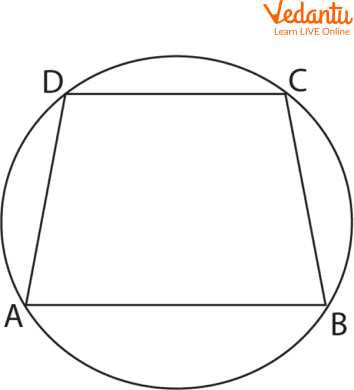
Reference image for property 5
Tangent Properties of Circle
Property 1: A tangent to a circle is perpendicular to the radius drawn to the point of tangency.
If AB is a tangent that has P as a point of contact on the circle with centre O, segment OP will be perpendicular to the tangent AB.
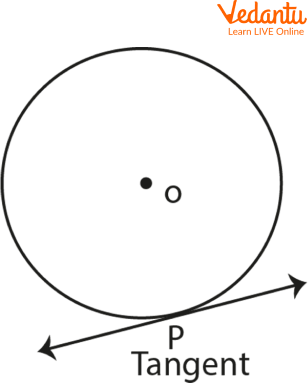
Reference image for property 1
Property 2: When two segments are drawn tangent to a circle from the same point outside the circle, the segments are equal in length.

Reference image for property 2
Solved Examples
Below are some angle properties of a circle questions and answers:
Q 1. In the figure given below, if the $\angle A D C=70^{\circ}$, what is the measure of $\angle A B C$?

Example 1
Ans: We know that the angle subtended by an arc is twice the angle subtended by it on the circumference.
From the figure, we know that
$\angle \mathrm{ADC}= 70^{\circ}$
So, we get
$\angle \mathrm{ABC}=2 \angle \mathrm{ADC}$
It can be written as
$\angle \mathrm{ABC}=2 \angle 70^{\circ}$
So, we get
$\angle \mathrm{ABC}=140^{\circ}$
Practice Questions
Q 1. The figure below shows a circle passing through points $A, B, C$, and $D$. The angle $\angle B A C=70^{\circ}$. What is the measure of $\angle DBC+\angle DCB$?
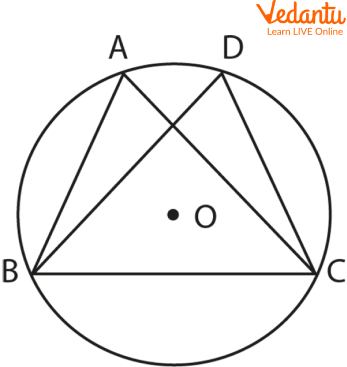
Image for Practice Question 1
Ans: $110^{\circ}$
Q 2. In the figure given below, $A C$ is the diameter of the circle. $A B=B C$ and $\angle A E D=118^{\circ}$. Find $\angle D A B$ ?
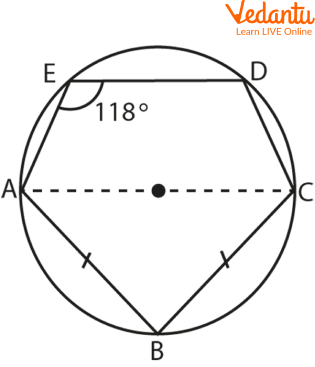
Image for Practice Question 2
Ans: $\angle D A B$ = $73^{\circ}$
Summary
In this article, we focused on one of the most important topics in the chapter on Circles. We learned numerous angle and cyclic properties of circles that helped us in understanding theorems. Not just that but we also covered all the angle and tangent properties of circles. To have better clarity about the application of the properties, we went through the angle properties of a circle worksheet, where we solved some examples using the properties. These properties and theorems are helpful in understanding and solving geometric problems.
FAQs on Angle and Tangent Properties of a Circle Explained
1. What is the angle between a tangent and a radius of a circle?
The angle between a tangent and the radius at the point of contact is always 90°.
This is a fundamental property of circles:
- The radius is drawn to the point where the tangent touches the circle.
- The tangent touches the circle at exactly one point.
- The angle formed between them is a right angle.
2. What is the alternate segment theorem in a circle?
The alternate segment theorem states that the angle between a tangent and a chord through the point of contact is equal to the angle in the opposite arc of the circle.
In simple terms:
- Draw a tangent at point A.
- Draw a chord AB from A.
- The angle between the tangent and chord AB equals the angle in the opposite segment of the circle.
3. What are the properties of tangents drawn from an external point?
Tangents drawn from the same external point to a circle are equal in length.
If P is an external point and PA and PB are tangents to the circle, then:
- PA = PB
- Each tangent is perpendicular to the radius at the point of contact.
4. How do you prove that a tangent is perpendicular to the radius?
A tangent is perpendicular to the radius because any other line through the point would cut the circle at two points, so only a right angle forms a true tangent.
Proof outline:
- Let O be the center and T the point of contact.
- Draw radius OT.
- Assume the tangent is not perpendicular.
- Then the line would pass inside the circle and intersect it at another point.
5. What is the angle between two tangents drawn from an external point?
The angle between two tangents from an external point is equal to 180° minus the central angle subtended by the points of contact.
If tangents PA and PB meet at P and O is the center:
- Let ∠AOB = central angle.
- Then ∠APB = 180° − ∠AOB.
6. How do you find the length of a tangent from an external point?
The length of a tangent from an external point is found using the formula PT = √(PO² − r²).
Where:
- PO = distance from external point to center
- r = radius of the circle
- PT = tangent length
7. What is the relationship between a tangent and a chord through the point of contact?
The angle between a tangent and a chord through the point of contact equals the angle in the opposite arc of the circle.
This follows from the alternate segment theorem:
- Draw tangent at point A.
- Draw chord AB.
- The angle between tangent and chord equals the angle in the far arc.
8. What is the difference between a secant and a tangent in a circle?
A tangent touches the circle at exactly one point, while a secant cuts the circle at two points.
Key differences:
- Tangent → one point of contact.
- Secant → two points of intersection.
- The radius is perpendicular to a tangent at the contact point.
9. Can a circle have more than one tangent at a point?
No, a circle can have only one unique tangent at a given point.
This is because:
- The tangent must be perpendicular to the radius at that point.
- Only one line can be drawn perpendicular to a given radius at a specific point.
10. How do angle properties of a circle help in solving geometry problems?
Angle and tangent properties of a circle help find unknown angles using fixed rules like 90° between radius and tangent and the alternate segment theorem.
Common uses:
- Finding missing angles in cyclic quadrilaterals.
- Solving tangent–chord angle problems.
- Determining central and exterior angles.
