








How to Solve Addition Word Problems For Class 2 Step by Step with Examples
Addition is the most basic mathematical operation that we can use for calculations. We need to practice using real-life situations and for that word problems are the best. Addition is based on certain properties, i.e. closure, commutative, and associative. Closure property is when two or more whole numbers are added to get a whole number. Commutative property is when two or more whole numbers are added but the result is not dependent on the order of addends. Associative property is when we add three or more numbers and the result obtained is the same and does not depend on the grouping of the addends.
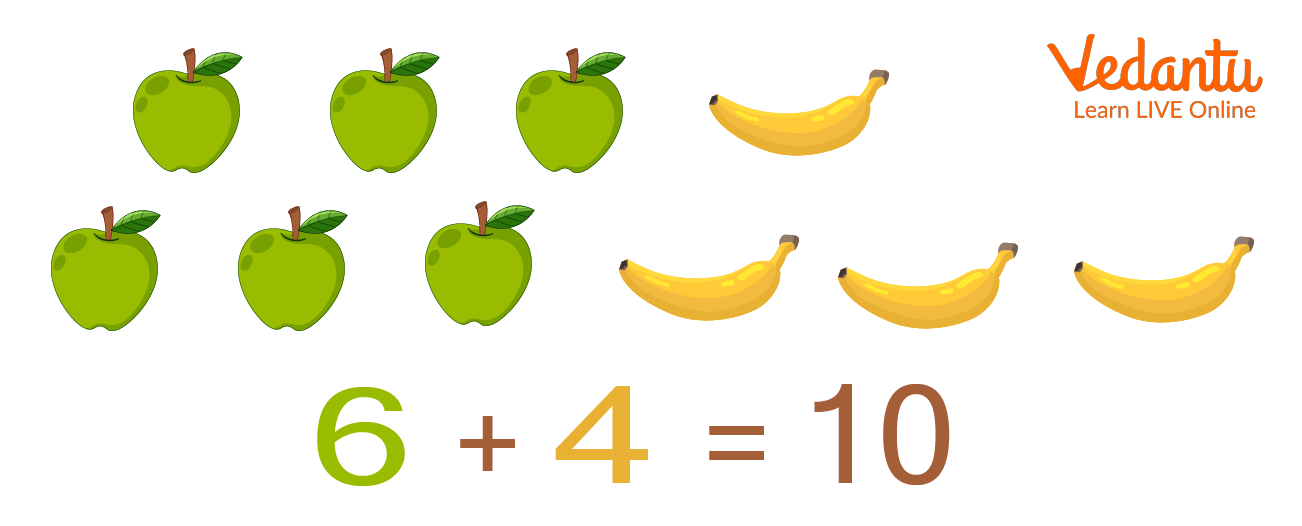
Addition of Two Types of Fruits

Adding Dora Cakes
Word Problems for Class 2 with Solution
In the below examples, we will see some word problems for Class 2 with solutions.
Example 1. Let us take two numbers 30 and 68. What is the sum of those two numbers?
Ans: One number = 30
Other number = 68
Therefore, sum of those two numbers = 30 + 68 = 98
Example 2. If there are 45 boys and 34 girls. What is the total number of students present in the classroom?
Ans: Number of boys in the classroom = 45
Number of girls in the classroom = 34
Therefore, total number of students in the classroom = 45 + 34 = 79
Example 3. Prithvi scored a brave 88 runs in the first match of the Ranji Trophy and scored 62 runs in the second match of the Ranji Trophy group stage. Find the total number of runs scored by him in the two matches.
Ans: Runs scored in first match= 88
Runs scored in the second match= 62
Total runs scored in those two matches = 88 + 62 = 150
2 + 8 = 10 so we carry 1
Now, 8 + 6 = 14 and we add that carried 1 here making it 15
So, the total is 150.
Example 4. There are 58 books on a bookshelf in the central library. 18 more books are kept on the same bookshelf later on. What is the total number of books on that shelf now?
Ans: Books on the bookshelf before = 58
Books on the bookshelf after the addition of new books= 18
Total number of books within the bookshelf = 58 + 18 = 76
8 + 8 = 16 so we carry 1
Now, 5 + 1 = 6 and we add that carried 1 here making it 7
So, the total is 76.
Practice Problem Sums for Class 2
Q1. Shankar went to the local sweet shop and bought 31 Gulab Jamun. Her sister came home for Bhai Duj and brought 23 more Gulab jamun. How many Gulab jamun did Shankar have now altogether?
Ans: 54
Q2. Hema scored 43 marks out of 50 in a summative assessment. She scored 35 in marks on the final exam. How many marks does he get in all?
Ans: 78
Q3. Soham bought 31 pencils. His brother Ram has 46 pencils. How many pencils do they have altogether?
Ans: 77
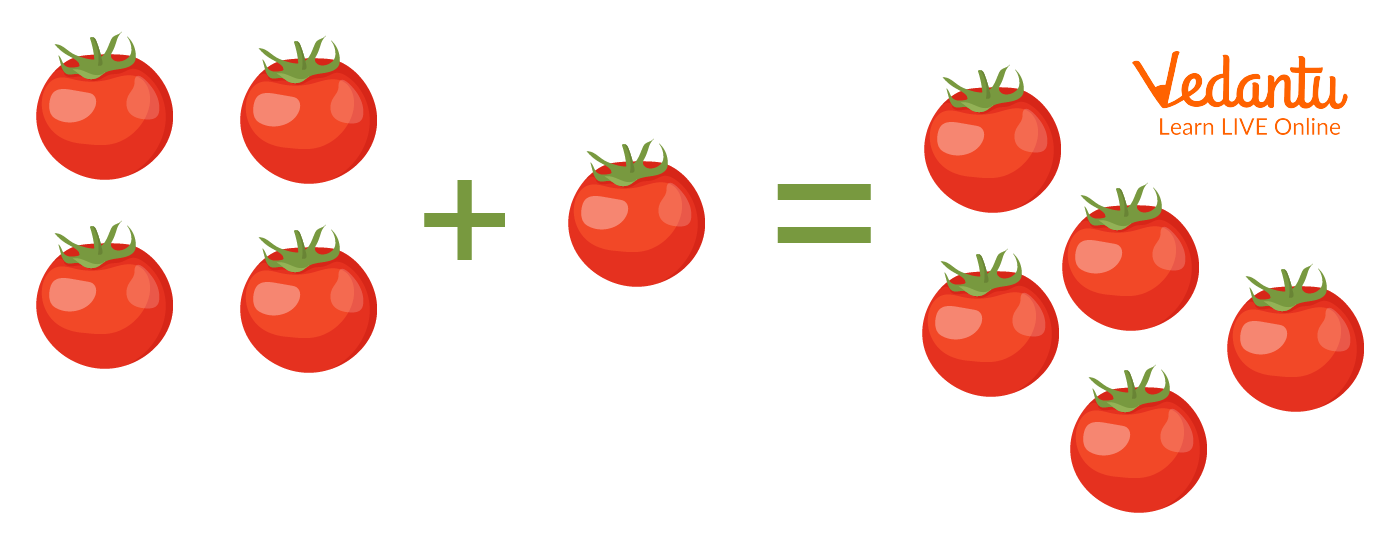
The Sum of 4 Tomatoes with 1
Summary
In conclusion, we have learnt that addition is the most basic tool of calculation. This tool is the key to every other form of calculation. It is also a real-life skill that comes into use almost every day. Additional word problems are effective in making students understand the application of addition and clarify the concept by actual problems that they would face in life. These problems have everyday incidents regarding addition of objects such as clothes, food items, or toys. It can also relate to money where they calculate the total payable amount for the goods and items they purchase from a shop.
FAQs on Addition Word Problems For Class 2 Explained Simply
1. What are addition word problems for Class 2?
Addition word problems for Class 2 are simple story-based questions where students add two or more numbers to find the total.
These problems usually involve real-life situations such as:
- Counting toys, fruits, or pencils
- Adding money or marks
- Combining groups of objects
2. How do you solve addition word problems step by step?
To solve addition word problems, follow simple steps: read, identify, add, and write the answer.
Steps:
- Step 1: Read the question carefully.
- Step 2: Find the numbers given.
- Step 3: Look for addition clue words like "total", "together", or "in all".
- Step 4: Add the numbers.
- Step 5: Write the final answer with units.
3. What are the common keywords used in addition word problems?
Common addition keywords are words that show you need to add numbers to find the total.
Important clue words include:
- In all
- Total
- Together
- Altogether
- Sum
4. Can you give an example of an addition word problem for Class 2?
Yes, an example of an addition word problem is: "A basket has 18 mangoes. Mother puts 7 more mangoes in it. How many mangoes are there in total?"
Solution:
- Numbers given: 18 and 7
- Operation: Addition
- Calculation: 18 + 7 = 25
5. What is the formula for addition in Class 2 Maths?
The basic addition formula is Addend + Addend = Sum.
In simple words:
- The numbers being added are called addends.
- The answer is called the sum.
6. How do you add two-digit numbers in word problems?
To add two-digit numbers, add the ones first and then the tens.
Steps:
- Write numbers in column form.
- Add the ones digits.
- Add the tens digits.
- Ones: 4 + 5 = 9
- Tens: 3 + 2 = 5
7. How do you solve addition word problems with carrying?
Addition with carrying is used when the sum of ones is 10 or more.
Steps:
- Add the ones digits.
- If the sum is 10 or more, carry over 1 to the tens place.
- Add the tens digits including the carried number.
- Ones: 7 + 8 = 15 (write 5, carry 1)
- Tens: 2 + 1 + 1 = 4
8. What is the difference between addition and subtraction word problems?
The main difference is that addition word problems combine quantities, while subtraction word problems take away quantities.
- Addition keywords: total, in all, together
- Subtraction keywords: left, minus, take away, difference
- Addition: 10 + 5 = 15
- Subtraction: 10 − 5 = 5
9. Why are addition word problems important for Class 2 students?
Addition word problems are important because they help students apply addition in real-life situations.
They improve:
- Problem-solving skills
- Logical thinking
- Understanding of numbers
- Basic arithmetic fluency
10. What are common mistakes in addition word problems?
Common mistakes in addition word problems include choosing the wrong operation or adding incorrectly.
Students often:
- Ignore important keywords
- Forget to carry in two-digit addition
- Misread the numbers
- Write the answer without units
