








How to Add Numbers Up To 20 with Easy Methods and Solved Examples
Addition and subtraction are useful for many activities of everyday life, like setting the table, making changes at the supermarket, and playing some games. The issue with addition that students face is often simply overcome if they follow the idea in a fun way! The game encourages students to count the total numbers. The game implies numbers within 20; students need to be confident in mathematical addition by working at different levels of complexity. In this article, we will learn about finding the sums to 20 and some facts of addition.
What is a Sum?
Sum is a way of putting things together. The sum brings two or more numbers together to make a new total.
Sum
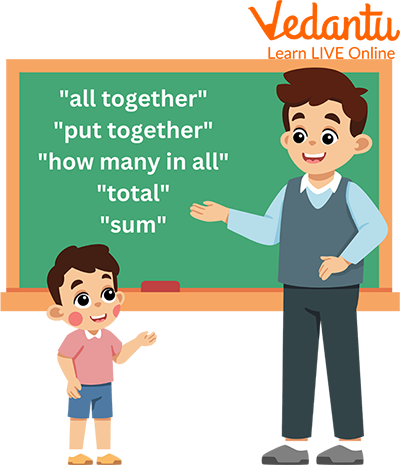
The terms such as "all together, "put together," "how many in all," "total," and "sum" indicate that you will need to add two or more numbers.
The plus sign (+) is used when two things are added together.
Addition Facts Chart
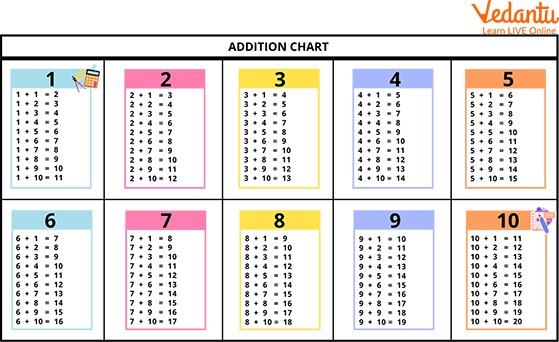
Addition Facts Chart
Addition Strategies
To find a total of two single-digit numbers, just count the first number on your fingers and then count the second number on your finger, and the sum of total fingers is the result.
For Example: 3 + 3 = 6
1. Counting : Number lines are a great resource for your students. In first grade, labeled and closed number series is a great place to start. Teach your students to start with the largest number and count forward.

Counting
2. Zero Facts : Adding zero to something is straightforward and is the same number that is adding to zero.
Any number + zero = the same number (no change)
12 + 0 = 12
0 + 12 = 12
3. Make 10 : As adults, several people automatically create 10s to form friendlier numbers to feature in our heads. Creating ten is such a strategy for our young learners, as well. As soon as addition with regrouping is introduced, problem-solving skills increase significantly. Active creating ten and eventually memorizing that pairs create 10 may be an ability that they're going to fall back on once learning the way to add larger numbers along or once they area unit adding 3+ numbers along
7 + 3 = 10
Addition Up to 20 Worksheets
Counting sheets with single-digit additions; all sums are less than 20. A horizontal addition format is used. Students can use a variety of problem solving strategies (finger counting, counting, etc.)
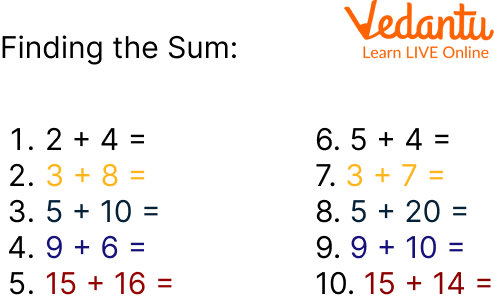
Addition Upto 20 Worksheet 1
Ans:
1. 2 + 4 = 6
2. 3 + 8 = 11
3. 5 + 10 = 15
4. 9 + 6 = 15
5. 15 + 16 = 31
6. 5 + 4 = 9
7. 3 + 7 = 10
8. 5 + 20 = 25
9. 9 + 10 = 19
10. 15 + 14 = 29

Addition Upto Worksheet 2
Ans:
18
15
12
10
11
17
Practice Questions

Practice Question
Answer:
3 + 1 = 4 3 + 5 = 8 3 + 3 = 6 1 + 6 = 7 4 + 5 =9 6 + 4 = 10
5 + 2 = 7 2 + 3 = 5 7 + 2 = 9 1 + 7 = 8
Summary
In this article, we got to know about the Addition. Addition and subtraction prepare us for learning about other math topics, including multiplication and division, in school. These addition tricks are a great way to learn mathematics calculations in an easy way for kids. They also help to develop the addition skills and strategies for solving the addition questions and making them more engaging and interesting. And after solving the given worksheets and practice questions, it will be easier for you to find the sum of numbers.
FAQs on Addition Up To 20 Made Simple for Beginners
1. What is addition up to 20?
Addition up to 20 is the process of adding two whole numbers whose total is 20 or less. It is an early maths skill that helps learners understand number bonds, counting, and basic arithmetic.
- Example: 7 + 5 = 12
- Both numbers and the sum stay within 0 to 20
- It builds a foundation for mental maths and problem-solving
2. How do you add numbers up to 20?
To add numbers up to 20, combine the two numbers and count forward to find the sum. You can use counting on, number lines, or number bonds.
- Start with the bigger number
- Count forward the smaller number
- Example: For 9 + 6, start at 9 and count 6 more → 15
3. What are number bonds to 20?
Number bonds to 20 are pairs of numbers that add together to make 20. They help improve mental addition and quick recall.
- 10 + 10 = 20
- 12 + 8 = 20
- 15 + 5 = 20
- 17 + 3 = 20
4. What is the commutative property of addition up to 20?
The commutative property of addition means changing the order of numbers does not change the sum. This rule applies to addition up to 20.
- 6 + 4 = 10
- 4 + 6 = 10
- The total remains the same
5. Can you give an example of addition up to 20 with regrouping?
Yes, addition up to 20 with regrouping involves making a ten to simplify the calculation. Example: 8 + 7 = 15.
- Break 7 into 2 and 5
- Add 8 + 2 = 10
- Add 10 + 5 = 15
6. What is the fastest way to add numbers within 20 mentally?
The fastest way to add within 20 mentally is to use number bonds and the make 10 strategy. These methods reduce counting steps.
- Example: 9 + 8
- Take 1 from 8 to make 10
- 10 + 7 = 17
7. Why is learning addition up to 20 important?
Learning addition up to 20 is important because it builds the foundation for basic arithmetic and future maths skills. It strengthens number sense and confidence.
- Helps with subtraction and multiplication later
- Improves mental maths speed
- Supports real-life calculations like counting money
8. What are common mistakes when adding up to 20?
Common mistakes in addition up to 20 include counting errors and forgetting number bonds. These mistakes can lead to incorrect sums.
- Skipping numbers while counting forward
- Miscounting teen numbers (13–19)
- Example mistake: Saying 8 + 6 = 13 instead of 14
9. How do you use a number line to add up to 20?
To use a number line for addition up to 20, start at the first number and jump forward by the second number. The landing point is the sum.
- Example: 5 + 7
- Start at 5
- Move 7 steps forward
- You land on 12
10. What are doubles in addition up to 20?
Doubles in addition up to 20 are facts where the same number is added to itself. They are quick facts that help with mental maths.
- 4 + 4 = 8
- 7 + 7 = 14
- 9 + 9 = 18
