








How to Add Positive and Negative Integers with Sign Rules and Examples
Integers are whole numbers that can be positive, negative, and zero. Adding an integer needs a specific set of rules. The addition of integers rules is important to understand as they have to be used while adding and subtracting integers rules. We have one set of common rules which hold good for the addition and subtraction of integers.
To understand adding integers rules, let’s jump right in!

Introduction to Addition of Integers
Integers are defined as numbers including negative numbers (numbers with a ‘-’ sign), positive numbers, and zero. Only whole numbers (0,1,2,3,....) come under integers. Fractions, decimals, and mixed fractions do not fall under integers as they do not fall under whole numbers.
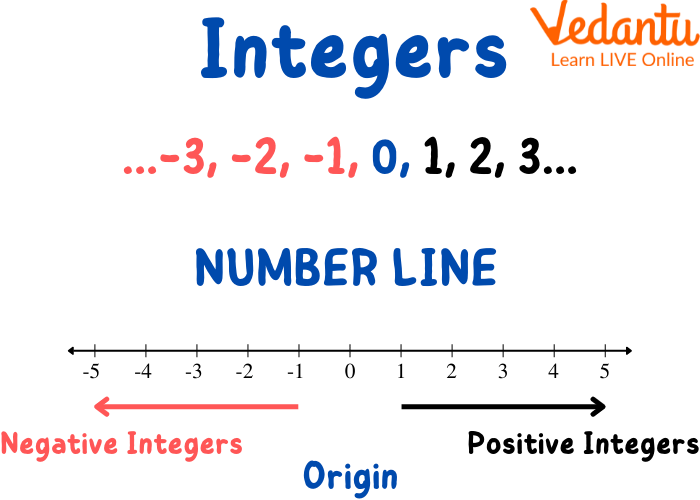
Number Line
Integer Rules
We can perform various mathematical operations using integers but adding and subtracting integers rules will be discussed in this article. Firstly adding integers rules will be discussed and by using those rules the concept of adding integers will get easy for you.
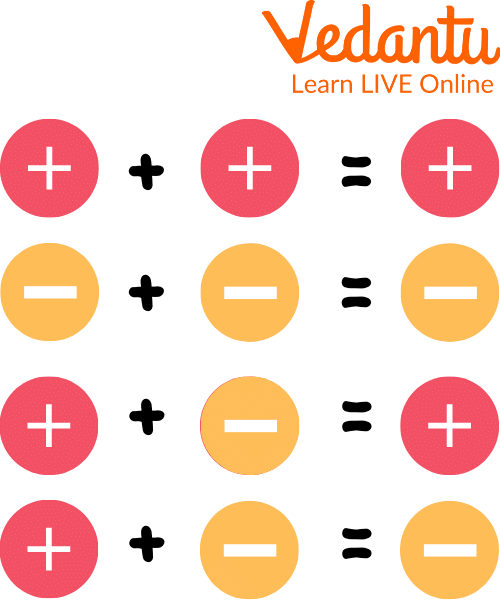
Rules for the Addition of Integers
Rules for Adding Integers
There are special rules for adding integers (adding integers rules). As integers have symbols along with the value of the number, it is important to follow these rules while adding.
For simplicity purposes and to understand the core concepts better, we are going to consider the addition of 2 digits having ‘+’ or ‘-’ signs.
How to Add Integers
Case 1- When Both the Digits are Positive
When the 2 numbers to be added are both positive, we add both the digits and assign their symbol as positive.
For example, 3 + 4 = 7
Remember that we usually use positive digits and thus it is not always necessary to mention ‘+’ before a positive number.
We add positive digits 3 and 4 to obtain a positive sum 7

Addition of 2 Positive Integers
Case 2- When Both the Digits are Negative
When the 2 numbers to be added are both negative, we add both the digits and assign their symbol as negative.
For example, (-3) + (-4) = (-7)
Remember that it is important to mention ‘-’ before a negative number.
We add negative digits 3 and 4 to obtain a negative sum which is (-7)
Remember the following phrase
“While adding the same signs, keep the signs!”
Case 3- When the Bigger Number has a Positive Sign
When the bigger number of the 2 digits added is positive, we subtract the smaller number from the bigger number and assign the symbol to be positive
For example, (-3) + 4 = 1
We are subtracting 4-3 which is 1 and assigning it the symbol of the bigger number which is positive, our answer as +1

Addition and Subtraction of Integers
Case 4- When the Bigger Number has a Negative Sign
When the bigger number of the 2 digits added is negative, we subtract the smaller number from the bigger number and assign its symbol to be negative
For example, 3 + (-4) = (-1)
We are simply subtracting 4-3 which is 1 and assigning it the symbol of the bigger number which is negative, our answer as (-1)
Remember the following phrase
“While adding opposite signs, subtract and keep the sign of the bigger number!”

Adding Negative Integer to Positive Integer
Solved Examples
Q1. Find the sum of (+14) + (-19)
Ans: Here both the numbers have different signs and a more significant number has a negative sign
So we subtract 19 - 14 = 5
We assign a ‘-’ sign as the bigger number is negative.
The answer is -5
Q2. Find the sum of (-18) + (-13)
Ans: Here both the numbers have the same negative sign
So we add 18 + 13 = 31
We assign a ‘-’ sign as both numbers are negative.
The answer is -31
Q3. Find the sum of (-10) + (+16)
Ans: Here both the numbers have different signs and the more significant number has a positive sign
So we subtract 16 - 10 = 6
We assign a ‘+’ sign as the bigger number is positive.
The answer is +6
Q4. Find the sum of (+13) + (+7)
Ans: Here both the numbers have the same positive sign
So we add 13 + 7 = 20
We assign a ‘+’ sign as both numbers are positive.
The answer is 20
Q5. Find the sum of (-5) + (-8)
Ans: Here both the numbers have the same negative sign
So we add 5 + 8 = 13
We assign a ‘-’ sign as both numbers are negative.
The answer is -13
Practice Questions
Q1. Find the sum of 72 + 34.
Ans: 106
Q2. Find the sum of (-56) + 28.
Ans: (-28)
Q3. Find the sum of 89 + (-37).
Ans: 52
Q4. Find the sum of (-91) + (-15).
Ans: -106
Q5. Find the sum of 43 + 23.
Ans: 66
Summary
The addition of integers has certain rules based on the signs and values of the integers. To summarize how to add integers, we have 4 cases. When both the numbers to be added are positive or negative, the numbers are added and their signs are kept the same as the number added. When a bigger number added is positive, we subtract the given numbers and keep the positive signs to the sum obtained. When a bigger number added is negative, we subtract the given numbers and keep the negative sign to the sum obtained.
FAQs on Addition of Integers Rules and Step by Step Guide
1. What are the rules for addition of integers?
The rules for addition of integers depend on the signs of the numbers being added.
- Same signs: Add the numbers and keep the common sign. Example: 4 + 3 = 7, (−4) + (−3) = −7.
- Different signs: Subtract the smaller absolute value from the larger and keep the sign of the number with the larger absolute value. Example: (−7) + 5 = −2.
2. How do you add integers with the same sign?
To add integers with the same sign, add their absolute values and keep the common sign.
- Example (positive): 6 + 2 = 8.
- Example (negative): (−6) + (−2) = −8.
3. How do you add integers with different signs?
To add integers with different signs, subtract the smaller absolute value from the larger and keep the sign of the larger absolute value.
- Example: (−9) + 4 → 9 − 4 = 5, keep the negative sign → −5.
- Example: 10 + (−3) → 10 − 3 = 7, keep the positive sign → 7.
4. What is the integer addition rule using a number line?
On a number line, move right for positive integers and left for negative integers to add integers.
- Start at the first number.
- Move right if adding a positive integer.
- Move left if adding a negative integer.
5. What is an example of addition of integers?
An example of addition of integers is (−8) + 3 = −5.
- Step 1: Compare absolute values (8 and 3).
- Step 2: Subtract 8 − 3 = 5.
- Step 3: Keep the sign of −8 (larger absolute value).
6. What are the properties of addition of integers?
The addition of integers follows key mathematical properties such as closure, commutative, associative, and additive identity.
- Closure: The sum of two integers is always an integer.
- Commutative: a + b = b + a.
- Associative: (a + b) + c = a + (b + c).
- Additive identity: a + 0 = a.
7. What is the additive inverse in addition of integers?
The additive inverse of an integer is the number that gives a sum of zero when added to the original number.
- For 7, the additive inverse is −7.
- For −12, the additive inverse is 12.
8. Why does adding two negative integers give a negative result?
Adding two negative integers gives a negative result because both numbers move in the negative direction on the number line.
- Example: (−3) + (−4) = −7.
- You add 3 + 4 = 7 and keep the negative sign.
9. What are common mistakes when adding integers?
A common mistake in addition of integers is ignoring the signs while adding or subtracting.
- For different signs, students often add instead of subtracting absolute values.
- For same signs, they may forget to keep the negative sign.
- Confusing subtraction with addition of negative numbers, such as 5 + (−2).
10. What is the formula for addition of integers?
There is no single formula, but the rule can be summarized as a + b = sign × (sum or difference of absolute values).
- If signs are same: a + b = sign(a) × (|a| + |b|).
- If signs are different: a + b = sign of larger |a| or |b| × (|larger| − |smaller|).
