








What Is Addition Definition Formula Properties and Solved Examples
The addition is a mathematical operation. They are methods and tasks related to numbers. It can be described by combining two or more numbers or adding two or more numbers. It is one of four arithmetic operations along with subtraction, multiplication, and division.
How Can Addition be Performed?
Let's start with an example. 7 + 4 means combining the numbers 7 and 4 to get the solution. The result, as you know, is 11. Sums can be divided into terms and sums. A term is a number added, and the answer to addition is a sum. To solve the sum, the terms must be joined together. So the expression 7 + 4 = 11 can be written as:
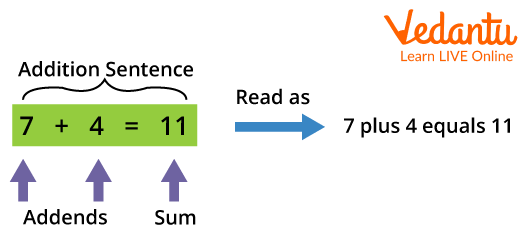
Example of Addition
Different Methods of Addition
Now we will learn about different ways by which we can solve addition problems:
Go to Visualizations: Comprehension can be improved by using pictorial totals or having students draw countable objects
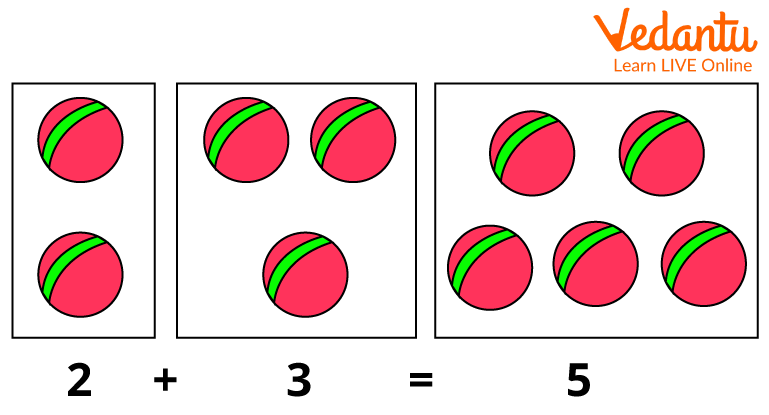
Addition with Countable Objects
Addition Using a Number Line: A number line is a horizontal line that has numbers placed at equal intervals.
Number Lines help simplify the calculation process.
For example, if the sum is 3 + 4, the child can first count to three digits then by placing four fingers to get 7. You don't have to count to 3 first to find the solution.
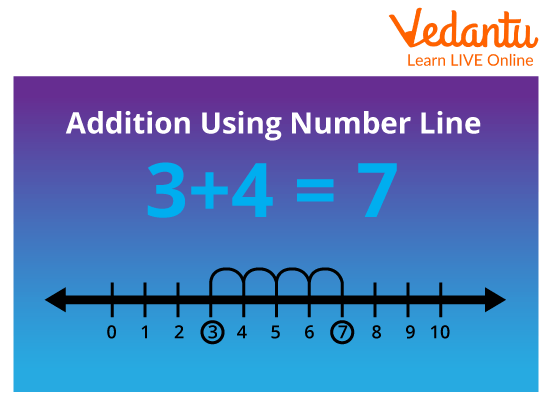
Addition Using Number Line
Counting: As your child gets used to the number strings, you will want to use the same strategy in their head. Counting your fingers out loud will help you gain.
More about Addition Concept
The addition operator can be divided into the following parts:
Addend: The numbers being added are called addition.
Plus Sign: There is a plus sign \[[ + ]\] between additions.
If the statement is written horizontally, place an equal sign \[[ = ]\] just before the sum item.
Sum: The final result after adding terms is called the sum.
Addition Examples Worksheet
Add the following examples:
1. \[\textbf{2 + 2 = }\]
Ans: Here we have to add the terms which are 2 and 2 so on combining 2 and 2 together we get a sum of 4.
Therefore, \[2 + 2 = 4\]
2. \[\textbf{9 + 0 = }\]
Ans: Here we need to combine 9 and 0 so on combining 9 and 0 we get the sum as 9.
Therefore, \[9 + 0 = 9\]
3. \[\textbf{8 + 2 =} \]
Ans: As above problems , \[8 + 2 = 10\]
4. \[\textbf{4 + 4 = }\]
Ans: Sum of \[4 + 4 = 8\].
5. \[\textbf{2 + 9 = }\]
Ans: Therefore, Sum will be 11.
Conclusion
Addition is the mathematical operation that defines the sum or total of quantities. The addition operator is plus (+) sign. We have learnt about the concept of addition in this article and we have studied various methods by which addition can be done. You can now apply your understanding of addition in solving the worksheet given below.
FAQs on Addition Concept in Mathematics with Clear Explanation
1. What is addition in mathematics?
Addition is the mathematical operation of combining two or more numbers to find their total or sum. It is one of the four basic arithmetic operations used in elementary maths.
- The numbers being added are called addends.
- The result is called the sum.
- Symbol used: +
2. How do you add two numbers step by step?
To add two numbers, align their place values and combine digits from right to left, carrying over when needed.
- Step 1: Write numbers vertically by place value (ones under ones, tens under tens).
- Step 2: Add the ones digits.
- Step 3: Carry over if the sum is 10 or more.
- Step 4: Add the tens (including any carry).
- 7 + 5 = 12 → write 2, carry 1
- 2 + 3 + 1 = 6
3. What is the addition formula?
The basic addition formula is a + b = c, where a and b are addends and c is the sum. In algebra, addition follows general rules such as:
- a + 0 = a (identity property)
- a + b = b + a (commutative property)
4. What are the properties of addition?
The main properties of addition are the commutative, associative, identity, and closure properties.
- Commutative: a + b = b + a
- Associative: (a + b) + c = a + (b + c)
- Identity: a + 0 = a
- Closure: The sum of two whole numbers is a whole number.
5. What is the difference between addition and subtraction?
Addition combines numbers to find a total, while subtraction finds the difference between numbers. Key differences include:
- Addition: Uses the + sign and increases value (e.g., 4 + 3 = 7).
- Subtraction: Uses the − sign and decreases value (e.g., 7 − 3 = 4).
6. How do you add large numbers easily?
To add large numbers easily, use the column addition method and add digit by digit with proper carrying. Steps:
- Align numbers by place value.
- Start adding from the rightmost digit.
- Carry over when the sum exceeds 9.
- 7 + 9 = 16 → write 6, carry 1
- 6 + 8 + 1 = 15 → write 5, carry 1
- 5 + 3 + 1 = 9
- 4 + 2 = 6
7. How do you add decimals?
To add decimals, align the decimal points and add as you would with whole numbers. Steps:
- Write numbers vertically with decimal points in a straight line.
- Add zeros if needed to equalize decimal places.
- Add from right to left and place the decimal point in the answer.
- Write as 3.50 + 2.75
- Add to get 6.25
8. How do you add fractions?
To add fractions, first make the denominators the same, then add the numerators. For example:
- If denominators are equal: 2/7 + 3/7 = 5/7
- If different: 1/4 + 1/6
- LCM of 4 and 6 is 12
- Convert: 3/12 + 2/12 = 5/12
9. What are common mistakes in addition?
Common mistakes in addition include place value errors and forgetting to carry over. Typical errors are:
- Not aligning digits correctly.
- Ignoring carry digits.
- Misplacing decimal points in decimal addition.
- Adding denominators directly in fractions (incorrect).
10. Where is addition used in real life?
Addition is used in everyday life to calculate totals, costs, measurements, and quantities. Common real-life applications include:
- Adding prices while shopping.
- Calculating total marks in exams.
- Measuring distances or lengths.
- Managing budgets and expenses.
