








How to Add and Subtract Powers with Same Base Rules Formulas and Solved Examples
Algebra is one of the very important parts of mathematics. To understand algebra, one must know how to use exponents and radicals. The power over the given base number is known as exponents/index. For example, $4^2=4 \times 4$, where 4 is the base and 2 is the exponent. The Addition of powers is the process of adding exponents or powers of a number irrespective of whether the base is the same. In this article, we will learn about the addition and subtraction of powers with numerical bases.
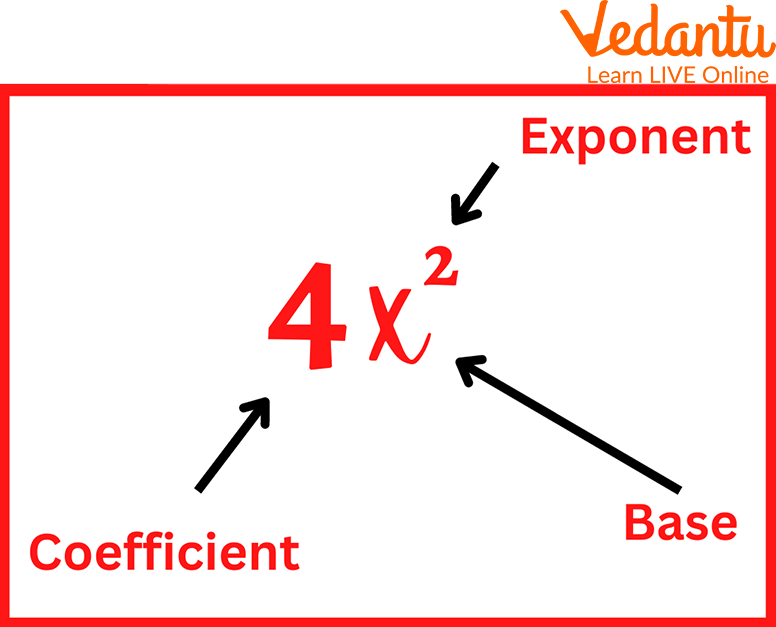
Introduction to Powers
Addition and Subtraction of Powers with Numerical Bases
Addition and subtraction are the two primary operations of mathematics. But we cannot directly add or subtract powers, we can only perform addition or subtraction only on the variables that have the same base and the same power. We can only add powers in multiplication and subtract powers in the division.
$3^4+2^5=$
$=3^4$
$=3 \times 3 \times 3 \times 3$
$=81$
Also, $2^5$
$=2 \times 2 \times 2 \times 2 \times 2$
$=32$
Therefore, $3^4+2^5= 81 + 32$
$=113$
Addition of Numbers with Powers
Adding numbers with power can be done when the base and powers are the same. There would be times when the base and powers are different, but we can still add those expressions. Let us have a look at the ways of adding powers.
Check if they got the same base and also the same power.
The usual form of addition of powers with same base is $x^{n}+x^{n}=2x^{n}$.
For example, $4^{2}+4^{2}$
$=2(4^{2})=2 \times 4 \times 4$
$=32$
If the base and power differ, then the expression will be calculated with individual terms.
The usual form is like $z^{n}+x^{m}$.
Addition and Subtraction of Powers
To add and subtract powers, you must first ensure that the base and power of the two terms we use to add or subtract are the same. If they are the same, then you only have to add together their coefficients and let the base and power remain identical.
$3^3+2^5 =?$
$=(3 \times 3 \times 3 )(2 \times 2 \times 2 \times 2 \times 2)$
$=(27)+(32)$
$=59$
$3^3+2^5=59$
Laws of Indices
The First Law: Multiplication
If the two terms have identical bases (in this case, " $\mathrm{x}$ ") and are to be multiplied, their indices will be added.
Let’s see the addition of indices with different powers, $x^m \times x^n=x^{m+n}$
Example: $5^2 \times 5^1=5^{2+1}=5^3$
The Second Law is: Division
If the two terms have an identical base (in this case, " $\mathrm{x}$ ") and are to be divided, their indices will be subtracted.
$\dfrac{x^m}{x^n}=x^{m-n}$
Example: $\dfrac{2^3}{2^2}=2^{3-2} =2^{1} = 2$
The third law: Brackets
If a term with an exponent is raised to a power, then the powers are multiplied.
$\left(x^m\right)^n=x^{m \times n}$
Example: $\left(3^2\right)^2=3^{2 \times 2}=3^{4}$
Solved Examples
Q 1. Find the value of $9^5$.
Ans: $9^5=9 \times 9 \times 9 \times 9 \times 9= 59,049$
Q 2. Find the value of $81+2^4=?$
Ans: $2^4$
$=2 \times 2 \times 2 \times 2 $
$=16$
Therefore, 81 + 16 = 97.
Q 3. Find the value of $2^6+3^5$
Ans: Since $2^6+3^5$ can be written in expanded form ad
$=(2 \times 2 \times 2 \times 2 \times 2 \times 2 )+(3 \times 3 \times 3 \times 3 \times 3)$
$=(64)+(243)$
$=307$
Practice Questions
Q 1. $\left(2^3\right)^2=$? (Ans: $64 .$)
Q 2. Find the value of $4^{-5}$. (Ans: $=\dfrac{1}{1024}$)
Q 3. $8^2 \times 4^1=$? (Ans: 256)
Summary
In this article, we have learned about the addition of power. Adding exponents refers to the simple addition of numbers but in the form of exponents or power. This article taught us that the variables and exponents must be the same to add or subtract with powers. The power of a number tells us how many times a number is to be used in multiplication. Powers are also known as Indices or Exponents. For example, $7^{2}$ could be called “7 to the power of 2” “7’’to the second power”, or simply “7 squared”. In the end, we added the practice problem to check the command over the topic. So after going through the article, give it a try!
FAQs on Addition and Subtraction of Powers Explained with Rules and Practice
1. What is addition and subtraction of powers?
Addition and subtraction of powers means combining exponential terms, but only like terms (same base and same exponent) can be directly added or subtracted. In algebra, expressions such as 3x² + 5x² can be combined because both have the same base and exponent. However, 2³ + 2⁴ cannot be simplified further since the exponents are different. Always check if the base and exponent match before combining terms.
2. Can you add powers with the same base?
You can only add powers with the same base if their exponents are also the same. For example:
- 4x³ + 7x³ = 11x³ (same base and exponent)
- 2² + 2³ cannot be combined directly because the exponents differ
3. What is the rule for subtracting powers with the same base?
You subtract powers directly only when the base and exponent are identical. For example:
- 9a⁴ − 5a⁴ = 4a⁴
4. Why can't you add powers with different exponents?
You cannot add powers with different exponents because they represent different values and are not like terms. For example, 2² = 4 and 2³ = 8, so 2² + 2³ = 4 + 8 = 12, not 2⁵. Addition does not follow exponent laws like multiplication does, so different exponents must be calculated separately.
5. What is an example of adding powers in algebra?
An example of adding powers in algebra is combining like exponential terms. Consider:
- 6y² + 3y²
Step 2: Add the coefficients → 6 + 3 = 9.
Final Answer: 9y².
6. Is 2³ + 2³ equal to 2⁶?
No, 2³ + 2³ = 16, not 2⁶. Since 2³ = 8, we add: 8 + 8 = 16. This simplifies as 2 × 2³ = 2⁴, not 2⁶. The law aᵐ × aⁿ = aᵐ⁺ⁿ applies only to multiplication, not addition.
7. What is the difference between adding powers and multiplying powers?
The difference is that multiplying powers with the same base adds exponents, while adding powers requires like terms.
- a² × a³ = a⁵ (add exponents when multiplying)
- a² + a³ cannot be combined (different exponents)
8. How do you simplify expressions with addition and subtraction of exponents?
To simplify expressions with addition and subtraction of exponents, combine only like terms and evaluate others separately. Steps:
- Identify terms with the same base and exponent.
- Add or subtract their coefficients.
- Leave unlike terms as they are.
9. What are common mistakes when adding and subtracting powers?
A common mistake is adding exponents when terms are being added instead of multiplied. Key mistakes include:
- Thinking a² + a³ = a⁵ (incorrect)
- Ignoring unlike terms
- Forgetting to combine only coefficients
10. Can you give a real-life example of addition of powers?
A real-life example of addition of powers appears in area calculations involving similar square regions. If two squares each have area x², the total area is x² + x² = 2x². Since both terms have the same base and exponent, they combine as like terms. This concept is used in geometry, algebra, and polynomial simplification.
