








How to Add and Subtract Integers Using Rules and Number Line with Examples
What do addition and subtraction mean in mathematics? The addition and subtraction of integers are two operations we perform on integers to increase or decrease their values. Integers include whole and negative numbers, such as 4, 5, 0, -9, -18, etc. Every number shown on a number line that does not have a fractional part is an integer. Let us learn more about adding and subtracting integers. In this article, we will learn the adding and subtracting integers rules to make the concept interesting, relatable, and easy to understand.
Integers on Number Line
Integers are a collective term for negative numbers, zero, and natural numbers. The right side of the number line is occupied by positive numbers, while negative numbers occupy the left side. The sign on the number denotes whether it is moving to the right of or away from zero.
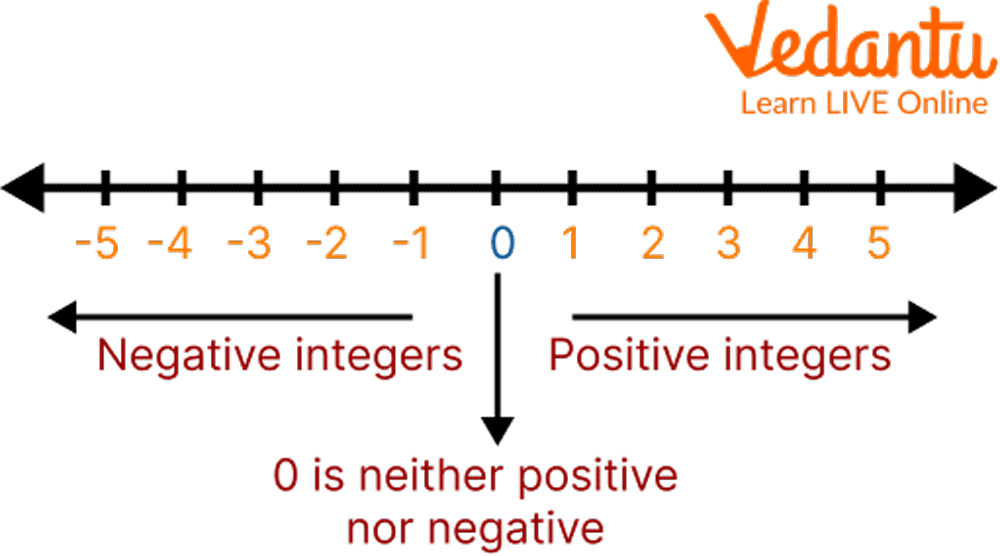
Integers on Number Line
For example, +3 means the number is to the right of 0, and -3 means it is to the left of 0. If a number has no sign, it is a positive integer.
Adding and Subtracting Integers on a Number Line
There is a specific rule for adding and subtracting positive and negative numbers from a number line:
We start with the first number and move to the right of the number line if we need to add a positive number to another positive number.
It should be noted that whenever we add a negative number, the number line shifts to the left.
We can convert the subtraction fact to an addition fact and change the sign of the subtraction if we need to subtract a positive number.
Now we will see how we are applying addition and subtraction rules for the integers one by one.
Rules to Add Integers
The following guidelines should be kept in mind when adding positive and negative integers:
Add the two integers when both have a positive sign.
When both integers have a negative sign, add them together and give the sum a (-) sign.
Subtract and use the sign of the larger number if the sign of the two numbers differs.
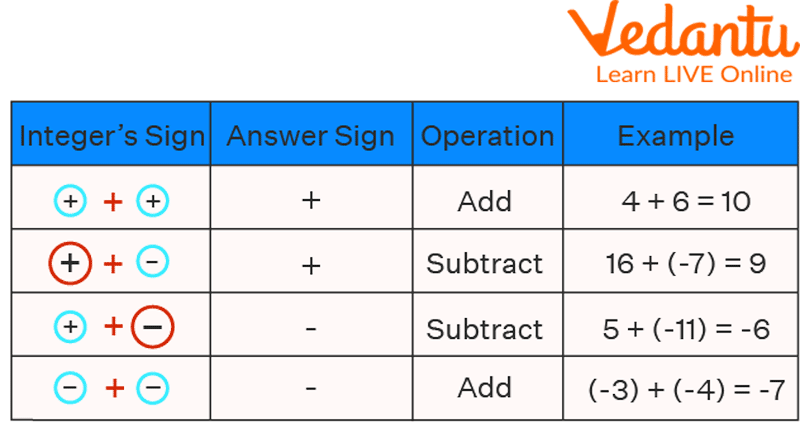
Rules to Add Integers
Rules to Subtract Integers
The following guidelines should be kept in mind to know how to subtract integers steps:
When subtracting two integers with the same sign, we first take the absolute values o
If the two numbers are, we add the common sign to the final result. A number's positive or absolute value is the number itself.
The sign of the subtrahend changes when two numbers with different signs are subtracted. The result will be positive if both integers change to the positive integer and negative if they change to the negative integer.
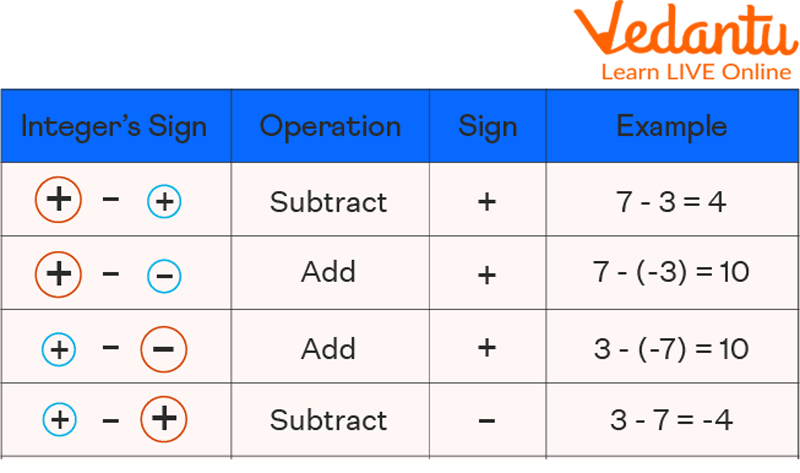
Rules to Subtract Integers
Solved Examples
Example 1: Evaluate 2 - 3 using a number line.
Solution: We will begin at +2 on a number line because it is our minuend. Since we are subtracting the value of 2 by 3, we must move the left three steps. We arrive at (-1), which is our answer.
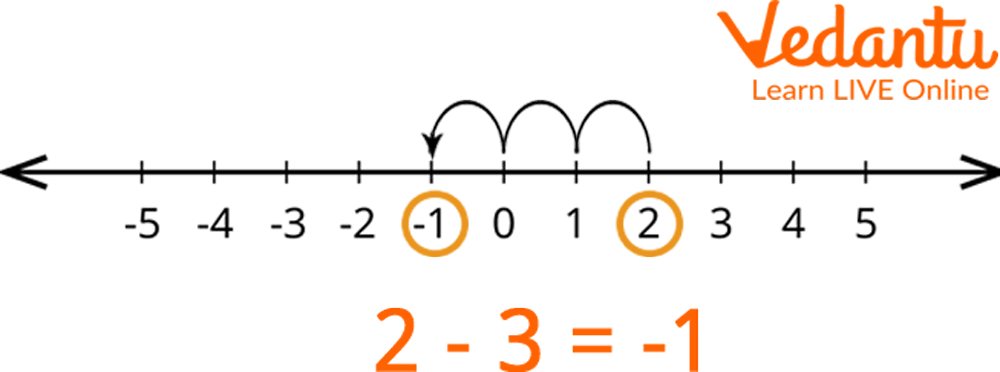
Number Line
Example 2: Add -16 and -23.
Solution: We have given that -16 and -23 are both negative numbers. The result of adding them together is a negative sum;
(-16)+(-23) = -16-23 = -39
Example 3: Subtract -46 from 88.
Solution: We reverse the sign of -46 and add it to 88 to subtract it from 88.
Therefore;
88- (-46) = 88 + 46 = 134
Example 4: Subtract -4 from -20.
Solution: We reverse the sign of -4 and add it to -20 to subtract it from -20.
Therefore;
-20 - (-4) = -20 + 4 = -16
Practice Problems
Q 1. Subtract: 544 – (-389) (Ans: 933)
Q 2. Subtract: 0 – (38) (Ans: -38)
Q 3. Addition: - 134 + (-18) (Ans: -152)
Q 4. Addition: 78 + (-22) (Ans: 56)
Summary
This article taught us the rules for adding and subtracting positive and negative numbers. A positive integer is carried out when you add two positive integers. A sum of negative integers is produced by adding two negative values. When subtracting two integers with the same sign, we first take the absolute values of the two numbers apart, and then we add the common sign to the final result. The sign of the subtrahend changes when two numbers with different signs are subtracted. At the end of the article, we have added the practice problem, so after going through the article, give it a try to practice questions too. This will help you to analyze your understanding of this topic.
FAQs on Adding and Subtracting Integers Step by Step Guide
1. What is adding and subtracting integers?
Adding and subtracting integers means performing arithmetic operations with positive and negative whole numbers, including zero. Integers include numbers like -5, -2, 0, 3, and 10.
- Addition of integers combines values based on their signs.
- Subtraction of integers often means adding the opposite number.
- These operations follow specific sign rules to determine the final result.
2. How do you add integers with the same sign?
To add integers with the same sign, add their absolute values and keep the common sign.
- If both numbers are positive: 4 + 6 = 10
- If both numbers are negative: -3 + (-7) = -10
3. How do you add integers with different signs?
To add integers with different signs, subtract their absolute values and keep the sign of the number with the larger absolute value.
- Example: 8 + (-5)
- Subtract: 8 − 5 = 3
- Keep the sign of 8 → 3
4. What is the rule for subtracting integers?
The rule for subtracting integers is to add the opposite of the number being subtracted. This means change subtraction to addition and flip the sign of the second number.
- Example: 7 − (-3)
- Change to addition: 7 + 3
- Result: 10
5. How do you subtract a negative integer?
Subtracting a negative integer is the same as adding its positive value. When you subtract a negative, the signs change to addition.
- Example: 5 − (-2)
- Rewrite as: 5 + 2
- Answer: 7
6. What is an example of adding and subtracting integers?
An example of adding and subtracting integers is solving expressions like -6 + 9 − 4.
- Step 1: -6 + 9 = 3
- Step 2: 3 − 4 = -1
- Final answer: -1
7. How do you use a number line to add and subtract integers?
You use a number line by moving right for positive numbers and left for negative numbers.
- Start at the first integer.
- Move right to add a positive number.
- Move left to add a negative number.
8. Why does subtracting a negative become addition?
Subtracting a negative becomes addition because subtraction means adding the opposite. The opposite of a negative number is positive.
- Example: 8 − (-4)
- Change to: 8 + 4
- Result: 12
9. What are the common mistakes when adding and subtracting integers?
Common mistakes when adding and subtracting integers usually involve sign errors.
- Forgetting to keep the correct sign after adding.
- Not changing subtraction to addition of the opposite.
- Ignoring absolute values when signs differ.
10. Where are adding and subtracting integers used in real life?
Adding and subtracting integers are used in real life to represent gains and losses, temperature changes, and elevation differences.
- Temperature: 5°C dropping by 8°C gives -3°C.
- Bank balance: $50 spent from $30 results in -20.
- Elevations above and below sea level use positive and negative integers.
