








How to Solve 3 Digit Addition With Regrouping Step by Step with Solved Examples
Putting things together is done by addition. Regrouping is known as arranging numbers in columns of tens and ones for addition. Addition with regrouping is also known as carrying addition. In addition, with regrouping, we arrange two or more large numbers column by column according to their place value, and when the sum of any of these columns exceeds 9, we regroup that sum into tens and ones. In this article, we will learn 3-digit addition with regrouping plans where we will learn about 3-digit addition and its regrouping.

3-Digit Addition with Regrouping Word Problem
3-Digit Addition
In 3-digit addition, we need to place the given numbers into columns according to their respective place values, like ones, tens, hundreds, thousands, and so on. It should be remembered that the numbers being added are known as addends, and the result of adding these numbers is known as their sum.
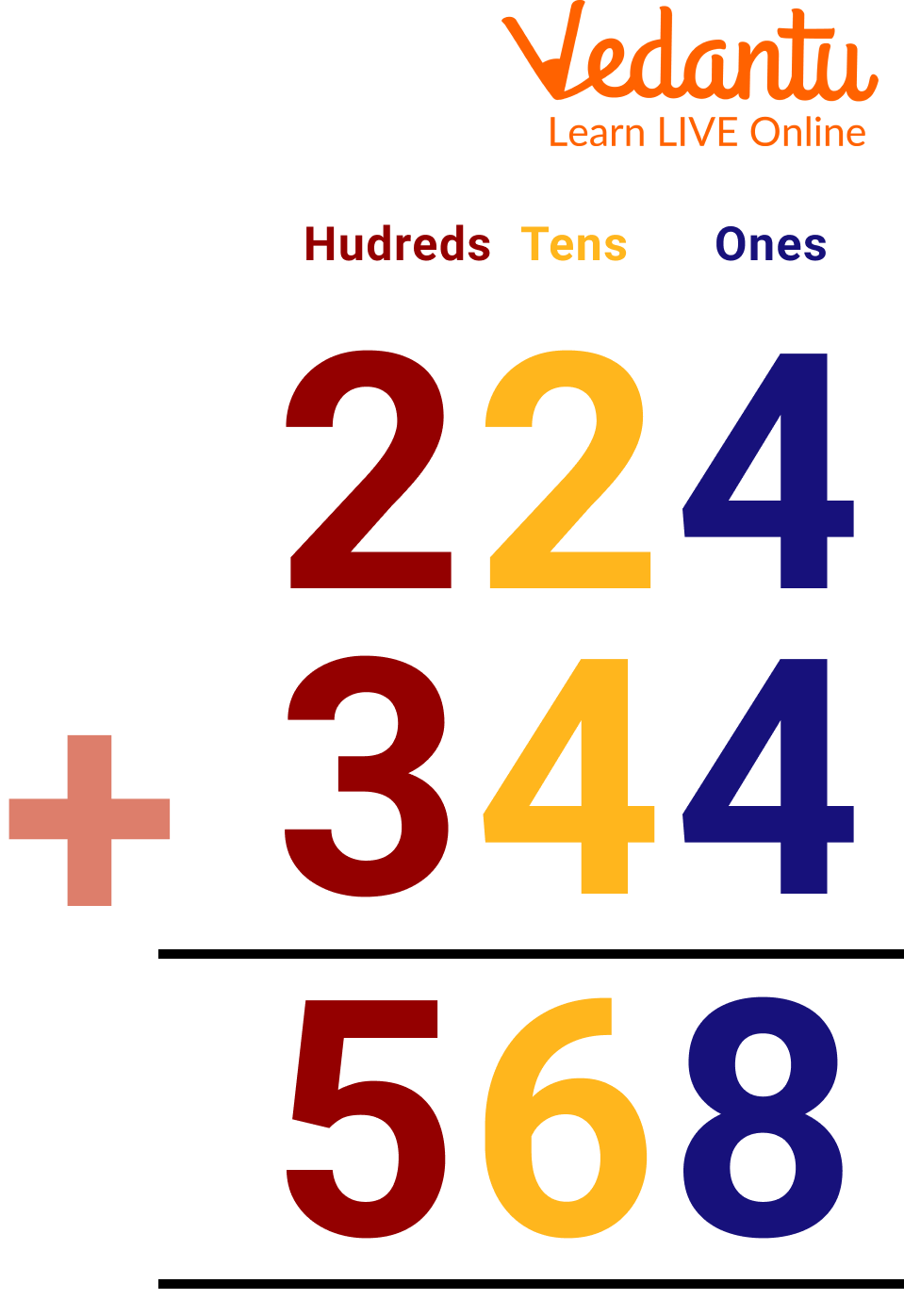
3-Digit Addition
3-Digit Addition with Regrouping
If you are adding three-digit integers, you should always add your digits in the one's place first, then the tens place, and finally the hundreds place. Reassessing your situation enables you to determine whether you have too much, just enough, or not enough of something. Remember that in case of 10 or more, put it next door whenever you need to regroup. So, for solving, first, arrange numbers according to their place value, then add one place, then tens place, then hundreds place, and so on.
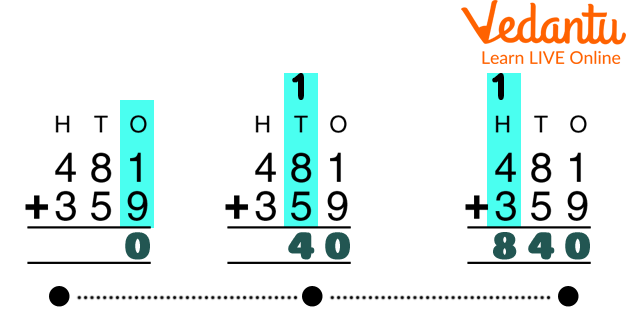
3-digit Addition with Regrouping Word Problems
Steps for 3-Digit Addition with Regrouping
Following are the steps for the addition of 3-digit numbers with regrouping:
Let us add 295 +143 using the following steps:
Step 1: Arrange 295 and 143 into columns based on their place values. As a result, the numbers 5 and 3 will appear in the ones column, 9 and 4 in the tens column, and 2 and 1 in the hundreds column.
Step 2: Beginning with the ones column, we may add the digits to get 5 + 3 = 8.
Step 3: Now let's add the numbers in the tens column: 9 + 4 = 13. We need to regroup it because 13 is greater than 9. As a result, we enter 3 in this column and move 1 to the following column.
Step 4: The numbers and the carried-over number are now added in the hundreds column. It will therefore be 2 + 1 + 1 = 4. Therefore, we enter 4 as the total for this column. Consequently, 295 + 143 = 438.
How to Teach 3-Digit Addition with Regrouping?
Regrouping, also known as carrying and borrowing, is forming groups of tens when adding or subtracting two-digit numbers (or more). When initially introducing it, it is important to utilise physical manipulatives and connect regrouping to place value.
Solved Examples
1. Solve 495 + 65.
Ans:
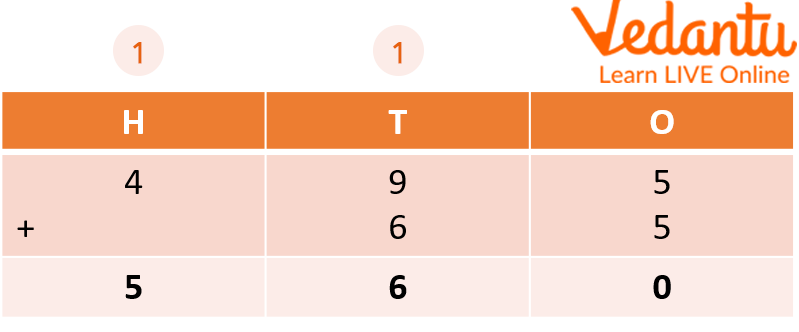
Solved Example
2. Add 295 + 143.
Ans: we get 295 + 143 = 438
Here, 5 and 3 at one place, 9 and 4 at the tens place, and 2 and 1 at the hundreds place. Now, add 5 + 3 = 8, then tens column, i.e., 9 + 4 = 13 then carry 1 to the next column, as these are two numbers, then add 2 + 1 + 1 = 4. So, we get 438.
3. Add 155 + 123.
Ans: We get 155 + 123 = 278.
Here, 5 and 3 at one place, 5 and 2 at the tens place, and 1 and 1 at the hundreds place. Now, add 5 + 3 = 8 then tens column, i.e., 5 + 2 = 7, and then add 1 + 1 = 1. We get 278.
4. Add 68 + 23.
Ans: Adding ones place, we get 8 + 3 = 11, so carry 1 at tens place, then add tens place we get 6 + 2 + 1 = 9. Thus, we have 68 + 23 = 91.
5. Add the smallest and largest three-digit number.
Ans: The smallest three-digit number is 100.
The largest three-digit number is 999.
By adding them, we get 1099.
Practice Questions
1. By using addition with regrouping, add 182 + 50.
Ans: 232
2. By using addition with regrouping, add 600 + 450.
Ans: 1050
3. Add 512 + 100.
Ans: 612
4. State true or false: 650 + 420 = 1070.
Ans: True
5. By using regrouping, add 549 and 496.
Ans: 1045
Summary
The addition of 3-digit numbers with regrouping in Mathematics refers to converting groupings of ones into tens to facilitate addition and subtraction. Additionally, if the numbers you are adding result in a two-digit number and are not in the farthest left column, you must regroup. When adding integers, be sure that at least one addend contains three digits. By placing the three-digit integers in columns according to their place values, we can add them. Then, after combining the numbers from the ones and tens columns, we go to the hundreds column.
I hope after reading this article, you will now have full command over the topic. If you still find any issues, do check out our other articles. You can also download 3-digit addition with a regrouping pdf.
FAQs on 3 Digit Addition With Regrouping Explained for Students
1. What is 3 digit addition with regrouping?
3 digit addition with regrouping is the process of adding two three-digit numbers and carrying over values when a column sum is 10 or more. In this method, you add digits column by column (ones, tens, hundreds). If the sum in a column is 10 or greater, you regroup (carry) the extra value to the next place value. This is also called addition with carrying in elementary maths.
2. How do you do 3 digit addition with regrouping step by step?
To do 3 digit addition with regrouping, add each place value from right to left and carry over when needed.
- Step 1: Add the ones column. If the sum is 10 or more, write the ones digit and carry the tens digit.
- Step 2: Add the tens column, including any carried value.
- Step 3: Add the hundreds column, including any carry.
- 6 + 8 = 14 → write 4, carry 1
- 5 + 7 + 1 = 13 → write 3, carry 1
- 4 + 3 + 1 = 8
3. Why do we regroup in 3 digit addition?
We regroup in 3 digit addition because our number system is based on place value (base 10). When the sum in any column is 10 or more, it equals 1 group of the next higher place value. For example, 14 ones equals 1 ten and 4 ones. Regrouping ensures each place (ones, tens, hundreds) has only one digit from 0 to 9.
4. Can you give an example of 3 digit addition with regrouping?
Yes, here is a clear example of 3 digit addition with regrouping: 267 + 185.
- 7 + 5 = 12 → write 2, carry 1
- 6 + 8 + 1 = 15 → write 5, carry 1
- 2 + 1 + 1 = 4
5. What happens if there is regrouping in more than one column?
If there is regrouping in more than one column, you carry over each time the column sum is 10 or greater. For example, 589 + 476:
- 9 + 6 = 15 → write 5, carry 1
- 8 + 7 + 1 = 16 → write 6, carry 1
- 5 + 4 + 1 = 10
6. What is the difference between addition with regrouping and without regrouping?
The difference is that addition with regrouping involves carrying over, while addition without regrouping does not. In addition without regrouping, each column adds up to less than 10. In addition with regrouping, at least one column has a sum of 10 or more, so you must carry to the next place value.
7. What place value chart is used in 3 digit addition?
A place value chart with hundreds, tens, and ones is used in 3 digit addition. The chart helps align digits correctly:
- Hundreds (H)
- Tens (T)
- Ones (O)
8. What are common mistakes in 3 digit addition with regrouping?
Common mistakes in 3 digit addition with regrouping include forgetting to carry over and misaligning place values.
- Not adding the carried number to the next column
- Writing numbers in the wrong place value
- Starting addition from left to right instead of right to left
9. How do you check your answer in 3 digit addition?
You can check your answer in 3 digit addition by using the inverse operation (subtraction). Subtract one of the addends from the sum. Example: 456 + 378 = 834. Check: 834 − 378 = 456. If you get the original number, your addition is correct.
10. Where is 3 digit addition with regrouping used in real life?
3 digit addition with regrouping is used in real life when adding amounts greater than 100. Examples include:
- Adding money totals (e.g., $245 + $389)
- Calculating distances in kilometers or meters
- Adding scores or quantities in business and shopping
