






What Are the Most Interesting Facts About the Moon for Kids
The Moon is the natural satellite of the planet Earth. It is a natural object which revolves around the Earth. It is a member of the Solar System family and is the only satellite of our planet. It is the second brightest object we see in the sky after the Sun.
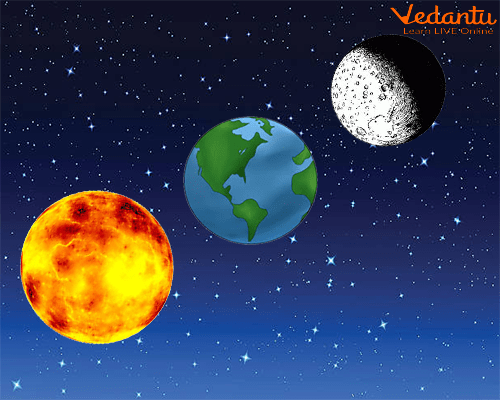
The Earth, The Sun, and The Moon
The Moon does not have a light of its own. It gets its light from the Sun. It looks very beautiful on Earth. It is always surrounded by bright stars. The Moon changes its phases with every revolution around the Earth. Let us study all the concepts like how far away is the moon, what is the moon made of, and the phases of the moon for kids one by one.
Moon Earth Distance
The approximate distance between the Moon and the Earth is around 384,400 kilometres. The distance in miles is around 238,900 miles from the Earth. The moon is not that far from the Earth.
The sea level also gets affected because of the Moon. The Moon’s gravity leads to the rise and fall of the sea waves. The high tides and low tides created in the sea are affected by the gravity of the Moon.
What is the Moon Made of?
The Moon is mostly made up of rocks. There are a lot of pits present on the moon, known as craters. A lot of meteorites keep on crashing into the surface of the moon, which leads to rock and dust.
The Lunar Surface of the Moon is composed of many elements. These elements are oxygen, silicon, magnesium, calcium, aluminium, chromium, etc. Traces of water are also found on the surface of the Moon.
Phases of the Moon for Kids
The phases of the Moon change every day based on its revolution around the Earth. There are eight phases of the Moon. On a full moon day, the moon shines bright in the sky, and we often call it ‘Poornima’.
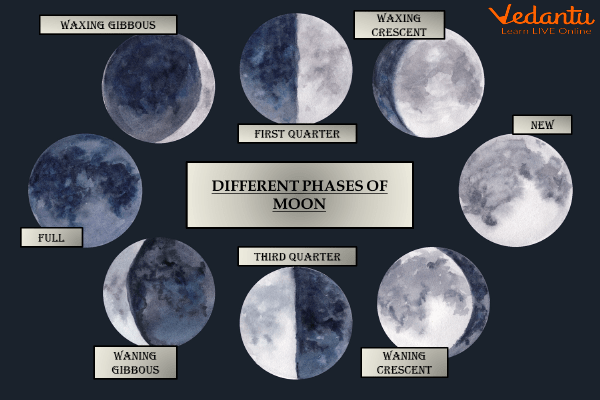
Phases of The Moon
There is a no moon day as well, where the Moon is not visible at all, and we call it ‘Amavasya’. Other than these, the other phases are New Moon, Waxing Crescent, First Quarter, Waxing Gibbous, Waning Gibbous, Third Quarter, and Waning Crescent.
Summary
The Moon shines brightly at night and can be seen from our home Earth. People go to various tourist places where they look for destinations famous for night watching. It also affects various religious and cultural activities of India. Neil Armstrong was the first person to ever land on the Moon. People have been experimenting and inventing new things on the surface of the Moon.
FAQs on Fun and Amazing Moon Facts for Kids
1. What is the Moon made of?
The Moon is made mostly of rock and dust, similar to the outer layer of Earth. Scientists believe it has different layers, including:
- A crust made of solid rock
- A rocky mantle beneath the crust
- A small, partly molten core at the center
The Moon’s surface is covered with fine gray dust called lunar soil or regolith.
2. How far is the Moon from Earth?
The Moon is about 384,400 kilometers (238,855 miles) away from Earth on average. This distance can change slightly because the Moon travels in an elliptical orbit. It would take about 3 days for a spacecraft to reach the Moon from Earth.
3. Why does the Moon have phases?
The Moon has phases because we see different amounts of its sunlit side as it orbits Earth. The main phases include:
- New Moon
- First Quarter
- Full Moon
- Last Quarter
These phases repeat in a cycle that takes about 29.5 days, known as a lunar month.
4. Does the Moon have gravity?
Yes, the Moon has gravity, but it is much weaker than Earth’s gravity. The Moon’s gravity is about one-sixth of Earth’s gravity. This means:
- You would weigh less on the Moon.
- You could jump much higher than on Earth.
Moon gravity is also responsible for helping create ocean tides on Earth.
5. Can people live on the Moon?
People cannot currently live on the Moon because it has no air, no liquid water, and extreme temperatures. The Moon also lacks a breathable atmosphere, which means:
- No oxygen to breathe
- No protection from harmful solar radiation
- Very hot days and very cold nights
Scientists are studying ways to build safe habitats for future Moon missions.
6. How was the Moon formed?
Scientists believe the Moon formed after a large object collided with early Earth about 4.5 billion years ago. This idea is called the Giant Impact Hypothesis. According to this theory:
- A Mars-sized body hit Earth.
- Debris from the collision went into space.
- The debris joined together to form the Moon.
7. Why does the Moon shine at night?
The Moon shines because it reflects light from the Sun. The Moon does not produce its own light. Sunlight hits the Moon’s surface and bounces back to Earth, making it appear bright in the night sky.
8. What are craters on the Moon?
Moon craters are large round holes formed by meteoroids hitting the Moon’s surface. Because the Moon has no thick atmosphere, space rocks can strike it easily. These impacts:
- Create bowl-shaped holes
- Throw dust and rocks outward
- Remain visible for millions of years
Some famous craters include Tycho and Copernicus.
9. Has anyone walked on the Moon?
Yes, astronauts first walked on the Moon in 1969 during the Apollo 11 mission. The first person to step onto the Moon was Neil Armstrong, followed by Buzz Aldrin. In total, 12 astronauts have walked on the Moon between 1969 and 1972.
10. Does the Moon rotate?
Yes, the Moon rotates on its axis, but it rotates at the same speed it orbits Earth. This is called synchronous rotation. Because of this:
- We always see the same side of the Moon from Earth.
- The other side is called the far side of the Moon.
It takes about 27.3 days for the Moon to complete one rotation and one orbit.
