Class 9 Social Science Part 2 Chapter 6 Important Questions and Answers on Forming Startups
The Class 9 Social Science Chapter 6 important questions and answers PDF contains 15 solved questions from From Ideas to Startups. These questions cover entrepreneurial qualities, the steps in preparing a business plan, functional areas of a business and the role of startups in India's economy.
Students can use this From Ideas to Startups Class 9 question answer collection to practise different question types and understand business situations. The chapter PDF also helps students check definitions, examples and profit calculations.
Class 9 Social Science Chapter 6 Important MCQs with Answers
Q1. What is entrepreneurship?
(a) The process of saving money in a bank
(b) The process of turning an idea into a business venture
(c) The process of buying goods for personal use
(d) The process of collecting taxes from businesses
Answer: (b) The process of turning an idea into a business venture
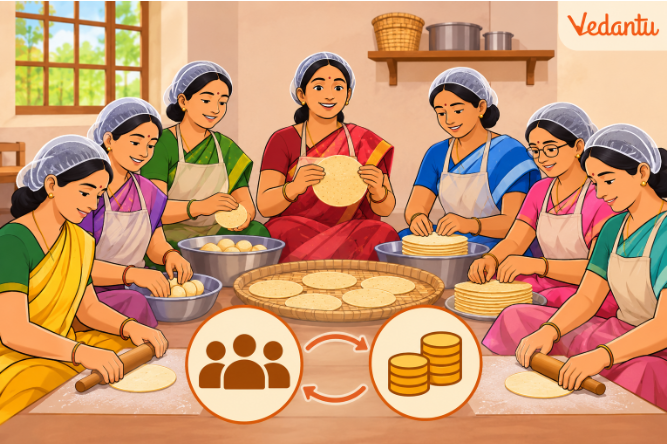
Q2. What was an important feature of the Lijjat Papad cooperative society?
(a) Only the founding members received profits.
(b) Every member was an equal owner, and profits were shared equally.
(c) The government managed all its business activities.
(d) Members could work only in large factories.
Answer: (b) Every member was an equal owner, and profits were shared equally.
Q3. A bakery owner hires bakers and trains them in food hygiene and baking standards. Which functional area of the business is responsible for these activities?
(a) Marketing and Sales
(b) Finance and Accounting
(c) Human Resources
(d) Management of Investments
Answer: (c) Human Resources
Q4. A bakery regularly throws away unsold cakes because customer demand changes from day to day. What should the owner do to reduce this problem?
(a) Stop keeping records of sales
(b) Increase production every day
(c) Produce cakes without checking demand
(d) Plan production according to demand and manage inventory carefully
Answer: (d) Plan production according to demand and manage inventory carefully.
Q5. A bakery earns ₹2,95,000 in a month and spends ₹2,22,000 before tax. What is its profit before tax?
(a) ₹60,000
(b) ₹73,000
(c) ₹83,000
(d) ₹5,17,000
Answer: (b) ₹73,000
Class 9 Social Science Chapter 6 Very Short Answer Questions
Q6. What is a startup?
Answer: A startup is a young, early-stage company founded by entrepreneurs to offer an innovative product or service.
Q7. What is a business plan?
Answer: A business plan is a written document that explains a business's goals and the steps needed to achieve them. It guides an entrepreneur in starting and running the business.
Q8. What are fixed costs and variable costs? Give one example of each.
Answer: Fixed costs remain unchanged with the level of production in the short term, such as shop rent. Variable costs change with production, such as the cost of raw materials.
Q9. What were the Chettiar community's main strengths in business?
Answer: The Chettiar community was known for strong business ethics, trust-based lending, good accounting and record-keeping skills, and reinvesting profits into trade and community welfare.
Class 9 Social Science Chapter 6 Short Answer Questions
Q10. What entrepreneurial qualities does the story 'From a Dead Mouse to Riches' teach us?
Answer: The story from the Jataka Tales teaches us several important qualities of an entrepreneur.
Identifying opportunities: The young man saw an opportunity to earn money by selling a dead mouse.
Hard work: He worked continuously to increase his earnings through different activities.
Making good decisions: He used his small earnings carefully to start new business activities.
Helping society: After becoming wealthy, he used part of his wealth to help people in his community.
The story shows that intelligence, hard work and the ability to identify opportunities can help a person build a successful business.
Q11. How did Mohan Singh Oberoi turn a small beginning into a successful hotel business?
Answer: Mohan Singh Oberoi started his career as a hotel desk clerk in Shimla, earning ₹50 per month.
He learned different aspects of hotel operations, including guest services, billing and administration.
In 1934, he mortgaged his wife's jewellery and invested his savings to buy a small hotel.
He hired and trained skilled employees to improve customer service.
He managed the finances carefully and maintained high standards in his hotels.
Through hard work, planning and good management, he built the Oberoi Group into a respected hotel business.
Q12. Why can a business fail even when it has a good idea? Explain with the example of a bakery.
Answer: A good business idea alone does not guarantee success. A business must manage its resources and activities carefully.
Poor financial planning: A bakery may suffer losses if its expenses exceed its revenue.
Weak operations: Poor-quality products, delays, and wastage may reduce customer satisfaction.
Lack of skilled workers: Untrained staff may affect the quality of baked goods and customer service.
Poor marketing: Customers may not know about the bakery if it does not promote its products.
A bakery needs proper planning, trained workers, good products and effective marketing to run successfully.
Class 9 Social Science Chapter 6 Long Answer Questions
Q13. What are the important steps in preparing a business plan? Explain with the example of starting a bakery.
Answer: A business plan is a written document that explains a business's goals and the steps needed to achieve them. It helps entrepreneurs plan their activities, arrange resources and make decisions.
The important steps in preparing a business plan are:
1. Needs and idea
Identify what customers need and the problem the business will solve.
For example, a bakery may decide to provide fresh bread, cakes and healthy snacks.
2. Potential customers
Identify the people who are likely to buy the products.
A bakery may serve schoolchildren, college students, families and residents.
3. Money and costs
Estimate the money needed to start and run the business.
Include expenses such as rent, ovens, ingredients, packaging and staff salaries.
Decide whether the money will come from savings, loans or investors.
4. Location
Choose a place where customers can easily reach the business.
A bakery near schools, colleges or markets may attract more customers.
Online orders and delivery services can also help the bakery reach people.
5. Human resources
Decide how many employees are needed and what skills they should have.
A bakery may need bakers, helpers, cleaners, cashiers and delivery staff.
6. Pricing and profits
Set prices that cover expenses, earn a profit and remain affordable for customers.
Offering products at different prices can help attract more buyers.
7. Promotion or marketing
Promote the bakery through posters, social media and special offers.
Good packaging and customer service can also help attract customers.
8. Challenges and risks
Identify problems such as competition, rising ingredient costs, changing customer demand and wastage.
Plan ways to manage these problems and reduce losses.
A business plan helps entrepreneurs organise their resources and make changes when needed. It acts as a guide for starting and running a business.
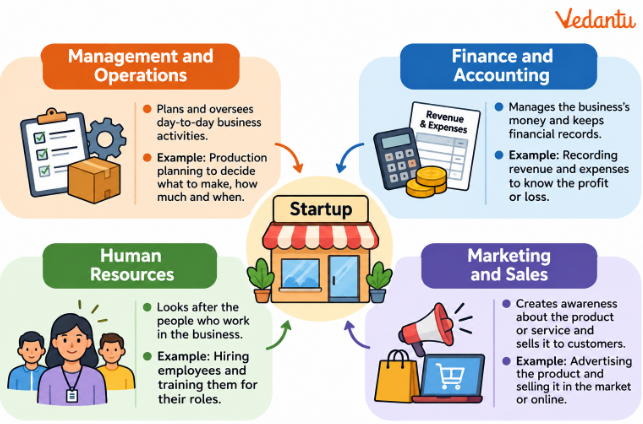
Q14. Explain the four main functional areas of a business. How does a profit and loss account help a business?
Answer: Functional areas are departments or groups within a business that perform different tasks. They help the business run smoothly and use its resources properly.
The four main functional areas are:
1. Management and Operations
Management involves planning, organising and guiding the use of resources to achieve business goals.
Operations focuses on producing and delivering goods or services efficiently.
In a bakery, this includes arranging ingredients, choosing equipment, maintaining quality and planning daily production.
2. Finance and Accounting
Finance involves planning, obtaining and using money for business activities.
Accounting involves recording, organising and reporting financial transactions.
It helps the business track revenue, expenses, profit and cash flow.
A profit and loss account shows whether the business has earned a profit or suffered a loss over a particular period.
3. Human Resources
Human resources focuses on managing the people working in a business.
It includes hiring employees, training them and maintaining a good workplace.
In a bakery, this involves hiring skilled bakers, helpers, cleaners and cashiers.
4. Marketing and Sales
Marketing and sales help attract customers and encourage them to buy products.
Activities include advertising, social media promotion, discounts and online selling.
For example, a bakery may introduce seasonal cakes and offer discounts to attract customers.
5. Profit and loss account
A profit and loss account records the revenue and expenses of a business for a particular period.
The textbook gives the example of ABC Bakery, which earned ₹2,95,000 in revenue during March 2026.
Calculation:
Profit Before Tax = Total Revenue − Total Expenses
= ₹2,95,000 − ₹2,22,000
= ₹73,000
Profit After Tax = Profit Before Tax − Tax
= ₹73,000 − ₹13,000
= ₹60,000
Final Answer: ABC Bakery earned a profit after tax of ₹60,000.
The profit and loss account helps an entrepreneur understand business performance and make decisions about spending, saving and future investments.
Q15. How do entrepreneurs and startups contribute to India's economy and society? Explain with examples from the chapter.
Answer: Entrepreneurs identify opportunities, take risks and start businesses to provide goods and services. Their activities create employment, encourage innovation, and contribute to societal development.
1. Creating employment
New businesses provide jobs to workers and help families earn income.
Startups create employment in fields such as technology, healthcare, agriculture and online services.
2. Producing goods and services
Entrepreneurs manufacture goods and provide services that people need.
Their businesses support trade and increase economic activity.
3. Encouraging innovation
Entrepreneurs develop new products and find better ways to solve problems.
For example, startups in health-tech and agri-tech use technology to improve healthcare and farming activities.
4. Improving people's lives
Businesses provide useful goods and services such as medicines, transportation and technology.
These products and services can make daily life easier.
5. Supporting government services
Businesses pay taxes to the government.
Tax revenue helps fund schools, hospitals, roads and other public facilities.
6. Helping communities
Some businesses support education, healthcare and environmental protection through corporate social responsibility.
For example, Shri Mahila Griha Udyog Lijjat Papad began in 1959 with seven women and ₹80. It developed into a cooperative that helped thousands of women become financially independent.
The organisation also provides scholarships to the school-going children of its members.
7. Supporting India's development
The government promotes entrepreneurship through initiatives such as Startup India.
Startups support the vision of Atmanirbhar Bharat by encouraging innovation and local solutions.
Entrepreneurship also contributes to the goal of Viksit Bharat 2047 through employment, economic growth and community development.
Entrepreneurs and startups contribute to the economy by creating jobs, developing new products, supporting communities and helping India become more self-reliant.
Key Concepts for Class 9 Social Science Chapter 6 Important Questions and Answers
The Class 9 Social Science Chapter 6 important questions and answers cover how entrepreneurs identify opportunities, prepare business plans and manage different business activities. Students should understand these concepts and connect them with examples from the textbook.
How Vedantu Helps Students Practise Class 9 Social Science Chapter 6 Questions
Vedantu's Class 9 Social Science Chapter 6 important questions and answers help students understand the chapter's business concepts and practise writing answers for school examinations.
Students can use the solved questions in the following ways:
MCQs: Check their understanding of entrepreneurship, cooperative societies, business operations and profit calculations.
Very short answers: Practise direct definitions of startups, business plans and different types of costs.
Short answers: Explain entrepreneurial qualities, business success stories and the challenges faced by small businesses.
Long answers: Organise detailed responses about business planning, functional areas and entrepreneurship's contribution to society.
Numerical questions: Practise calculating revenue, profit before tax and profit after tax.
Chapter PDF: Use the solved answers to identify missing points and practise topics that need more attention.
Other study materials: Refer to chapter notes and NCERT Solutions to understand business terms and textbook examples.
Important Study Material Links for Class 9 Social Science Part 2 Chapter 6 From Ideas to Startups
Use these study materials alongside the Class 9 Social Science Chapter 6 important questions and answers to understand the chapter and practise textbook exercises.
Class 9 Social Science Chapter-Wise Important Questions
Students can practise questions from other chapters of Understanding Society: India and Beyond. Chapter 6 from Part II is excluded from the list.
Important Study Materials for CBSE Class 9 Social Science
FAQs on Important Questions Class 9 Social Science (Understanding Society: India And Beyond - Part 2) Chapter 6 From Ideas To Startups | 2026–27
1. Why is a business plan called a dynamic roadmap for a startup?
A business plan is called a dynamic roadmap because entrepreneurs can change it as their business grows. Customer preferences, costs and market conditions may change over time. Entrepreneurs must review their plans and make necessary changes to keep the business running successfully.
2. What are the main barriers that can prevent a small business from growing?
Small businesses may face financial, technical, human resource, market and regulatory barriers. These include difficulty obtaining loans, outdated machinery, a shortage of skilled workers, strong competition and complex approval procedures. Entrepreneurs must identify these problems and find suitable solutions.
3. How can a startup reduce its environmental impact?
A startup can reduce its environmental impact by using recyclable packaging, avoiding unnecessary waste and using resources carefully. For example, a bakery can reduce food waste by planning production according to customer demand. Entrepreneurs should consider how their business activities affect the environment.
4. What is the difference between a business's cash flow and profit?
Profit is the amount left after deducting business expenses from revenue. Cash flow refers to the money entering and leaving a business during a particular period. A business may earn a profit but still face difficulties if it does not have enough cash available to pay its immediate expenses.
5. How can students identify a business opportunity in their surroundings?
Students can observe problems at school, home or in their neighbourhood. They should identify who faces the problem, how often it occurs and whether people need a solution. For example, students may notice a need for affordable stationery or reusable lunch packaging. They can then consider whether people would pay for their product or service.
6. How can Vedantu help students prepare Class 9 Social Science Chapter 6 important questions and answers?
Vedantu provides Class 9 Social Science Chapter 6 important questions and answers covering entrepreneurship, business planning, functional areas and profit calculations. Students can practise solved MCQs, short answers, long answers and case-based questions. Vedantu's chapter-wise PDF, NCERT Solutions and study notes also help students understand textbook concepts and prepare for school examinations.
7. How can students answer case-based questions in From Ideas to Startup Class 9 short question answer exercises?
Students can use Vedantu’s chapter-wise Ideas to Startup Class 9 extra questions and answers to practise business planning. They should identify the problem in the case, name the business function that solves it and suggest a suitable action. For example, a bakery short of workers during festivals can hire temporary staff.