


Class 9 Social Science Chapter 5 Important Questions and Answers on Managing Finances
The Class 9 Social Science Chapter 5 important questions and answers PDF has 15 solved questions on budgeting, saving, investing, insurance and taxation. Use it to revise the parts that need extra attention for your exams and to check your calculations. The Managing Your Personal Finances Class 9 question answer set also shows how people make money decisions in everyday life.
Class 9 Social Science Chapter 5 Important MCQs with Answers
Q1. Which of the following is one of the five pillars of personal finance?
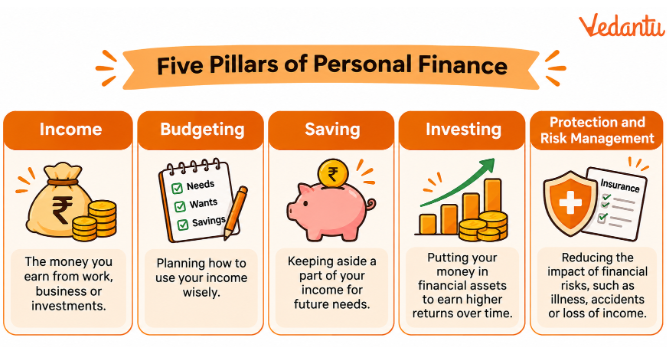
(a) Advertising
(b) Budgeting
(c) Manufacturing
(d) Marketing
Answer: (b) Budgeting
Q2. Sameer invests ₹500 in a savings scheme that earns 8% interest per year. How much money will he have after one year?
(a) ₹508
(b) ₹520
(c) ₹540
(d) ₹580
Answer: (c) ₹540
Q3. What is meant by portfolio diversification in mutual funds?
(a) Investing all the money in one company's shares
(b) Keeping all savings as cash at home
(c) Spreading investments across different financial assets to reduce risk
(d) Borrowing money to purchase more shares
Answer: (c) Spreading investments across different financial assets to reduce risk
Q4. A family wants protection against hospital expenses caused by an illness or accident. Which type of insurance should they choose?
(a) Motor insurance
(b) Health insurance
(c) Property insurance
(d) Cattle insurance
Answer: (b) Health insurance
Q5. Which statement correctly explains the relationship between risk and return?
(a) Higher-risk investments always give higher returns.
(b) Low-risk investments always cause losses.
(c) Higher-risk investments may offer higher returns but also carry a greater chance of loss.
(d) All investments have the same level of risk.
Answer: (c) Higher-risk investments may offer higher returns but also carry a greater chance of loss.
Class 9 Social Science Chapter 5 Very Short Answer Questions
Q6. What is personal finance?
Answer: Personal finance refers to planning and managing an individual's money to meet their needs and wants. It includes decisions about spending, saving, investing and preparing for future financial needs.
Q7. What is compounding?
Answer: Compounding is the process in which an investment earns returns on both the original amount and the returns earned earlier. These returns are reinvested to generate additional earnings.
Q8. What is an EMI?
Answer: EMI stands for Equated Monthly Instalment. It is the fixed amount paid every month to repay a loan. Each EMI includes part of the principal and the interest charged by the lender.
Q9. What is progressive taxation?
Answer: Progressive taxation is a system in which higher portions of taxable income are taxed at higher rates. It aims to reduce income inequality by asking people with greater financial capacity to contribute more.
Class 9 Social Science Chapter 5 Short Answer Questions
Q10. What are the four main steps involved in preparing a budget?
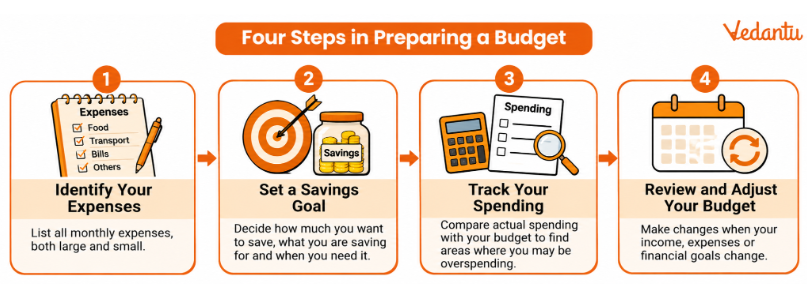
Answer: The four main steps in budgeting are:
Identify your expenses: List all monthly expenses, both large and small, to understand where your money is spent.
Set a savings goal: Decide how much you want to save, what you are saving for and when you need the money.
Track your spending: Compare actual spending with your budget to find areas where you may be overspending.
Review and adjust your budget: Make changes when your income, expenses or financial goals change.
Budgeting helps people control unnecessary spending, meet their needs and save for future goals.
Q11. Why is saving money alone not always enough to build wealth? How does inflation affect savings?
Answer: Saving means keeping aside a part of one's income for future use. However, money kept without earning returns may lose purchasing power because of inflation.
Inflation causes the prices of goods and services to rise over time.
As prices rise, the same amount of money can buy fewer goods.
Investing savings in suitable assets may help money grow and protect its value.
Investments can earn returns, but some carry the risk of financial loss.
Example: If a school bag costs ₹1,000 today and inflation is 6% for one year:
Increase in price = ₹1,000 × 6/100 = ₹60
New price = ₹1,000 + ₹60 = ₹1,060
Therefore, the same school bag will cost ₹1,060 after one year, assuming a 6% price increase.
Q12. Explain the differences between fixed deposits, bonds, shares and mutual funds.
Answer: Four common investment options discussed in the chapter are:
Fixed Deposits (FDs): A person deposits a lump sum with a bank or post office for a fixed period at a specified interest rate. FDs generally offer steady returns with relatively low risk.
Bonds: People lend money to governments or companies for a fixed period and earn interest. Government bonds are generally considered safer than corporate bonds.
Shares: Buying shares makes a person a part-owner of a company. Returns may come from dividends or an increase in share prices. However, share prices can also fall.
Mutual Funds: Mutual funds collect money from many investors and invest it in shares, bonds and other financial assets. Professional fund managers manage these investments.
Each option has different levels of risk, return, liquidity and investment duration.
Class 9 Social Science Chapter 5 Long Answer Questions
Q13. Why are insurance and responsible borrowing important parts of personal finance? Explain the different types of insurance.
Answer: Insurance and responsible borrowing help individuals and families protect their savings and manage financial difficulties.
1. Importance of insurance
Insurance is a legal contract between an individual and an insurance company. The individual pays a regular amount called a premium. In return, the company provides financial compensation for specified losses or expenses covered under the policy.
Insurance works on the principle of risk sharing. Many people pay premiums into a common pool, which is used to support insured people when covered losses occur.
2. Types of insurance
Health Insurance: Helps cover medical expenses such as hospitalisation, medicines, diagnostic tests and treatment.
Life Insurance: Provides financial support to dependants if the policyholder passes away.
General Insurance: Protects against losses related to vehicles, homes, businesses and other property. It includes motor, property, crop and cattle insurance.
3. Importance of responsible borrowing
Borrowing can help people meet important financial needs, but loans must be taken carefully.
An education loan can help a student pursue higher education.
Borrowing for unnecessary purchases may create a debt burden.
A borrower should consider their income and ability to repay before taking a loan.
Paying loan instalments on time helps avoid additional financial difficulties.
4. Managing EMIs
An EMI is a fixed monthly payment that includes principal and interest.
For example, the textbook describes a family taking a ₹30,000 loan to purchase a refrigerator and paying ₹3,000 per month for 12 months.
Total repayment = ₹3,000 × 12 = ₹36,000
Amount paid above the original loan = ₹36,000 − ₹30,000 = ₹6,000
This example shows that borrowing can increase the total cost of a purchase.
Having too many EMIs can also reduce the money available for savings and emergencies.
Insurance protects families against unexpected financial losses, while responsible borrowing helps them avoid unnecessary debt.
Q14. What factors should a person consider before investing? Explain how compounding helps money grow with an example.
Answer: Before investing money, a person should consider financial goals, the level of risk involved and when the money will be needed.
1. Factors to consider before investing
Risk: The chance of losing money on an investment.
Return: The profit earned from an investment.
Time Horizon: The length of time for which money can remain invested.
Liquidity: How easily an asset can be converted into cash when needed.
2. Relationship between risk and return
Different investments involve different levels of risk.
Fixed deposits generally involve lower risk and offer steady returns.
Mutual funds may provide higher returns but are subject to market risks.
Shares may offer higher returns over the long term, but their prices can rise or fall.
A person should choose investments according to their financial goals and risk tolerance.
3. Importance of compounding
Compounding allows investors to earn returns on both the original investment and the returns already earned.
The textbook gives the example of Bhavisha and Dhruv. Both invest ₹1,000 at the end of each year and earn a 7% annual return.
Bhavisha starts at age 25, while Dhruv starts at age 35. By age 65, Bhavisha has accumulated more money because her investments have had more time to grow.
4. Numerical example
A family invests ₹30,000 at 8% compound interest per year for five years. Calculate the amount and compound interest, assuming annual compounding.
Given:
Principal (P) = ₹30,000
Rate of interest (r) = 8% = 0.08
Time (n) = 5 years
Formula:
$A = P(1 + r)^n$
Substituting the values:
$\begin{aligned} A &= 30,000(1 + 0.08)^5 \\ A &= 30,000(1.08)^5 \\ A &= 30,000 \times 1.4693280768 \\ A &= \boxed{\text{₹}44,079.84} \end{aligned}$
Compound Interest = Amount − Principal
= ₹44,079.84 − ₹30,000
= ₹14,079.84
Final Answer:
Amount after 5 years = ₹44,079.84
Compound interest earned = ₹14,079.84
This calculation shows how compounding helps money grow when returns are reinvested over time.
Q15. What is personal income tax? Explain direct and indirect taxes and calculate income tax using the tax slabs given in the textbook.
Answer: Taxes are compulsory payments made by individuals and businesses to the government. The government uses tax revenue to provide public services such as schools, hospitals, transport, roads and defence.
1. Types of taxes
Direct Taxes: Taxes paid directly on a person's or organisation's income or profits. Income tax is an example.
Indirect Taxes: Taxes added to the prices of goods and services. Goods and Services Tax (GST) is an example.
2. Personal income tax
Personal income tax is a tax on a person's taxable income earned during a financial year.
India follows a progressive system of taxation. Different portions of income are taxed at different rates. People with higher taxable incomes generally pay more tax.
3. Income tax slabs for FY 2025–26
The textbook provides the following new-regime tax slabs. These were also verified against the Income Tax Department's information for Assessment Year 2026–27.
4. Numerical example from the textbook
Priya, a salaried business analyst, earns ₹14,00,000 annually. Calculate her slab-wise income tax using the ₹75,000 standard deduction.
Step 1: Calculate taxable income
Taxable Income = ₹14,00,000 − ₹75,000 = ₹13,25,000
Step 2: Calculate tax on each slab
Calculation:
₹20,000 + ₹40,000 + ₹18,750 = ₹78,750
Step 3: Calculate Health and Education Cess
The Health and Education Cess is 4% of the income tax (plus surcharge, if any). This step is additional to the textbook's worked example.
Cess = ₹78,750 × 4/100 = ₹3,150
Total tax including cess = ₹78,750 + ₹3,150 = ₹81,900
Priya's taxable income exceeds ₹12 lakh, so the Section 87A rebate applicable up to that threshold does not reduce this example's tax.
Final Answer:
Taxable income = ₹13,25,000
Slab-wise income tax = ₹78,750
Health and Education Cess = ₹3,150
Total tax including cess = ₹81,900, assuming the stated salary is her only income and no further tax adjustments apply.
5. Importance of paying taxes
Taxes help the government provide schools, hospitals, roads and other public facilities.
They support public services such as transport, security and defence.
Progressive taxation asks people with higher incomes to contribute at higher tax rates.
Paying taxes honestly and on time supports the development of the country.
Income tax is an important source of government revenue and helps provide essential public services.
Class 9 Social Science Chapter 5 Important Questions: Key Topics on Managing Your Personal Finances
After practising the Class 9 Social Science Chapter 5 important questions and answers, check that you understand the chapter's main financial concepts. Focus on how people plan their spending, save for future needs, invest money and protect themselves against financial losses.
Focus on these topics:
These topics also help students prepare for Managing Your Personal Finances Class 9 extra questions and answers, particularly questions involving financial decisions and numerical examples.
Prepare Better Answers with Vedantu's Class 9 Social Science Chapter 5 Important Questions
Vedantu's Class 9 Social Science Chapter 5 important questions and answers help students check their understanding of financial terms and organise their answers clearly.
Five pillars of personal finance: Know what each pillar means and how it helps in managing money.
Budgeting: Follow the four budgeting steps and use examples like school expenses or monthly family needs.
Investments: Compare fixed deposits, bonds, shares and mutual funds by their features and risks.
Calculations: Write down the given values, apply the correct formula and check each step.
Long answers: Split the answer into clear parts and add examples from the textbook.
Students looking for Managing Your Personal Finances Class 9 extra questions can practise Vedantu's solved questions before checking their answers. The Class 9 Social Science Part 2 Chapter 5 important questions also help students identify topics that need more attention.
Class 9 Social Science Part 2 Chapter 5 Managing Your Personal Finances Important Study Materials
Use these resources alongside the Class 9 Social Science Chapter 5 important questions and answers to study financial concepts and practise textbook questions.
Class 9 Social Science Chapter-Wise Important Questions
Students can practise questions from other chapters of Understanding Society: India and Beyond. The current chapter is excluded from the list.
Important Study Materials for CBSE Class 9 Social Science
FAQs on Important Questions and Answers for Class 9 Social Science Part 2 (Understanding Society: India and Beyond – Part 2) Chapter 5 Managing Your Personal Finances | 2026–27
1. What are the different sources of income mentioned in Managing Your Personal Finances?
People can earn income from different sources. Teachers receive salaries, while shopkeepers earn profits from their businesses. Property owners may receive rent, and investors can earn interest from bank deposits. Shareholders may also receive dividends from companies.
2. Why is it important to start investing at an early age?
Investing early gives money more time to grow through compounding. The textbook explains this through Bhavisha and Dhruv, who start investing at ages 25 and 35, respectively. Bhavisha accumulates more money by age 65 because her investments earn returns over a longer period.
3. What is the difference between government bonds and corporate bonds?
Government bonds are issued by the government, while companies issue corporate bonds to raise money. Both may provide interest to investors. Government bonds are generally considered safer than corporate bonds. However, the level of risk also depends on the bond and its issuer.
4. How does the Ayushman Bharat Pradhan Mantri Jan Arogya Yojana help families?
Ayushman Bharat - Pradhan Mantri Jan Arogya Yojana (AB-PMJAY) is a government health insurance scheme for eligible households. It helps cover hospital treatment expenses and reduces the financial burden of medical emergencies. The scheme is an example of how health insurance can protect family savings.
5. What is the role of the Central Board of Direct Taxes (CBDT) in India?
The Central Board of Direct Taxes (CBDT) works under the Ministry of Finance. It administers laws related to direct taxes, including income tax. The textbook also explains that the Ministry of Finance proposes income tax slabs through the Union Budget.
6. How can Vedantu help students practise Managing Your Personal Finances Class 9 extra questions and answers?
Vedantu provides Class 9 Social Science Chapter 5 important questions and answers covering budgeting, saving, investing, insurance and taxation. Students can practise solved MCQs, short answers, long answers and numerical questions. These chapter-wise study materials help students check their calculations, understand financial concepts and prepare for school examinations.