Class 10 English Chapter 9 The Book That Saved the Earth Important Questions with Answers PDF
This chapter-specific practice set contains 6 MCQs, 5 very short answers, 8 short answers and 7 long answers, including extract-based and illustration-based questions. The answers focus on the play's events, character behaviour, dramatic irony, and its central message.
The Book That Saved the Earth Important Questions MCQ with Answers
Q1. Why did the Historian describe the twentieth century as the 'Era of the Book'?
(a) Books were used only to decorate museums.
(b) Books were widely used for education, information and many other purposes.
(c) Books had replaced all other forms of communication.
(d) Books were used as weapons against Mars.
Answer: (b) Books were widely used for education, information and many other purposes.
Explanation: The Historian explains that books were available on almost every subject. People used them to learn, understand and record information.
Q2. Where did Captain Omega, Lieutenant Iota and Sergeant Oop land on Earth?
(a) A military laboratory
(b) The Centerville Public Library
(c) A food storage centre
(d) The Museum of Ancient History
Answer: (b) The Centerville Public Library.
Explanation: The Martian crew enters the Centerville Public Library but does not recognise it. They are confused by the books and initially assume the building serves another purpose.
Q3. What did Think-Tank first identify the books as?
(a) Communication devices
(b) Weapons
(c) Sandwiches
(d) Weather instruments
Answer: (c) Sandwiches.
Explanation: Think-Tank notices the shape of the books and incorrectly concludes that they are sandwiches eaten by Earthlings.
Q4. Who was finally ordered to eat the 'sandwich' in the library?
(a) Captain Omega
(b) Lieutenant Iota
(c) Sergeant Oop
(d) Apprentice Noodle
Answer: (c) Sergeant Oop.
Explanation: Think-Tank orders Captain Omega to eat a book. Omega passes the task to Iota, who passes it to Oop. He reluctantly bites the book and finds it unpleasant.
Q5. Which nursery rhyme frightened Think-Tank so much that he decided to escape from Mars?
(a) Mistress Mary
(b) Hey Diddle Diddle
(c) Humpty Dumpty
(d) Jack and Jill
Answer: (c) Humpty Dumpty.
Explanation: After seeing a picture of Humpty Dumpty, Think-Tank notices its resemblance to his own large, egg-shaped head. He mistakenly believes that Earthlings are planning to capture him.
Q6. Who eventually replaced Think-Tank as the ruler of Mars?
(a) Captain Omega
(b) Lieutenant Iota
(c) Sergeant Oop
(d) Noodle
Answer: (d) Noodle.
Explanation: At the end, the Historian explains that Noodle becomes the new leader of Mars. This ending contrasts Noodle's intelligence with Think-Tank's foolish overconfidence.
Class 10 English Chapter 9 Very Short Answer Questions
Q7. Who is the author of 'The Book That Saved the Earth'?
Answer: Claire Boiko is the author of The Book That Saved the Earth.
Q8. In which year did the Martians plan to invade Earth?
Answer: The Martians planned to invade Earth in the year 2040.
Q9. What was the name of the book that prevented the Martian invasion?
Answer: Mother Goose, a collection of nursery rhymes, prevented the Martian invasion.
Q10. What did Think-Tank use to admire himself?
Answer: Think-Tank used a mirror. He asked it to confirm that he was the most intelligent being, revealing his vanity.
Q11. Why did Noodle suggest that the Martian crew take vitamins?
Answer: Noodle reminded Think-Tank that the crew had been given vitamins intended to increase their intelligence. This suggestion helped the Martians begin to understand the writing in the books.
Class 10 English Chapter 9 Short Answer Questions
Q12. Why were the Martians unable to recognise the library and its books?
Answer: The Martians had never encountered objects like the books in the Centerville Public Library. Lieutenant Iota thought the place might be a storage building, while Sergeant Oop suggested that the books could be hats. Think-Tank then confidently called them sandwiches. Their confusion shows how easily people can misunderstand unfamiliar objects when they make assumptions without investigating.
Q13. How did Sergeant Oop become the victim of Think-Tank's mistaken idea about books?
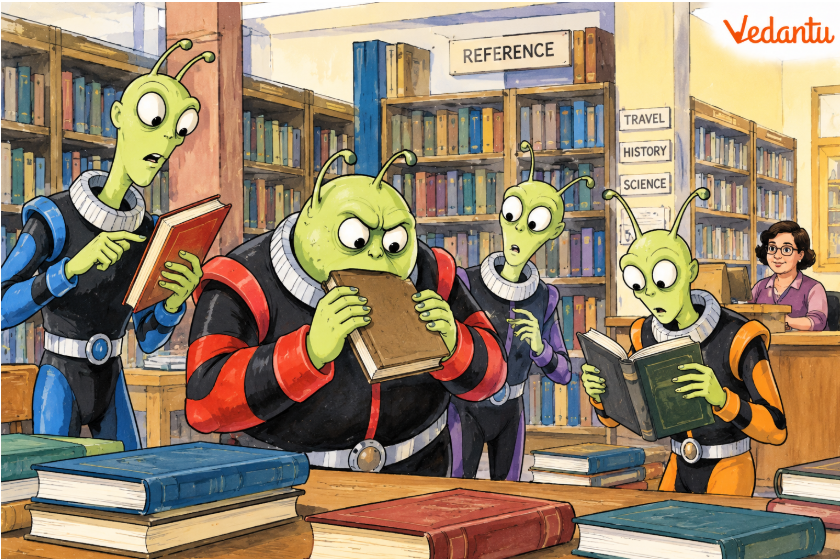
Answer: Think-Tank declared that books were sandwiches and ordered Captain Omega to eat one. Omega passed the responsibility to Lieutenant Iota, who passed it to Sergeant Oop. Unable to refuse an order, Oop bit a corner of the book and pretended to chew and swallow it. The scene is humorous because the audience knows that the Martians are trying to eat something meant for reading.
Q14. How did Noodle correct Think-Tank without directly challenging his authority?
Answer: Noodle used polite and indirect suggestions. Instead of telling Think-Tank that his ideas were wrong, he presented useful information as small thoughts that had occurred to him. When Think-Tank claimed books were sandwiches, Noodle suggested that Earthlings used them for communication. Later, he explained that people opened books and looked at them. Think-Tank adopted these ideas while pretending they were his own.
Q15. What did Think-Tank misunderstand about the rhyme involving Mistress Mary's garden?
Answer: Think-Tank believed that the rhyme described real scientific achievements. He assumed that Earthlings could grow silver and other unusual materials in gardens. He also interpreted the mention of shells as evidence that Earthlings could produce explosives. In reality, the rhyme was a playful nursery verse. His mistake caused him to worry about Earth's supposed military power.
Q16. Why did the rhyme about the cow jumping over the moon alarm Think-Tank?
Answer: Think-Tank interpreted the imaginary events of the rhyme literally. He believed that Earthlings had trained animals in music and advanced space travel. The cow jumping over the moon suggested to him that Earth's animals might be capable of interplanetary attacks. The audience recognises the absurdity of this conclusion, making the scene funny.
Q17. What was the turning point that finally stopped the invasion of Earth?
Answer: The turning point came when Sergeant Oop read the Humpty Dumpty rhyme and showed its accompanying picture. Think-Tank thought the figure resembled his own large head. He interpreted the character's fall as a warning that Earthlings planned to capture him and attack Mars. Frightened, he cancelled the invasion and ordered the Martians to leave Earth.
Q18. How does the Historian's narration make the play more interesting?
Answer: The Historian introduces the story from the twenty-fifth century and describes how a simple book prevented an invasion in 2040. This creates curiosity because the audience wants to discover how a nursery-rhyme book could achieve something so extraordinary. At the end, the Historian explains what happened after the failed invasion, giving the play a clear and satisfying conclusion.
Q19. What happens to the relationship between Earth and Mars after Think-Tank's failed invasion?
Answer: According to the Historian, Earth and Mars later establish friendly relations. Noodle replaces Think-Tank as the Martian leader, and Earthlings teach the Martians how to recognise and read books. A model library is established in Marsopolis, the capital of Mars. However, the Martians still avoid Mother Goose, remembering the fear it caused during Think-Tank's rule.
Class 10 English Chapter 9 Long Answer Questions
Q20. Describe Think-Tank's character. How do his behaviour and decisions create humour in the play?
Answer: Think-Tank is the commander-in-chief of Mars and believes himself to be the most intelligent creature in the universe. However, his actions repeatedly prove otherwise.
1. Proud and Self-Important: Think-Tank expects Noodle to address him with long, flattering titles. He enjoys being praised.
2. Obsessed with Appearance: He admires his large, egg-shaped head and believes that it is a sign of superior intelligence.
3. Overconfident: When the Martian crew discovers books, he immediately declares them to be sandwiches without examining them properly.
4. Unwilling to Admit Mistakes: Even after Noodle offers better explanations, Think-Tank pretends that he had already considered them.
5. Poor at Understanding Language: He takes the nursery rhymes literally and mistakes imaginative descriptions for scientific or military information.
6. Easily Frightened: He assumes that the picture of Humpty Dumpty represents himself and becomes terrified of an imaginary Earthling attack.
7. Cowardly in a Crisis: Instead of checking the information, he orders the invasion to stop and decides to escape from Mars.
8. Dependent on Others: Although he considers himself brilliant, Noodle repeatedly provides the ideas that move the investigation forward.
Conclusion: Think-Tank's behaviour creates humour through the contrast between his high opinion of himself and his inability to understand simple things. His character also shows the dangers of arrogance and refusing to question one's assumptions.
Q21. Compare the personalities of Think-Tank and Noodle. Why does Noodle prove to be a better leader?
Answer: Think-Tank and Noodle represent two very different approaches to intelligence and leadership.
Important Differences
1. Intelligence and Observation: Think-Tank assumes that his first interpretation must be correct. Noodle pays attention to evidence and offers explanations based on what he has observed.
2. Handling Mistakes: Think-Tank cannot accept being wrong. Noodle points out mistakes carefully without humiliating his superior.
3. Confidence: Think-Tank's confidence is based on his position and self-image. Noodle's confidence comes from his ability to think.
4. Leadership: Think-Tank demands obedience, while Noodle demonstrates qualities such as patience, understanding and good judgment.
5. Outcome: Think-Tank's misunderstanding ends in panic and retreat. Noodle eventually becomes the leader of Mars.
Conclusion: Noodle proves to be a better leader because he combines intelligence with humility. The play suggests that real wisdom involves careful thinking and openness to new information.
Q22. Explain how Think-Tank's interpretation of the three nursery rhymes changes the Martians' plan to invade Earth.
Answer: Three nursery rhymes from Mother Goose play an important role in making Think-Tank increasingly afraid of Earthlings.
1. The Rhyme about Mistress Mary's Garden
The first rhyme describes an unusual garden with decorative objects and playful imagery.
Think-Tank misinterprets the description and believes that Earthlings have learned to grow valuable metals and explosives.
Effect: He becomes concerned about Earth's supposed technological achievements and orders the invasion fleet to wait.
2. The Rhyme about the Cow Jumping over the Moon
The second rhyme includes imaginary events involving animals and objects behaving in impossible ways.
Think-Tank believes that Earthlings have trained their animals in advanced space travel and other complex skills.
Effect: He becomes even more frightened and decides that the invasion should not take place that day.
3. The Rhyme about Humpty Dumpty
The third rhyme describes an egg-shaped character who falls from a wall.
When Oop shows the accompanying picture, Think-Tank thinks the figure looks like him.
Effect: He believes that Earthlings know about him and plan to attack Mars. He orders an immediate evacuation.
How the Three Rhymes Affect Think-Tank
Conclusion: Each rhyme increases Think-Tank's fear. The Martians are defeated not by weapons but by their commander's inability to distinguish imagination from reality.
Q23. How does the play use humour, satire and dramatic irony to criticise arrogance? Explain with examples.
Answer: Claire Boiko uses several dramatic techniques to make The Book That Saved the Earth entertaining while conveying an important message.
1. Humour through Misunderstanding: The Martians cannot identify books. Their guesses that books are hats, sandwiches and communication devices create funny situations.
2. Physical Comedy: Sergeant Oop is forced to bite a book. His uncomfortable reaction adds visual humour to the scene.
3. Exaggeration: Think-Tank's enormous head and extravagant titles exaggerate his pride and self-importance.
4. Satire of Authority: Think-Tank expects complete obedience despite making obvious mistakes. The play mocks leaders who value praise more than sound judgement.
5. Dramatic Irony: The audience knows what books and nursery rhymes are, but the Martians do not. This difference in knowledge makes Think-Tank's conclusions especially amusing.
6. Literal Interpretation: Think-Tank assumes that the events described in nursery rhymes are real. His inability to recognise imaginative writing leads him to absurd conclusions.
7. Reversal of Expectations: The commander who plans to conquer Earth becomes so frightened that he orders the Martians to flee.
8. Ironic Ending: The intelligent but less powerful Noodle eventually replaces Think-Tank as leader.
Conclusion: Through humour and dramatic irony, the play shows that authority and self-confidence do not guarantee intelligence. A person must also be willing to observe, question and learn.
Q24. Read the following adapted extracts based on The Book That Saved the Earth and answer the questions.
The extracts below are paraphrased for practice, not quotations from the textbook.
Extract A
Think-Tank looks at the unfamiliar object and decides that it is food. He orders his crew to test his explanation. The responsibility is passed down until Sergeant Oop reluctantly tries to bite the object.
(a) What is the unfamiliar object?
Answer: It is a book.
(b) Where does this incident take place?
Answer: The incident takes place in the Centerville Public Library.
(c) Why does Sergeant Oop obey the order?
Answer: He is a subordinate officer who is expected to follow instructions from his superiors.
(d) Which quality of Think-Tank is revealed through this incident?
Answer: His overconfidence and unwillingness to verify his assumptions.
Extract B
After reading the final nursery rhyme, the Martian crew shows Think-Tank an illustration. He notices a resemblance between the character in the picture and himself. Convinced that Earthlings are planning an attack, he immediately orders the Martians to retreat.
(a) Which rhyme is being read?
Answer: The rhyme about Humpty Dumpty.
(b) Why does Think-Tank feel threatened?
Answer: He believes that Humpty Dumpty represents him and that the rhyme predicts an attack on him.
(c) What decision does he make?
Answer: He orders the crew to leave Earth, prepares to escape and directs the invasion fleet to evacuate Mars.
(d) What is ironic about his reaction?
Answer: He plans to conquer Earth but becomes frightened by a harmless children's rhyme.
Extract-Based Practice Tip: When answering extracts from a play, identify the speaker or situation, explain what happens and connect the incident to a character trait or the central theme.
Q25. Study the illustration showing a Martian examining the Mother Goose book. Explain why this book is central to the play's ending.
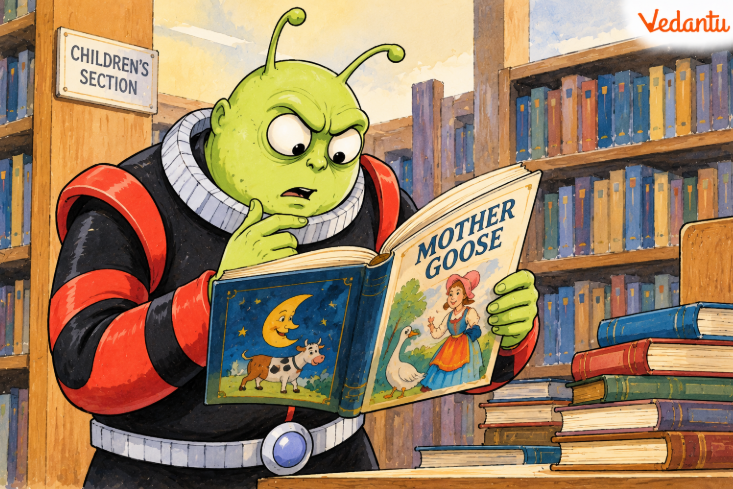
Answer: Mother Goose is a collection of nursery rhymes that prevents the Martians from invading Earth.
1. Discovery in the Library: The Martian crew discovers Mother Goose among the books in the Centerville Public Library.
2. Confusion about Writing: At first, the Martians cannot understand the writing in the book.
3. Think-Tank's Suspicion: Think-Tank becomes interested in the printed marks and assumes that the book contains an important code.
4. Use of Vitamins: Noodle reminds Think-Tank about the vitamins given to the crew. The crew takes them before attempting to interpret the writing.
5. First Misunderstanding: The rhyme about Mistress Mary's garden makes Think-Tank imagine that Earthlings can grow dangerous materials.
6. Second Misunderstanding: The rhyme about the cow jumping over the moon convinces him that Earthlings possess extraordinary scientific abilities.
7. Final Misunderstanding: The Humpty Dumpty rhyme causes him to believe that Earthlings are planning to capture him.
8. Cancellation of the Invasion: Think-Tank orders the Martian crew to withdraw and prepares to flee.
9. No Actual Earthling Attack: Earthlings do not defeat the Martians in battle. Think-Tank's mistaken interpretation creates the fear that stops the invasion.
10. Symbolic Importance: The book represents the power of language, imagination and knowledge even though Think-Tank fails to understand them.
Conclusion: Mother Goose saves Earth because Think-Tank mistakes innocent children's rhymes for evidence of a powerful civilisation planning to attack him.
Q26. Why is the title 'The Book That Saved the Earth' appropriate? Explain the main message of the play.
Answer: The title is appropriate because the events of the play revolve around a book that unexpectedly prevents the Martian invasion of Earth.
1. The Planned Invasion: Think-Tank intends to bring Earth under Martian control in 2040.
2. The Discovery of Books: The Martian crew enters a library and encounters objects it cannot identify.
3. The Importance of Mother Goose: The crew eventually tries to read a collection of nursery rhymes.
4. Misunderstood Language: Think-Tank interprets playful rhymes as information about Earth's technological and military strength.
5. Fear of Earthlings: The rhymes convince him that Earthlings are far more dangerous than he expected.
6. The Humpty Dumpty Incident: Think-Tank recognises a supposed resemblance between himself and the egg-shaped character.
7. Retreat from Earth: Fearing an attack on Mars, he orders the invasion to stop.
8. Earth's Unexpected Protection: A harmless book achieves what military force might otherwise have been needed to accomplish.
9. Message about Knowledge: The play shows why information must be interpreted carefully. Reading words without understanding their context can lead to incorrect conclusions.
10. Message about Pride: Think-Tank's arrogance prevents him from questioning his assumptions. His confidence becomes a weakness rather than a strength.
11. Importance of Humility: Noodle demonstrates that intelligence is more valuable when combined with observation, patience and humility.
12. Lasting Effect: Even after Earth and Mars establish friendly relations, the Martians remain reluctant to read Mother Goose.
Conclusion: The title captures the story's central irony: Earth is saved by a nursery-rhyme book because an arrogant Martian ruler completely misunderstands it.
Why Practise Class 10 English Chapter 9 Important Questions with Vedantu?
Vedantu's The Book That Saved the Earth Important Questions help students revise the play's characters, humorous incidents, nursery rhymes and central message through different question formats. Students can use the answers to prepare for literature questions that require explanation, interpretation and evidence from the text.
How to Prepare The Book That Saved the Earth Important Questions?
Follow the plot in order: Revise the Martians' arrival, their discovery of books, Think-Tank's incorrect interpretations and the final retreat.
Compare characters: Understand why Think-Tank is arrogant while Noodle is tactful and observant.
Remember all three nursery rhymes: Focus on what Think-Tank incorrectly concludes from each one.
Practise extract-based questions: Identify the situation, explain the character's reaction and connect it to humour or irony.
Revise the ending: Explain how Mother Goose prevents the invasion and why Noodle eventually becomes the ruler of Mars.
Important Study Material Links for Class 10 English Chapter 9
Students can use these chapter-specific resources to revise the story, understand its characters and prepare answers using relevant incidents.
CBSE Class 10 English Other Books Important Questions and Study Resources
Chapter-Wise Important Questions for Class 10 English – Footprints Without Feet
Students can explore other chapters of Footprints Without Feet to practise character analysis, theme-based explanations and literature questions from different stories.
Important Study Materials for Class 9 English
FAQs on Important Questions and Answers for Class 10 English (Footprints Without Feet) Chapter 9 – The Book That Saved the Earth | 2026–27
1. How did a simple nursery-rhyme book save Earth from the Martian invasion?
The Martians discovered Mother Goose in an Earth library. Their commander, Think-Tank, took its imaginary nursery rhymes literally and assumed that Earthlings possessed dangerous weapons and advanced technology. When he saw Humpty Dumpty's picture, he believed Earthlings planned to attack him. Frightened, he ordered the invasion to stop.
2. Why is Think-Tank considered foolish despite claiming to be extremely intelligent?
Think-Tank repeatedly makes incorrect assumptions without checking the facts. He mistakes books for sandwiches, fails to understand how people read and interprets nursery rhymes as military information. His refusal to admit mistakes reveals the difference between real intelligence and arrogance.
3. How does Noodle correct Think-Tank's mistakes without offending him?
Noodle offers helpful information politely and indirectly. Instead of openly disagreeing, he presents his ideas as small observations or uncertain thoughts. This allows Think-Tank to accept the corrections without feeling challenged, even though Think-Tank often claims the suggestions as his own.
4. Why did Think-Tank become frightened after seeing the picture of Humpty Dumpty?
Humpty Dumpty's egg-shaped appearance reminded Think-Tank of his own large head. He assumed that the rhyme described a plan to make him fall and capture Mars. His fear came from a misunderstanding of an innocent children's rhyme.
5. What are the main differences between Think-Tank and Noodle in The Book That Saved the Earth?
Think-Tank is proud, impatient and unwilling to question himself. Noodle is observant, polite and capable of correcting mistakes tactfully. Think-Tank's foolish decisions cause the invasion to fail, while Noodle's wisdom eventually helps him become the leader of Mars.
6. Why did the Martians think books were sandwiches and communication devices?
The Martians were unfamiliar with books. Think-Tank first assumed they were sandwiches because of their appearance. When Noodle suggested that Earthlings used them for communication, Think-Tank ordered the crew to listen to them. Later, Noodle explained that people opened books and looked at them.
7. What types of questions are included in Class 10 English Footprints Without Feet Chapter 9 Important Questions?
The practice set includes MCQs, very short answers, short answers, long answers, extract-based questions and illustration-based questions. It covers Think-Tank, Noodle, the Martian crew, the three nursery rhymes, humour, dramatic irony and the ending of the play.
8. How do the three nursery rhymes influence Think-Tank's decisions?
The first rhyme makes Think-Tank believe that Earthlings can grow metals and explosives. The second convinces him that animals can perform advanced space activities. The third, about Humpty Dumpty, makes him fear a personal attack. Together, these misunderstandings cause him to abandon the invasion.
9. Why does Noodle become the ruler of Mars at the end of the play?
The Historian explains that Noodle eventually replaces Think-Tank. Throughout the play, Noodle demonstrates better judgment and understanding than his arrogant superior. His rise to leadership supports the idea that wisdom and humility are more valuable than empty claims of intelligence.
10. Where can students find The Book That Saved the Earth Class 10 Important Questions PDF for revision?
Students can practise the solved questions on this page, including MCQs, character-based answers and extract-based questions. A downloadable PDF can also support offline revision when available. Students should compare their answers with the original play and revise the major incidents before exams.
11. How can students prepare Class 10 English Chapter 9 The Book That Saved the Earth question answers for exams?
Students should revise the main events, character traits and three nursery rhymes before practising questions. Focus on Think-Tank's misunderstandings, Noodle's clever suggestions and the reasons behind the failed Martian invasion. Writing answers with specific examples from the play can improve understanding and exam preparation.
12. What is the central message of The Book That Saved the Earth?
The play shows that arrogance and incomplete knowledge can lead to serious misunderstandings. Think-Tank considers himself highly intelligent but repeatedly reaches foolish conclusions. Noodle's behaviour demonstrates the value of observation, humility and careful thinking.