



List of Popular Medical Courses Without NEET 2027 for Science Students
You can build a healthcare-related career without taking NEET, but the right course depends on the work you want to do. Pharmacy, life sciences and healthcare administration offer routes worth exploring, while nursing and allied health admissions need closer attention to course-specific rules. For students considering medical courses without NEET in 2027, the key distinction is between a healthcare qualification and a qualification to practise as a doctor. Also, admission without NEET does not necessarily mean admission without another entrance exam.
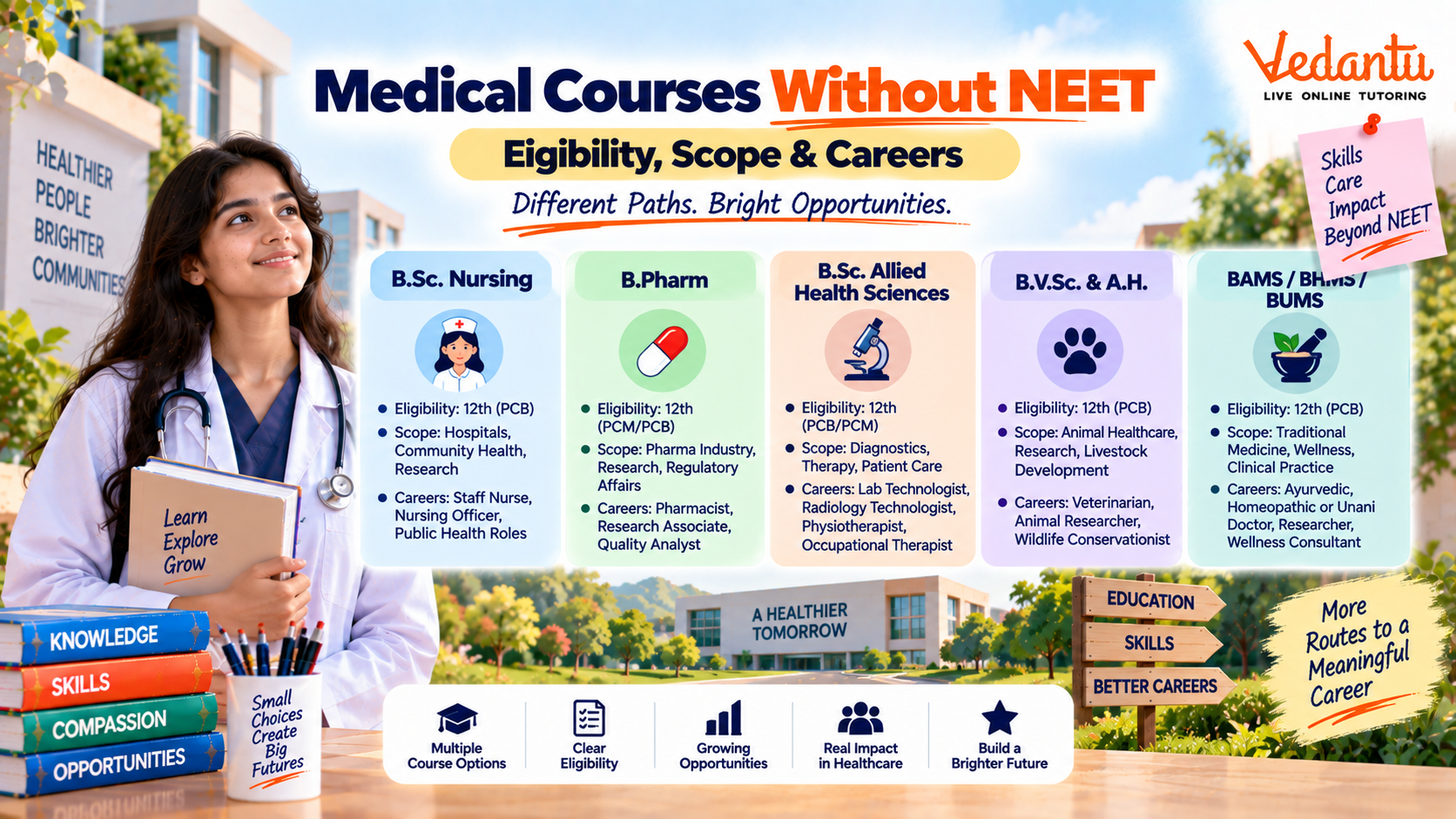
What Does “Medical Courses Without NEET” Actually Mean?
Students often use “medical courses” to describe any course connected with hospitals, medicines or human health. However, clinical medicine, pharmacy, allied healthcare and life sciences lead to different qualifications and responsibilities. A non-NEET healthcare degree is not an alternative licence to practise medicine.
- Medicine and dentistry: Admission to MBBS and BDS in India requires NEET-UG. A non-NEET science or healthcare course does not provide a direct transfer into either degree.
- AYUSH degrees: BAMS, BUMS, BSMS and BHMS are not non-NEET substitutes; they also fall within the NEET-UG admission framework.
- Pharmacy and life sciences: These have admission routes outside NEET, although a state, university or institution may require a different entrance examination.
- Nursing and allied health: Do not assume that every course or college admits students without NEET. The exact programme and admission authority matter.
For your 2027 applications, use the institution’s official prospectus together with the applicable regulator’s requirements to establish the entrance route, subjects, minimum marks, age conditions, duration and registration eligibility. The options below are a planning shortlist, not a confirmed exemption list for every institution. Vedantu’s overview of courses under NEET other than MBBS can help you separate NEET-linked choices from other healthcare pathways.
Check Our Vedantu Learning Centres Near You
Degree and Diploma Options to Explore Beyond NEET
Start with the role you want, then work backwards to the qualification. Pharmacy is a professional pathway involving medicines, whereas biotechnology and microbiology are science pathways that may lead towards research or industry. Healthcare administration focuses on running services rather than treating patients.
| Course | Usual Entry Background | Typical Duration | Admission Route | Career Direction |
|---|---|---|---|---|
| Bachelor of Pharmacy (B.Pharm) | Class 12 with English, Physics, Chemistry and Mathematics or Biology, subject to applicable rules | 4 years | State or institution entrance, counselling or qualifying-exam merit, depending on the institution | Pharmacy practice after registration; pharmaceutical production, quality and regulatory roles |
| Diploma in Pharmacy (D.Pharm) | Class 12 science with Physics, Chemistry and Biology or Mathematics | 2 academic years plus prescribed practical training | Merit or entrance-based selection under the relevant admission system | Pharmacist pathway after satisfying applicable training, examination and registration requirements |
| B.Sc. Biotechnology | Class 12 science; Biology and Mathematics requirements vary | Commonly 3 or 4 years, depending on the degree structure | Qualifying-exam merit or university/common entrance route | Biotechnology laboratories, production and research support; further study for specialised research |
| B.Sc. Microbiology or Biochemistry | Class 12 science with the subjects specified by the university | Commonly 3 or 4 years | Qualifying-exam merit or entrance-based admission | Laboratory support, quality control and research-oriented study |
| BBA/Bachelor’s in Hospital or Healthcare Administration | Class 12; some institutions accept multiple streams | Commonly 3 or 4 years | Merit, entrance or institution-specific selection | Hospital operations, patient services, billing and administrative coordination |
For pharmacy, the Pharmacy Council of India’s requirements, approval of the programme and State Pharmacy Council registration are important. For science degrees, university recognition alone does not establish eligibility for a regulated clinical role. For example, a general microbiology degree should not be treated as interchangeable with a professional medical laboratory qualification.
Paramedical and Allied Health Courses: Check the Exact Programme
Medical laboratory technology, imaging, optometry, physiotherapy and other allied health fields can involve substantial patient-facing or diagnostic work. However, “allied health courses without NEET” is not a reliable blanket category for 2027. Admission requirements, course structures and professional standards must be assessed programme by programme.
- Medical laboratory technology: Involves specimen handling, laboratory procedures and quality control. Professional training is different from a general laboratory science degree, and it does not make the graduate a pathologist.
- Medical imaging or radiography: Focuses on imaging procedures, equipment and safety within the permitted role. An imaging technologist is not a radiologist.
- Operation theatre and dialysis technology: Supports clinical teams through equipment preparation, monitoring and procedure-related work. Supervised hospital training is central to these pathways.
- Optometry: Involves vision assessment and eye-care services within the professional scope. It is distinct from ophthalmology, which is a medical speciality.
- Physiotherapy and occupational therapy: Focus on rehabilitation, movement or daily functioning. Do not rely on older course lists to assume that BPT or BOT admission will be NEET-free in 2027.
- Nutrition and dietetics: Course titles range from general nutrition science to professionally oriented programmes. Eligibility for clinical work depends on the qualification, practical training and applicable requirements.
For these fields, the National Commission for Allied and Healthcare Professions and relevant state or university authorities are important reference points, as applicable. Nursing follows a separate professional framework: B.Sc. Nursing should not be labelled universally NEET-free because admission routes differ across institutions and systems.
Students comparing certificate, diploma and degree routes can use Vedantu’s resource on paramedical courses after Class 10 and Class 12 to identify course categories. Treat the entry stage carefully: a short course available after Class 10 is not equivalent to a professional degree requiring Class 12 science.
Eligibility and Admission Without an Entrance Exam
Without NEET and without any entrance exam are different admission routes. A college may not use NEET but may still select students through a state examination, university test, interview or common entrance process. Merit-based admission usually means selection using qualifying-examination marks; it does not mean that every applicant receives a seat.
There is no single minimum percentage for all non-NEET medical degree options. PCB students have several relevant choices, but some programmes accept PCM, require English separately or admit students from other streams. Subject-wise pass requirements, aggregate calculations and category relaxations can also differ.
- Create a subject-based shortlist: Record your Class 12 subjects and compare them with each programme’s eligibility. Do not assume that Biology alone is sufficient.
- Identify the selection route: Separate merit-based applications from entrance-based ones so that you do not miss an examination registration.
- Check qualification validity: Establish which university awards the degree and whether professional approval or registration is required for the intended job.
- Prepare application documents: Keep marksheets, identity documents and applicable category or domicile certificates ready. Use the institution’s document list for the final application.
- Evaluate the offer before paying: Read the admission letter, complete fee schedule, refund conditions and practical-training arrangements rather than relying on verbal assurances.
Degree or Diploma: Which Route Fits Your Goal?
A diploma can suit a student seeking a specific technical qualification, but a shorter course does not automatically mean easier employment. A degree generally involves broader academic study and may support more postgraduate routes. The useful comparison is between two recognised qualifications for a particular role, not between “all degrees” and “all diplomas”.
- For a defined professional role: Prioritise the qualification accepted for registration and recruitment. A certificate with an attractive title may not meet either requirement.
- For research: A relevant science degree followed by postgraduate study may be more suitable than a narrowly focused technician course.
- For later academic progression: Examine actual postgraduate or lateral-entry eligibility. Progression is not automatic merely because two courses share a subject name.
- For affordability: Compare total tuition, examination charges, accommodation, travel, equipment and compulsory training costs across the full duration.
Career Scope: Match the Course to Daily Work
Choose a field whose routine you can realistically see yourself doing. Healthcare work may involve shifts, careful documentation, patient communication or repeated technical procedures. Interest in Biology is a useful starting point, but it does not by itself identify the right profession.
- If you enjoy medicines and Chemistry: Explore pharmacy, distinguishing pharmacist registration from industry roles in manufacturing, quality or regulatory work.
- If you prefer experiments and scientific investigation: Consider biotechnology, microbiology or biochemistry. Specialised research careers often require further qualifications and research experience.
- If you want practical hospital work: Compare recognised allied health programmes by supervised clinical exposure, equipment access and the graduate’s permitted responsibilities.
- If you prefer organising services: Healthcare administration may suit an interest in communication, coordination and operations without a clinical treatment role.
Salary depends on the role, qualification, location, employer, experience and registration status. Instead of choosing from an advertised “highest salary” figure, examine recent job descriptions for your target role: note the required degree, practical skills and experience. A postgraduate qualification can support specialisation, but it does not guarantee a particular job or salary.
If you like Biology but are unsure about hospital work, Vedantu’s discussion of career options apart from medical for PCB students can help you consider a wider shortlist before committing to a healthcare qualification.
How Vedantu Resources Can Support Your Course Shortlist
Vedantu’s overview of medical courses to pursue without NEET offers a starting point for exploring course names and career directions. Use it to identify two or three fields, then write down the eligibility, training requirements and intended job for each. This is particularly useful before submitting applications, when a broad interest in healthcare needs to become a specific course choice.
Compared with searching individual college prospectuses from the outset, career-exploration reading helps you organise your questions first. Official prospectuses remain the authority for admission decisions, while recognised colleges and clinical training settings provide the qualification and practical experience. Online reading, self-study or academic coaching cannot replace compulsory laboratory work, supervised patient training or professional registration.
Summary
Healthcare careers beyond NEET include pharmacy, life sciences and administration, while allied health and nursing require programme-specific admission checks. Choose by the work you want to do, the qualification it requires and the quality of practical training—not simply by the absence of an entrance exam. Vedantu’s career resources can help you build an initial shortlist. Before applying for 2027, establish the official eligibility, selection route and professional recognition of each shortlisted course.
FAQs on Medical Courses Without NEET 2027: Eligibility, Scope & Careers
1. What are the top medical courses you can pursue without NEET in 2027?
Several rewarding medical and allied health courses do not require NEET scores for admission in 2027. Some of the most popular options include:
- BSc Nursing
- Bachelor of Physiotherapy (BPT)
- Bachelor of Pharmacy (BPharm)
- BSc Medical Lab Technology (MLT)
- BSc Biotechnology
- BSc Nutrition & Dietetics
- Bachelor in Occupational Therapy
2. Is NEET mandatory for admission to BSc Nursing in 2027?
NEET is not mandatory for all BSc Nursing admissions in 2027. Some government and state colleges may consider NEET scores, but many private and deemed universities conduct their own entrance exams or offer admission based on 10+2 marks. Always check the specific college's admission process before applying.
3. What are the eligibility criteria for medical courses without NEET in 2027?
The basic eligibility criteria for most medical courses without NEET include:
- 10+2 passed with Physics, Chemistry, and Biology as core subjects
- Minimum aggregate marks (usually 50% for general category, 40% for reserved categories)
- Some courses or institutes may require English as a compulsory subject
4. What is the scope and career growth after completing paramedical courses without NEET?
Paramedical courses open diverse career opportunities in the healthcare sector. After graduation, students can pursue roles such as:
- Lab Technician
- Physiotherapist
- Pharmacist
- Nutritionist/Dietitian
- Occupational Therapist
- Hospital Administration
5. Can I study abroad in medical fields without NEET?
Yes, many international universities do not require NEET scores for admission to allied health and life sciences courses such as BSc Nursing, Pharmacy, Biotechnology, or Public Health. However, additional requirements may include English proficiency exams (IELTS/TOEFL) and country-specific eligibility.
6. What is the duration of medical courses that do not require NEET?
The duration for most medical and allied health courses without NEET typically ranges from 3 to 4 years. Some paramedical diploma programs may be 2 years in length. Always confirm the duration with the respective institute or university.
7. Which government jobs are available after completing non-NEET medical courses?
After completing non-NEET medical and paramedical courses, graduates can apply for various government roles, such as:
- Staff Nurse
- Laboratory Technician/Assistant
- Pharmacist (after state pharmacy council registration)
- Public Health Worker
- Allied Health Care Professional in government hospitals and clinics
8. Are there any good salary prospects after pursuing medical courses without NEET?
Yes, graduates from non-NEET medical courses can earn competitive salaries. Entry-level roles may start from INR 2.5 to 4 lakh per annum, with substantial growth opportunities through experience, upskilling, or pursuing higher studies like MSc, MPT, or specialized certifications.
9. What's the admission process for BPharm or physiotherapy without NEET in 2027?
For BPharm and BPT in 2027, the typical admission process involves:
- Merit-based selection through 10+2 PCB marks
- University-level entrance exams (if applicable)
- Personal interviews or counseling (some institutes)
10. Can I become a doctor (MBBS) without NEET in India in 2027?
No, NEET is compulsory for MBBS, BDS, and AYUSH (BAMS, BHMS, BUMS, etc.) admissions in India as per NMC regulations for 2027. All aspirants for these courses must qualify NEET irrespective of the institute type (government, private, or deemed).
11. Are diploma courses in medical fields available without NEET?
Yes, various diploma courses in paramedical and allied health fields are offered without NEET, including:
- Diploma in Medical Laboratory Technology (DMLT)
- Diploma in Operation Theatre Technology
- Diploma in X-Ray, ECG, and Medical Imaging
12. What are some alternative career options in the medical field apart from MBBS and BDS in 2027?
For students interested in healthcare but not pursuing MBBS/BDS, alternative careers include:
- Biotechnology Research
- Healthcare Management
- Microbiology
- Genetics Counseling
- Clinical Psychology
- Hospital Administration



