



List of Degree Courses & Top Colleges Through JEE Main and Advanced 2027
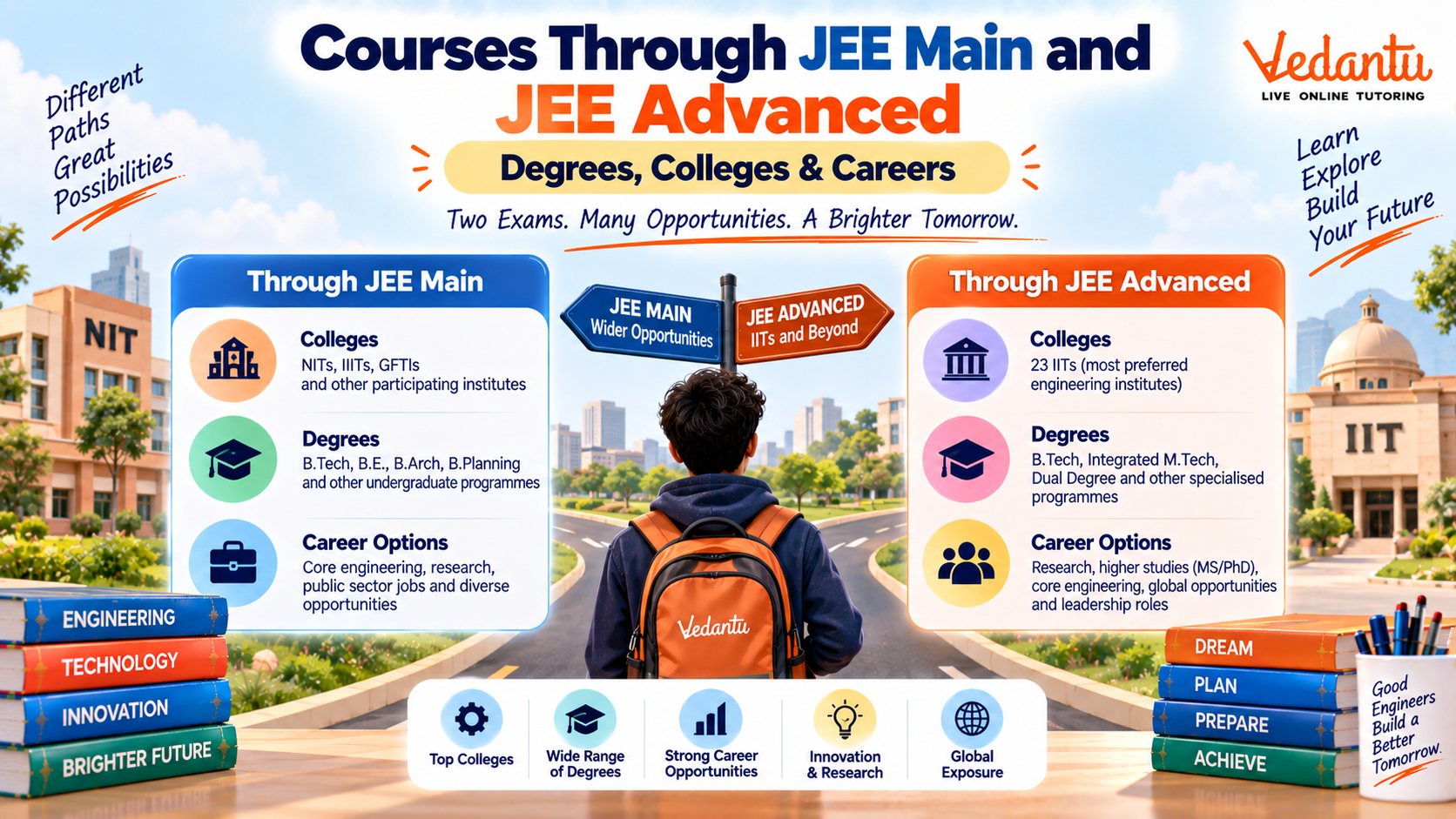
JEE Main and JEE Advanced open routes to engineering, architecture, planning and selected science degrees—not just Computer Science or Mechanical Engineering. JEE Main is the main entrance route for participating NITs, IIITs and other institutions, while JEE Advanced leads to undergraduate admission at IITs. Your actual options depend on the paper taken, rank, eligibility and available seats. The important decision is to choose a degree and college that suit both your interests and your longer-term career plans.
Visit Our Vedantu Learning Centres Near You
Which Courses Can You Join Through JEE Main and JEE Advanced?
The entrance route depends on the institution and programme, not just the degree name. For example, a B.Tech at an NIT generally uses JEE Main Paper 1, while a B.Tech at an IIT uses JEE Advanced. Architecture has a separate paper or aptitude-test requirement, depending on the institution.
| Entrance Route | Degree Options | Usual Duration | Institution or Admission Context |
|---|---|---|---|
| JEE Main Paper 1 | B.E. and B.Tech | 4 years | Participating NITs, IIITs, other GFTIs and additional accepting institutions |
| JEE Main Paper 1 | Selected integrated or dual-degree programmes | Often 5 years | Available only at institutions offering the specific programme |
| JEE Main Paper 2A | B.Arch | 5 years | Participating architecture institutions, including selected NITs and SPAs |
| JEE Main Paper 2B | B.Planning | 4 years | Participating institutions offering undergraduate planning |
| JEE Advanced | B.Tech and selected B.S. programmes | Usually 4 years | IITs offering the relevant engineering or science programme |
| JEE Advanced | B.Tech–M.Tech, B.S.–M.S. and selected integrated M.Sc. programmes | Usually 5 years | Selected IIT programmes; award structure varies |
| JEE Advanced plus qualification in AAT | B.Arch | 5 years | IIT architecture programmes covered by the applicable admission rules |
These are degree categories, not a promise that every participating college offers each option. For the application year, use the NTA information bulletin, JEE Advanced brochure, JoSAA business rules and seat matrix, and the relevant institute prospectus to confirm eligibility, programme availability and admission requirements.
Courses After JEE Main: Colleges and Admission Routes
For engineering, JEE Main Paper 1 provides access to the NIT+ system through Joint Seat Allocation Authority (JoSAA) counselling. This includes participating NITs, IIITs and other Government Funded Technical Institutes (GFTIs). Some state and private institutions also accept JEE Main scores but require their own applications or counselling.
- NITs: Institutions such as NIT Tiruchirappalli, NIT Karnataka Surathkal and NIT Warangal offer engineering programmes across multiple disciplines. The branch list differs by campus.
- Participating IIITs: These commonly offer computing, information technology and electronics-related programmes. IIIT Allahabad is one example; do not assume that every institution using “IIIT” follows an identical admission process.
- Other GFTIs: This group includes institutions with varied specialisations. Evaluate the exact department and degree rather than treating the group as one uniform college category.
- Architecture and planning institutions: Selected NITs and Schools of Planning and Architecture offer relevant programmes through the appropriate JEE Main Paper 2 route.
Vedantu’s overview of government engineering colleges accepting JEE Main scores can help you begin an institution shortlist. Separate that shortlist into colleges participating in JoSAA and those requiring another admission process so that an application is not missed.
Paper 1 does not replace Paper 2A or Paper 2B. A student interested in B.Arch or B.Planning needs the relevant examination route and subject eligibility. Also, qualifying for JEE Advanced through JEE Main is different from securing a seat at an NIT or IIIT.
Courses After JEE Advanced: More Than IIT B.Tech
JEE Advanced degree options include engineering, selected science programmes and certain integrated or dual degrees at IITs. IIT Bombay, IIT Delhi, IIT Madras and IIT Kharagpur are examples of participating institutions, but their programme lists are not interchangeable. A branch available at one IIT may not exist at another.
B.Tech, B.S. and Five-Year Programmes
A B.Tech focuses on an engineering discipline, combining scientific foundations with design, laboratories and applications. A B.S. may focus more strongly on a subject such as mathematics, physics, chemistry or economics, depending on the institute. Some science programmes include substantial computation and applied work, so the actual curriculum matters more than the abbreviation.
A dual degree combines specified qualifications, such as B.Tech and M.Tech. An integrated programme follows a combined academic structure leading to the stated award; it does not necessarily grant two separate degrees. Compare the final qualification, specialisation, research component, duration and permitted exit options before choosing a five-year course.
The Additional Requirement for IIT Architecture
For IIT B.Arch programmes covered by the Architecture Aptitude Test (AAT) route, students must qualify JEE Advanced and then qualify AAT. Under the JEE Advanced admission framework, seat allocation uses the JEE Advanced rank subject to AAT qualification, rather than a separate AAT rank. Taking JEE Main Paper 2A alone does not satisfy this IIT admission route.
If the two examinations still seem confusing, Vedantu’s JEE Main vs JEE Advanced comparison is a useful starting point for understanding their different roles before selecting degree options.
Engineering Branches and Career Options After JEE
JEE provides an admission route; it does not directly provide a career qualification. Career options develop through the degree, projects, internships, technical skills and, where necessary, further study or professional requirements. The following examples show how subjects studied can connect with work after graduation.
| Branch or Degree Area | What You Study | Possible Career Directions |
|---|---|---|
| Computer Science and Information Technology | Programming, algorithms, computing systems, databases and networks | Software development, systems engineering, cybersecurity and data-related roles |
| Electronics and Electrical Engineering | Circuits, signals, devices, control systems and power, with different emphasis by branch | Embedded systems, semiconductor design, communications, automation and power systems |
| Mechanical, Aerospace and Production Engineering | Mechanics, thermodynamics, design, fluids and manufacturing | Product design, manufacturing, thermal engineering, simulation and aerospace work |
| Civil Engineering | Structures, geotechnics, transport, water systems and construction | Infrastructure design, construction management, transport and water engineering |
| Chemical, Materials and Metallurgical Engineering | Processes, transport phenomena, material properties and production methods | Process engineering, energy, materials development and manufacturing research |
| B.S. and Integrated Science Programmes | Discipline-specific theory, mathematical methods, computation or laboratory research | Research, analytics, scientific computing and postgraduate specialisation |
| Architecture and Planning | Building design and studios in architecture; land use, transport and urban systems in planning | Architectural practice subject to registration requirements; urban, regional and transport planning |
These are possible pathways, not guaranteed job outcomes. Advanced research and some specialist roles may require postgraduate study. Similarly, moving from a non-computing branch into software usually requires additional programming practice and projects; it should not be treated as an automatic placement route.
How to Choose the Best Branch and College for You
There is no single best branch after JEE for every student. A popular course can still be a poor fit if you dislike its compulsory subjects. Compare real options as college–programme combinations, such as Electrical Engineering at one institution versus Computer Science at another.
- Read the curriculum beyond the first year. Look at compulsory subjects, laboratories and final-year work. Enjoying school chemistry does not automatically mean enjoying Chemical Engineering, which also involves substantial mathematics, physics and process analysis.
- Test your interest with a small task. Try an introductory programming exercise, a circuit activity, a mechanics design problem or a spatial drawing task. This is not an aptitude verdict, but it gives more useful evidence than branch popularity alone.
- Compare department-level opportunities. Examine laboratories, electives, project areas, internships and published placement information for the actual programme. A college-wide highest package says little about a typical outcome in a particular branch.
- Calculate the full commitment. Include tuition, hostel, mess, travel and the additional time involved in a five-year programme. Financial assistance has its own eligibility conditions.
- Choose a seat you can accept without a branch change. Branch-change policies vary, may be restricted and may not exist. Do not build your admission decision around an assumed transfer to Computer Science.
For example, a student strongly interested in circuits may prefer an electronics programme over a computing course chosen only for its reputation. Another student seeking research in mathematics may find a B.S. curriculum more suitable than an engineering branch. Both choices can be sensible when based on the actual coursework and opportunities.
From JEE Rank to Admission Through JoSAA
Eligibility, qualification, counselling and admission are separate stages. Meeting the conditions to take an examination does not automatically satisfy a college’s admission requirements. Qualifying an examination or receiving a rank also does not guarantee a seat.
- Establish your eligible routes. Match your examination paper and rank with the programmes you can apply for. Account for Class 12 subject and performance requirements, category documents and any programme-specific restrictions.
- Build an acceptable shortlist. Include ambitious options and more attainable alternatives, but list only courses you would genuinely consider joining.
- Read historical cutoffs correctly. Match the institute, programme, year, round, category, seat pool and quota. A category rank must not be compared with an OPEN-seat closing rank, which uses the Common Rank List.
- Fill choices in your true preference order. JoSAA considers choices in order, subject to rank, eligibility and seat availability. Putting a less-preferred “safe” option first can prevent allocation to a preferred option below it.
- Complete every required acceptance step. Follow the applicable deadlines for payment, document upload, responses to verification queries and reporting. Understand freeze, float and slide before selecting an option.
- Track routes outside JoSAA separately. State counselling, institution-level admissions and CSAB special rounds have their own rules. CSAB special rounds concern eligible vacant NIT+ seats, not IIT seat allocation.
Vedantu’s JEE Main rank vs college explanation can support your initial shortlist, but historical closing ranks are indicators rather than admission assurances. For the IIT route, its explanation of admission using the JEE Advanced scorecard provides a related starting point; the scorecard itself is not a seat allotment letter.
Using Vedantu Resources Alongside Other Learning Options
Vedantu’s linked JEE comparison and admission explainers are useful for students who need to understand entrance routes before discussing college choices with parents or teachers. Use them to clarify terminology, prepare a shortlist and identify questions about degrees or counselling. Official admission documents remain the authority for binding rules and deadlines.
For this decision, reading-based resources support independent research; a discussion with a teacher or counsellor can help you examine personal interests and trade-offs. Exam preparation is a different need: self-study requires you to organise practice and review errors, while the usefulness of any coaching course depends on its actual teaching, feedback and support. Choose preparation support for the gaps in your learning—not because it appears to promise a particular college or branch.
Summary
JEE Main offers routes to engineering, architecture and planning at participating institutions, while JEE Advanced opens IIT engineering, selected science, integrated and dual-degree options, with AAT qualification additionally required for the relevant architecture route. Choose by curriculum, interest, affordability and realistic admission possibilities—not branch popularity alone. Vedantu’s JEE comparison and admission resources can support your initial research. Next, arrange acceptable college–programme combinations in preference order and use official admission documents to complete the process correctly.
FAQs on Courses Through JEE Main and JEE Advanced: Degrees, Colleges & Career Paths
1. What are the different degrees offered through JEE Main and JEE Advanced?
JEE Main and JEE Advanced exams provide pathways to various undergraduate degrees in engineering and related fields. Common degrees include:
- B.Tech (Bachelor of Technology)
- B.E. (Bachelor of Engineering)
- B.Arch (Bachelor of Architecture) – through JEE Main Paper 2
- B.Plan (Bachelor of Planning) – through JEE Main Paper 3
- Dual Degree Programs (B.Tech + M.Tech, B.S. + M.S.) – offered by select IITs
2. Which colleges accept JEE Main 2027 and JEE Advanced 2027 scores?
JEE Main 2027 scores are accepted by:
- All National Institutes of Technology (NITs)
- Indian Institutes of Information Technology (IIITs)
- Government-funded Technical Institutes (GFTIs)
- Several state and private engineering colleges
- All 23 Indian Institutes of Technology (IITs) across the country
3. What are the key differences between JEE Main and JEE Advanced?
JEE Main is the first stage and is required for admission to NITs, IIITs, and GFTIs. JEE Advanced is for those seeking admission to IITs. Differences include:
- Eligibility: JEE Main can be attempted by all eligible students after Class 12. Only top performers in JEE Main qualify for JEE Advanced.
- Exam Pattern: JEE Advanced is generally considered more challenging, with a different question style and marking scheme.
- Accepted By: JEE Main: NITs, IIITs, GFTIs, and more; JEE Advanced: IITs only.
4. Which courses can I pursue at IITs through JEE Advanced?
With a JEE Advanced rank, students can pursue:
- B.Tech and B.S. programs in various engineering and science disciplines
- Dual Degree (B.Tech + M.Tech, B.S. + M.S.) programs
- Integrated M.Sc. and other interdisciplinary courses
5. Are architecture courses offered through JEE Main?
Yes, architecture aspirants can apply for B.Arch and B.Plan programs through JEE Main Paper 2 and Paper 3. Participating colleges include NITs, SPAs, and several other institutes. Admission is based on Paper 2 or 3 scores along with eligibility criteria.
6. How are seat allotments conducted for JEE Main and Advanced qualified candidates?
JoSAA (Joint Seat Allocation Authority) conducts centralized counseling for JEE Main and JEE Advanced qualified students. Key points:
- Registrations, choice filling, and seat allocations are completed online
- All rounds are based on merit, preference, and reservation categories
- Different rounds are conducted for NIT+ system and IITs
7. What career opportunities are available after completing a course through JEE?
Graduates from NITs, IITs, and other JEE-participating institutes have diverse career options:
- Core engineering roles in leading companies
- Research and development positions
- Public sector, government, and civil services
- Entrepreneurship opportunities
- Higher studies (M.Tech, MS, MBA, PhD)
8. Can diploma holders get lateral entry admission through JEE exams?
Generally, JEE Main and JEE Advanced do not offer lateral entry admission for diploma holders into the second year. Admission is for the first year of undergraduate programs. Separate state or university-level lateral entry exams are usually held for diploma holders.
9. Are there reservation policies in JEE seat allocation?
Yes, reservation policies are strictly followed as per government guidelines. Reserved categories include:
- OBC-NCL
- SC (Scheduled Castes)
- ST (Scheduled Tribes)
- GEN-EWS (Economically Weaker Section)
- PwD (Persons with Disabilities)
10. How many times can I attempt JEE Main and JEE Advanced?
JEE Main can be attempted up to three consecutive years from passing Class 12, with multiple sessions each year. JEE Advanced can be attempted a maximum of two times in two consecutive years. Attempt limits are subject to eligibility and current official exam guidelines.
11. What is the eligibility criteria for applying to JEE Main 2027 and JEE Advanced 2027?
For JEE Main 2027:
- Completion of 10+2 or equivalent with Physics, Chemistry, and Mathematics
- Satisfying minimum qualifying marks criteria (as stated in the official brochure)
- Qualify through JEE Main and feature in the top percentile (as per exam rules)
- Meet age and attempt limits specified by the authority
12. Can foreign nationals apply for JEE Main and JEE Advanced?
Yes, foreign nationals can apply for both JEE Main and JEE Advanced. Key points:
- Specific application procedures and eligibility norms apply
- Foreign national category seats are available at select institutes
- Applicants should refer to the latest information bulletin for detailed requirements



