



Which Medical Courses Can You Pursue After NEET 2027?
Your options after NEET 2027 extend beyond MBBS, but not every healthcare degree uses the same admission route. MBBS, BDS and the main AYUSH undergraduate courses require NEET qualification, while nursing, veterinary and allied health admissions depend on the course and institution. The important decision is not simply which seat your rank might fetch. It is which profession you want to enter, whether you meet its eligibility requirements, and whether the training and total cost suit your circumstances.
Discover Our Classes With A Guided Centre Tour
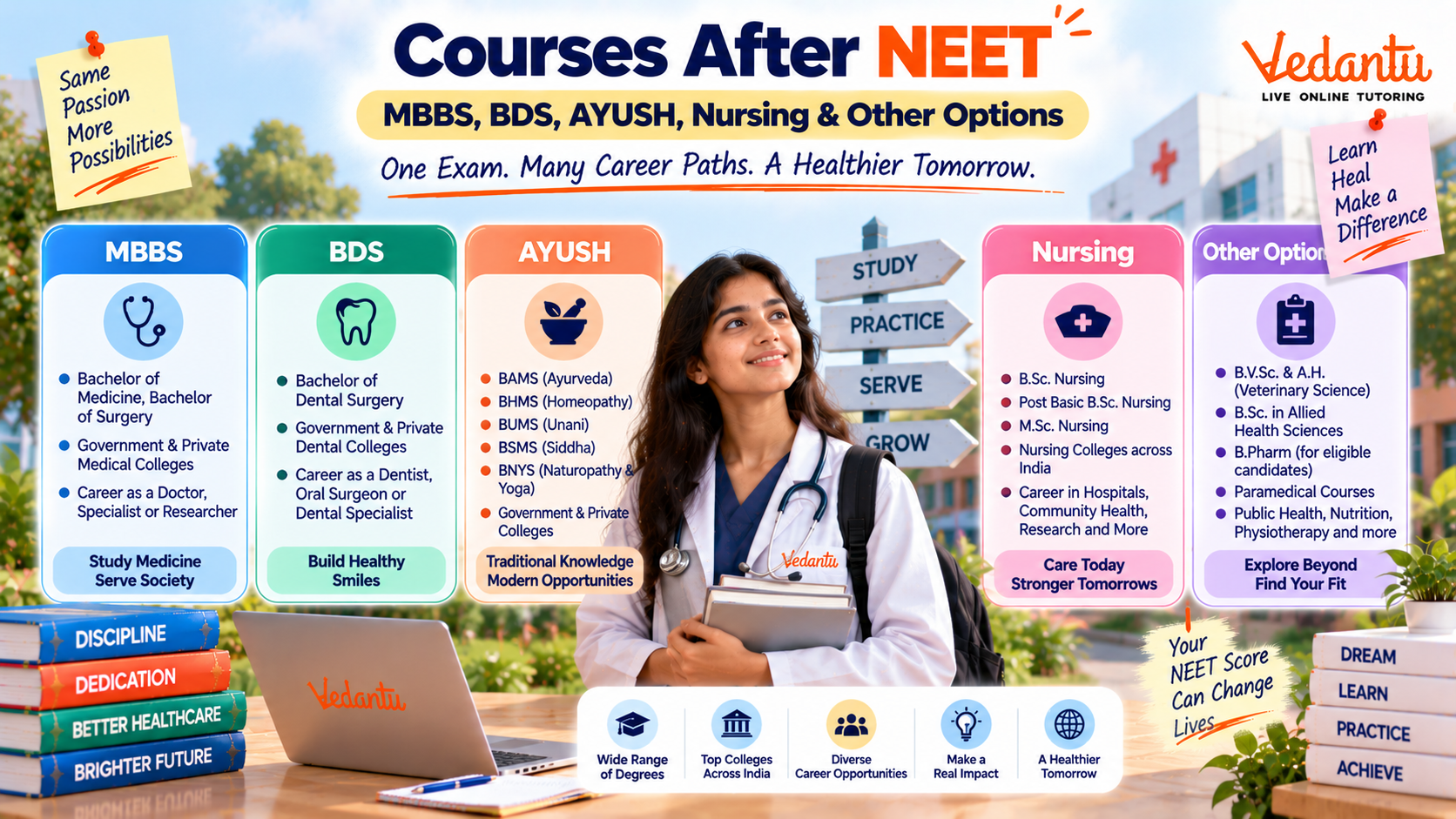
Courses After NEET 2027: Degrees, Duration and Admission Routes
The table below separates degrees that require NEET from options where its use is limited or institution-specific. Durations describe the standard course structure, including compulsory internship where indicated; they do not include later postgraduate study.
| Course | Standard Duration | Role of NEET | Main Professional Direction |
|---|---|---|---|
| MBBS — Bachelor of Medicine and Bachelor of Surgery | 5.5 years, including a one-year internship | Required for admission in India | Modern medicine; specialist training requires further qualifications |
| BDS — Bachelor of Dental Surgery | 5 years, including a one-year internship | Required | Dentistry and oral healthcare |
| BAMS — Bachelor of Ayurvedic Medicine and Surgery | 5.5 years, including internship | Required | Ayurveda |
| BHMS — Bachelor of Homoeopathic Medicine and Surgery | 5.5 years, including internship | Required | Homoeopathy |
| BUMS — Bachelor of Unani Medicine and Surgery | 5.5 years, including internship | Required; additional language-related eligibility can apply | Unani medicine |
| BSMS — Bachelor of Siddha Medicine and Surgery | 5.5 years, including internship | Required; Tamil-related requirements can apply | Siddha medicine |
| B.Sc. Nursing | 4 years | Used by selected institutions or admission routes, not universally | Nursing and patient care |
| B.V.Sc. & AH — Bachelor of Veterinary Science and Animal Husbandry | 5.5 years, including internship | Used for VCI All India Quota admissions; other routes follow applicable rules | Animal healthcare and veterinary practice |
| Physiotherapy, pharmacy and allied health degrees | Varies by degree and prescribed internship | No single common NEET admission rule across these programmes | Rehabilitation, medicines, diagnostics and technical healthcare roles |
For the 2027 admission cycle: use the NTA NEET UG information bulletin for examination eligibility and the relevant MCC, AACCC, state, VCI or institution prospectus for admission requirements, participating seats, fees and schedules. The established routes described here should not be treated as a confirmed 2027 seat matrix or counselling timetable.
MBBS and BDS: Choose Between Medicine and Dentistry
MBBS admission through NEET
MBBS is the undergraduate route into modern medical practice. Students study subjects such as anatomy, physiology and pathology before progressing through clinical training in areas including medicine, surgery, paediatrics and obstetrics and gynaecology. Completing the degree, internship and applicable registration requirements is different from qualifying as a specialist.
Choose MBBS because you want the responsibilities of medical practice, not only because it is a familiar first preference. Training involves substantial patient contact, demanding clinical postings and continued learning. A career in a particular specialty usually requires additional postgraduate training and selection.
BDS courses after NEET
BDS focuses on teeth, gums, oral disease and related clinical procedures. It can suit students who enjoy precise hands-on work and sustained patient interaction. Dental graduates may pursue clinical roles, further study or practice within the applicable registration framework.
BDS is a distinct profession, not a shorter version of MBBS. When comparing dental colleges, look at patient inflow, supervised clinical work, equipment and internship exposure. If private practice is a long-term goal, allow for the additional cost of a clinic and equipment rather than considering tuition alone.
AYUSH Courses: Eligibility and Professional Scope
BAMS, BHMS, BUMS and BSMS are NEET-based undergraduate options, but they train students in different systems of medicine. Their eligibility generally involves the prescribed Class 12 science subjects, minimum marks, age conditions and NEET qualification. Course-specific language requirements are particularly relevant when considering Unani or Siddha programmes.
- BAMS: Consider this if you have a genuine interest in Ayurveda and its curriculum and clinical approach.
- BHMS: Understand the homoeopathic curriculum and the professional scope attached to its qualification before choosing it.
- BUMS: Review both the Unani curriculum and the applicable language requirements before including colleges in your preference list.
- BSMS: Consider your interest in Siddha medicine alongside the language and clinical setting in which you will train.
An AYUSH degree is not interchangeable with MBBS. Registration, professional scope and permitted practice depend on the qualification and applicable law. Do not select an AYUSH course on the assumption that it automatically permits the same practice as an MBBS qualification.
BNYS, or Bachelor of Naturopathy and Yogic Sciences, should not automatically be grouped under the same NEET admission rules as BAMS, BHMS, BUMS and BSMS. Its admission route depends on the applicable state or university requirements.
Nursing Courses After NEET: Where the Score Matters
NEET is not a universal entrance requirement for B.Sc. Nursing. Selected institutions use NEET scores, while others follow separate entrance or admission processes. A NEET score therefore does not make you eligible for every nursing college, and not qualifying NEET does not automatically close every nursing route.
B.Sc. Nursing prepares students for nursing assessment, patient monitoring, medication administration within professional protocols, health education and coordinated care. It suits learners who want regular bedside involvement and can handle practical training, teamwork and shift-based work.
Nursing has its own academic, age and medical-fitness requirements. Some admission routes also have institution-specific conditions or additional selection stages. GNM and ANM are separate nursing qualifications and should not be treated as equivalent to a B.Sc. Nursing degree or assumed to share its admission process.
Veterinary and Other Healthcare Options
B.V.Sc. & AH is worth considering if your interest lies in animal health rather than human medicine. Veterinary education includes clinical care, disease prevention and animal husbandry. NEET is used for Veterinary Council of India All India Quota admissions, but students must distinguish that process from other state or university admission routes.
Other options include physiotherapy, occupational therapy, optometry, medical laboratory technology, medical imaging technology and pharmacy. These lead to different roles: rehabilitation is not the same as diagnosis, laboratory work or dispensing and managing medicines. They are healthcare career options, but should not all be labelled “medical courses through NEET counselling”.
If you want to keep a parallel application plan, Vedantu’s overview of medical courses without NEET, their eligibility and career scope can support your initial research. Use the exact college prospectus to establish whether its programme requires NEET, another entrance test or qualifying-examination merit.
Eligibility, Qualification and Admission Are Different
A common mistake is to assume that clearing NEET guarantees a medical seat. Admission involves several separate filters, and meeting one does not remove the others.
- Examination eligibility: You must satisfy the applicable conditions for NEET UG. Under the established framework, the minimum age is 17 by 31 December of the admission year, alongside prescribed qualifying-examination requirements.
- Course eligibility: The degree may require particular subjects, minimum marks, language qualifications or medical fitness. MBBS, BDS and AYUSH eligibility is not automatically identical to nursing or veterinary eligibility.
- NEET qualification: Meeting the applicable qualifying percentile allows consideration for routes that require it. The corresponding marks can change between years.
- Counselling eligibility: Category, domicile, quota and institution-specific conditions determine which seats you can seek.
- Seat allotment and admission: Rank, choices, available seats and reservation rules affect allotment. Document verification, payment and reporting complete the admission process.
The qualifying cutoff is not the admission cutoff. A college’s closing rank reflects a particular course, category, quota and counselling round. There is no single “safe NEET score” that guarantees MBBS, BDS or AYUSH admission across all institutions.
How NEET Counselling Connects You to a Course
There is no single counselling registration that covers every NEET-linked degree. NTA conducts the examination; the relevant counselling authorities and institutions handle seat allocation and admission.
- MBBS and BDS: MCC handles All India Quota and specified central, deemed-university and institutional counselling categories. State authorities handle seats within their respective counselling jurisdiction.
- AYUSH: AACCC handles specified All India Quota, central and deemed-university AYUSH seats. State authorities conduct counselling for seats under their jurisdiction.
- B.Sc. Nursing: Follow the route specified for the institution. Only participating seats fall within a particular counselling process.
- Veterinary: VCI counselling and relevant state or university processes have their own application requirements.
The usual sequence is registration, fee payment, choice filling, choice locking where required, allotment and reporting. Round-specific rules can affect upgrades, resignation, security deposits and eligibility for later rounds. Do not assume that a rule from one counselling authority applies to another.
Place choices in your genuine preference order and include only courses and colleges you would be willing and able to join. Vedantu’s overview of MBBS and BDS seats through NEET can provide background, but the applicable official seat matrix determines which seats are actually offered in a counselling round.
Build a Shortlist Around Career Fit, Rank and Total Cost
Start with the work you want to do, then assess realistic admission possibilities. A course you dislike does not become a good choice simply because its closing rank is within reach.
- Choose professional roles first: Decide whether you prefer human medicine, dentistry, a specific AYUSH system, nursing, animal care or a technical healthcare role. Read the curriculum and speak to practising professionals where possible.
- Compare like-for-like rank data: Use historical closing ranks only when the course, category, quota and round match your situation. Treat them as planning evidence, not a prediction for 2027.
- Calculate the full financial commitment: Include tuition across all years, hostel, mess, instruments, examination charges, deposits and travel. Read bond, service-obligation and discontinuation conditions before accepting a seat.
- Assess the clinical environment: Examine recognition for the exact programme, attached hospital facilities, patient exposure, laboratories and internship arrangements. A college name alone does not establish training quality.
- Maintain an acceptable backup: Track separate applications for suitable nursing or allied health programmes. If considering another NEET attempt, weigh your score gap, preparation needs, finances and wellbeing against joining a course you genuinely want.
For initial institution research, use Vedantu’s list of medical colleges in India accepting NEET to identify names to investigate. Narrow that list using the official recognition status, current admission route, clinical facilities and a written fee schedule rather than reputation alone.
Using Vedantu Resources Alongside Your Admission Planning
Vedantu’s linked course, college and seat explainers can support the research stage: understanding degree names, identifying alternative routes and preparing questions for colleges. A student awaiting counselling can turn that reading into a shortlist with columns for course, authority, eligibility, total cost and personal preference.
Keep admission research separate from preparation support. Reading resources suit students who can organise their own research; live classes may help a student who needs scheduled teaching and interaction, while recorded-only study requires more independent pacing. If another NEET attempt is part of your plan, assess the exact Vedantu programme or other coaching option on its published syllabus coverage, teaching format, doubt support, tests and access terms. No learning format replaces official counselling or guarantees admission.
Summary
Courses after NEET 2027 include MBBS, BDS and the main AYUSH degrees, with nursing and veterinary options following route-specific rules. Allied health programmes provide further possibilities but do not share one universal NEET requirement. Choose by professional interest, eligibility, clinical training and total cost—not marks alone. Use Vedantu’s linked explainers to organise your research, then build your preference list around the applicable official admission documents and colleges you would genuinely join.
FAQs on Courses After NEET 2027: Complete Guide to Medical, Dental, AYUSH & Allied Streams
1. What are the main courses available after NEET 2027?
After qualifying NEET 2027, students can pursue various medical and healthcare programs in India:
- MBBS (Bachelor of Medicine and Bachelor of Surgery)
- BDS (Bachelor of Dental Surgery)
- BAMS (Bachelor of Ayurvedic Medicine and Surgery)
- BHMS (Bachelor of Homeopathic Medicine and Surgery)
- BUMS (Bachelor of Unani Medicine and Surgery)
- BNYS (Bachelor of Naturopathy and Yogic Sciences)
- B.V.Sc & AH (Bachelor of Veterinary Science & Animal Husbandry)
- B.Sc Nursing (in select colleges requiring NEET)
2. Is MBBS the only career option after clearing NEET 2027?
No, MBBS is one of several professional degrees available after NEET 2027. Students can choose from:
- BDS
- BAMS
- BHMS
- BUMS
- BNYS
- B.V.Sc & AH
- B.Sc Nursing (where NEET is required)
3. What is the eligibility for admission to MBBS and BDS after NEET 2027?
For MBBS and BDS admissions after NEET 2027:
- Minimum 17 years of age (as of December 31, 2027)
- Completed 10+2 with Physics, Chemistry, Biology/Biotechnology, and English
- Meet the required NEET cutoff score for that year
4. Can I get admission to B.Sc Nursing courses through NEET 2027?
Yes, several reputed institutes now use NEET scores for B.Sc Nursing admissions from 2027 onwards.
- Institutes like AIIMS, JIPMER, and some government medical colleges require NEET rank for B.Sc Nursing seats
- Eligibility: 10+2 with Physics, Chemistry, Biology, and English; NEET qualification
- The final list of institutes is released annually by the concerned authorities
5. What are the AYUSH courses available after NEET 2027?
AYUSH courses refer to medical degrees in traditional and alternative systems:
- BAMS (Ayurveda)
- BHMS (Homeopathy)
- BUMS (Unani)
- BNYS (Naturopathy & Yogic Sciences)
- BSMS (Siddha, mainly in Tamil Nadu)
6. Can I pursue veterinary science after NEET 2027?
Yes, Bachelor of Veterinary Science & Animal Husbandry (B.V.Sc & AH) is offered through NEET 2027.
- Requires NEET qualification and participation in the respective counseling
- Seats available in state and central veterinary colleges
7. Are there any paramedical courses available through NEET 2027?
Some premier colleges use NEET scores for select paramedical courses.
- Programs include B.Sc (Medical Lab Technology), B.Sc (Radiology), B.Sc (Operation Theatre Technology) and others
- Not all colleges use NEET; check institute-specific notifications
8. What is the counseling process after NEET 2027 for MBBS/BDS/AYUSH?
After NEET 2027 results, candidates must participate in centralized counseling:
- MCC (Medical Counseling Committee): For 15% All India Quota, deemed universities, AIIMS, JIPMER
- State Counseling Authorities: For 85% state quota and private colleges
- AYUSH Admissions Central Counseling Committee (AACCC): For BAMS, BHMS, BUMS, BNYS
9. What are some alternative career options if I do not get a medical seat through NEET 2027?
If you do not secure a seat in MBBS, BDS, or AYUSH through NEET 2027, consider these alternatives:
- Allied health sciences (e.g., B.Sc Medical Imaging, B.Sc Anaesthesia)
- Bachelor of Physiotherapy (BPT)
- Bachelor of Occupational Therapy (BOT)
- Clinical research, Healthcare management, Medical biotechnology
- Other life science degree programs
10. Is NEET 2027 compulsory for MBBS/medical admissions abroad?
Yes, NEET qualification is mandatory for Indian students seeking MBBS admission abroad.
- Students must qualify NEET 2027 and obtain an Eligibility Certificate from NMC (National Medical Commission)
- It is required for enrollment in foreign medical universities as per government norms
11. How many attempts are allowed for NEET 2027?
As per the latest guidelines, there is no restriction on the number of NEET attempts.
Students can appear for NEET any number of times, subject to age criteria and educational qualification.
12. What are the minimum marks required in NEET 2027 to qualify for medical courses?
The minimum qualifying marks (cutoff) in NEET 2027 vary by category:
- General (UR): 50th percentile
- SC/ST/OBC: 40th percentile
- General-PwD: 45th percentile



