



How Personalized Online IB and IGCSE Tutoring Helps Students Succeed
IB and IGCSE online tutoring is personalized academic support delivered through live virtual classes for students studying international curricula. For families looking for flexible, focused help, it combines subject expertise, one-on-one attention, and tailored lesson planning to strengthen concepts, improve confidence, and support better study habits.
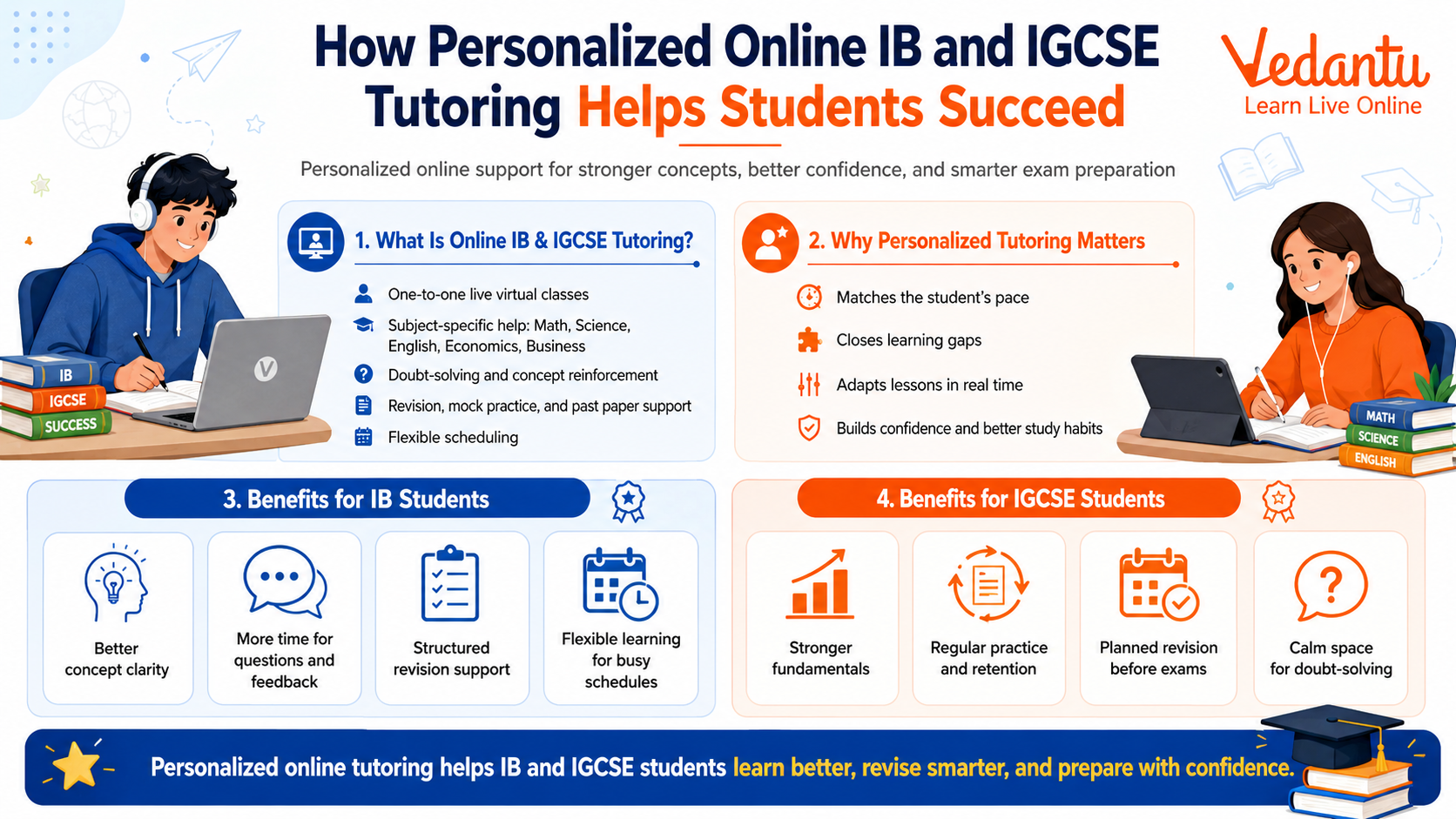
This matters because IB and IGCSE learners often balance demanding syllabi, varied assessment styles, and different learning speeds. A well-matched tutor can help students close learning gaps, revise more effectively, and prepare with more clarity than a one-size-fits-all approach usually allows.
What Is IB and IGCSE Online Tutoring?
Online IB tutoring is personalized support for students following the International Baccalaureate curriculum, while online IGCSE tutoring supports learners studying the Cambridge IGCSE pathway. In both cases, teaching happens through live virtual sessions and is usually adapted to the student’s subject needs, pace, and academic goals.
A custom tutoring plan commonly includes:
- One-on-one lessons for focused explanation and practice
- Subject-specific support in areas such as Math, Science, English, Economics, and Business
- Doubt-solving, topic revision, and concept reinforcement
- Exam preparation through revision help, mock practice, and past paper work
- Flexible scheduling for students in different routines or time zones
Why Personalized Online Tutoring Matters
Not every student learns at the same speed, and international curricula can increase pressure when expectations are high across multiple subjects. Some students need more time to build foundations, while others need stretch support for advanced performance, assessment planning, or revision strategy.
Personalized online tutoring helps because lessons can be adjusted in real time. If a student is struggling with a concept, the tutor can slow down, reteach, and assign targeted practice. If the student is already confident, the tutor can move into deeper application, exam technique, or higher-level problem solving.
This individual attention is one reason many parents compare private support with larger class formats. Related reading on why personalized learning is important and why individual attention matters can help families understand how tailored teaching supports steady academic growth.
Benefits of Online IB Tutoring for Students
For IB learners, personalized support can be especially useful in demanding subjects and assessment-heavy terms.
- Lessons can focus on concept clarity instead of covering material at a generic pace
- One-on-one IB tutoring gives students more time to ask questions and review mistakes
- Tutors can support structured revision and exam preparation for specific subjects
- Students can build confidence through regular guided practice and feedback
- Online scheduling adds flexibility for busy school calendars and international routines
How Online IGCSE Tutoring Supports Academic Growth
An IGCSE private tutor can help students build stronger fundamentals while also preparing them for subject-wise assessments. This is useful for learners who need more regular practice, clearer explanations, or a revision plan that breaks larger topics into manageable steps.
Common advantages of online IGCSE tutoring include:
- Stronger foundational understanding in core subjects
- Regular practice to improve retention and problem-solving confidence
- Structured revision plans before school tests and final exams
- Help with doubt-solving, assignments, and topic review
- A calmer learning space for students who hesitate to speak in groups
One-on-One IB Tutoring vs Group Learning
Both formats can support learning, but they serve different needs. Group classes may work well for broad coverage and peer exposure, while one-on-one IB tutoring is often better when a student needs focused intervention, customized pacing, or subject-specific exam support.
| Factor | One-on-One Tutoring | Group Learning |
|---|---|---|
| Pace | Adjusted to one student | Shared pace for the class |
| Attention | High individual attention | Teacher attention is divided |
| Doubt-solving | Immediate and targeted | May be limited by time |
| Lesson planning | Customized learning plan | Standardized for the group |
Subjects Covered by Online IB and IGCSE Tutors
A qualified IB IGCSE tutor may support one subject deeply or work across related areas depending on curriculum expertise. Families often look for help in subjects with heavy conceptual load, regular assessment demands, or cumulative skill development.
Commonly covered subjects include:
- Mathematics
- Physics, Chemistry, and Biology
- English language and literature support
- Economics and Business Studies
- Humanities and social science subjects where applicable
- Exam revision and topic-wise practice support
How a Good Tutor Supports More Than Marks
A strong tutoring relationship is not only about reteaching chapters. Good tutors help students organize study time, notice recurring mistakes, build revision discipline, and approach assessments with better clarity. Over time, this can improve independence as much as short-term performance.
This is one reason many families prefer personalized online tutoring over generic extra classes. When sessions are planned around a learner’s actual needs, students often become more willing to ask questions, review weak areas, and stay consistent with practice. Parents exploring broader tutoring choices may also find value in private home tuitions vs group tuition and how to choose the right online tutor for your child.
How to Choose the Right IB IGCSE Tutor
When selecting an online tutor, families should look beyond convenience alone.
- Check the tutor’s familiarity with the relevant international curriculum
- Look for subject-specific teaching experience, especially in exam-focused areas
- Ask whether lessons are adapted to the student’s pace and goals
- Understand how progress, doubts, and revision are handled between sessions
- Choose scheduling that fits school workload and family routine
- Prefer clear communication with both student and parent when appropriate
Who Benefits Most from Custom Online Support?
IB and IGCSE online tutoring can be helpful for many types of learners.
- Students facing concept gaps in one or more subjects
- Learners preparing for tests, mocks, or final assessments
- Students who need a quieter space for asking questions
- Advanced learners who want deeper challenge and practice
- Busy students who need flexible online scheduling
- International students managing different routines or time zones
Building a Stronger Learning Journey
The most effective support usually starts with a clear understanding of the student’s current level, target areas, and workload. From there, tutoring can focus on a practical learning plan with regular revision, focused practice, and steady feedback rather than last-minute preparation alone.
Families can also support this journey at home by encouraging routine, realistic goals, and consistent review. Useful strategies from broader academic planning resources, such as how to prepare a timetable for studying, can complement tutoring and help students use their sessions more effectively.
Conclusion
Custom online tutoring for IB and IGCSE students works best when it is personal, structured, and aligned with the learner’s real academic needs. Whether a student needs foundational help, stronger revision habits, or more focused exam preparation, one-on-one support can create a more confident and manageable learning path. For parents, the goal is not simply extra classes, but the right kind of guidance that helps a child understand better, study smarter, and progress with greater confidence.
FAQs on Transform Your Child’s Learning with Custom IB & IGCSE Tutoring
1. What is IB and IGCSE online tutoring?
IB and IGCSE online tutoring provides live, personalised academic support for students following International Baccalaureate or International General Certificate of Secondary Education programmes. A tutor adapts lessons to the learner’s curriculum, subjects, current understanding, pace and academic goals.
2. How does personalised online tutoring help IB and IGCSE students?
Personalised online tutoring helps IB and IGCSE students address specific learning gaps instead of following a standard class pace. Key benefits include:
- Clear explanations of difficult concepts
- Targeted practice based on individual weaknesses
- Immediate doubt-solving and constructive feedback
- Structured revision for tests, mocks and final examinations
- Improved confidence, study habits and independent learning
3. What subjects can an online IB or IGCSE tutor teach?
Online IB and IGCSE tutors can provide subject-specific support based on their curriculum expertise. Common subjects include Mathematics, Physics, Chemistry, Biology, English, Economics and Business Studies. Support may also cover humanities, language and literature, topic-wise revision, assignments and examination practice where applicable.
4. Is one-on-one tutoring better than group learning for IB and IGCSE students?
One-on-one tutoring is often more suitable when a student needs individual attention, customised pacing or focused examination support, while group learning can be useful for broad coverage and peer interaction. In a private session, the tutor can concentrate on one learner’s doubts, recurring mistakes, subject requirements and revision priorities.
5. How does online tutoring support IB and IGCSE exam preparation?
Online tutoring supports exam preparation by combining syllabus-based revision with targeted practice and feedback. A tutor may help students:
- Identify high-priority topics and learning gaps
- Review concepts before attempting exam-style questions
- Practise past papers and timed responses
- Understand command terms, mark allocations and question requirements
- Analyse errors and improve examination technique
6. How do I choose the right IB or IGCSE online tutor?
Choose an IB or IGCSE tutor who understands the student’s specific programme, subject and level. Check the tutor’s curriculum familiarity, subject expertise, teaching experience, lesson customisation and approach to assessment. Families should also consider scheduling flexibility, progress reporting and whether the tutor communicates concepts clearly to the student.
7. How often should an IB or IGCSE student attend online tutoring?
The ideal tutoring frequency depends on the student’s needs, workload and examination timeline. One or two focused sessions per week may support regular concept-building, while temporary additional sessions may help before mocks or final examinations. A tutor should recommend a realistic schedule after assessing the learner’s current level, goals and available study time.
8. Can online tutoring help students with learning gaps and difficult topics?
Yes, online tutoring can help close learning gaps through diagnostic questioning, step-by-step explanations and targeted practice. The tutor can revisit prerequisite concepts, correct misconceptions, adjust the lesson pace and monitor progress before moving to more advanced IB or IGCSE topics.
9. Are past papers useful in IB and IGCSE online tutoring?
Past papers are useful when they are combined with concept revision and detailed feedback. They familiarise students with question formats, command terms, time limits and mark allocations. Tutors can use them to identify recurring errors, teach suitable response strategies and help learners apply subject knowledge under examination conditions.
10. Can IB and IGCSE online tutoring accommodate different time zones?
Online tutoring can accommodate students in different time zones when suitable tutor slots are available. Flexible scheduling allows international learners to plan sessions around school hours, activities and family routines. Before enrolling, families should confirm session timings, tutor availability and procedures for rescheduling classes.
11. How can parents monitor progress in online IB and IGCSE tutoring?
Parents can monitor progress through clear goals, regular feedback and measurable learning outcomes. Useful indicators include:
- Topics completed and concepts mastered
- Performance in assignments, quizzes and mock papers
- Reduction in repeated errors
- Improved confidence and independent problem-solving
- Tutor feedback on participation, revision and next steps



