






Elephant Seal Habitat, Diet, Lifespan, and Deep-Diving Adaptations
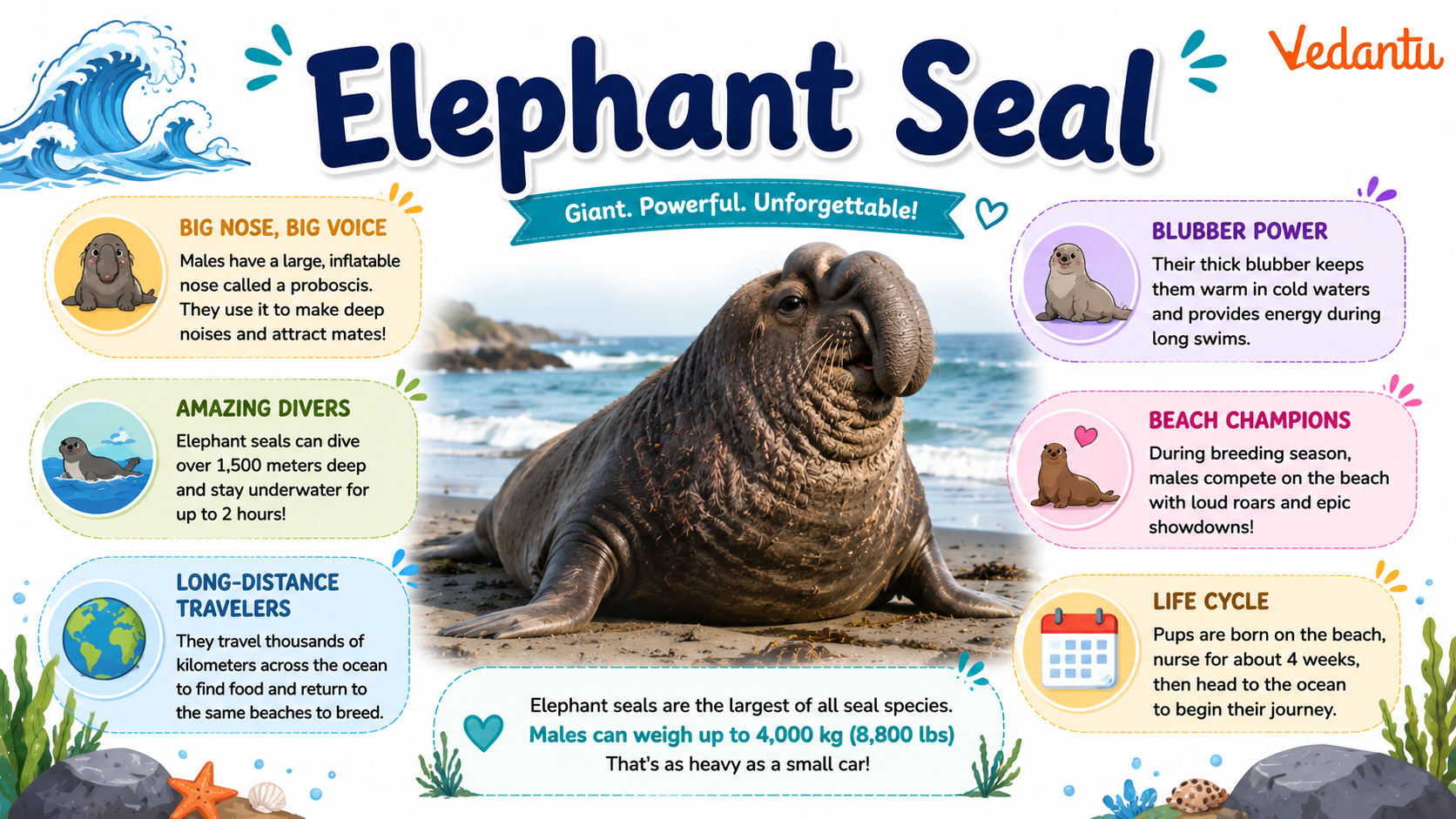
Quick Facts About Elephant Seal
| Feature | Details |
|---|---|
| Common Name | Elephant Seal |
| Scientific Name | Mirounga |
| Animal Group | Mammal (Marine Mammal) |
| Types | Northern Elephant Seal, Southern Elephant Seal |
| Length | Up to 6 meters (males) |
| Weight | Up to 4,000 kg (males) |
| Habitat | Cold coastal waters and beaches |
| Diet | Fish, squid, and other sea creatures |
| Lifespan | About 14–20 years |
| Conservation Status | Least Concern |
Appearance and Physical Characteristics
- Very large and heavy body with thick blubber (fat layer).
- Males have a long, inflatable nose that looks like an elephant’s trunk.
- Skin is wrinkled and usually grey or brown.
- Small front flippers and strong back flippers for swimming.
- Large dark eyes adapted for deep underwater vision.
Elephant Seal Habitat and Distribution
- Northern Elephant Seals: Found along the Pacific coast of North America.
- Southern Elephant Seals: Live around Antarctica and sub-Antarctic islands.
- Prefer cold waters but come to sandy or rocky beaches to breed.
- Spend nearly 80–90% of their life in the ocean.
Diet and Feeding Habits
Elephant Seal diet mainly includes fish, squid, rays, and small sharks.
They can dive deeper than 1,500 meters to find food in dark ocean waters.
They may stay underwater for 20–60 minutes during a single dive.
They are important predators and also prey for large sharks and killer whales.
Behaviour and Lifestyle
- Mostly solitary while hunting in the ocean.
- Gather in large groups called colonies during breeding season.
- Males fight fiercely for control of a group of females.
- Communicate using loud roars, grunts, and body movements.
- Move awkwardly on land but are powerful swimmers in water.
Elephant Seal Life Cycle
- Birth: Female gives birth to one pup on land.
- Pup Stage: The baby seal drinks rich mother’s milk and grows quickly.
- Weaning: After about 3–4 weeks, the mother leaves the pup.
- Juvenile Stage: Young seals learn to swim and hunt in the ocean.
- Adult Stage: Males grow much larger than females and develop the trunk-like nose.
What Makes Elephant Seals Special?
Southern elephant seals are the largest of all seal species.
They can dive deeper than most marine mammals.
A thick fat layer keeps them warm in icy waters.
Males use loud calls to defend their territory.
Types of Elephant Seals
- Northern Elephant Seal: Slightly smaller; found in California and Mexico coasts.
- Southern Elephant Seal: Larger; found near Antarctica.
Importance and Role in Nature
Help control fish and squid populations.
Provide food for top predators like orcas.
Studied to understand deep-sea diving and marine ecosystems.
Their health shows the condition of ocean environments.
Amazing Elephant Seal Facts
- Males can weigh as much as a small truck!
- They can hold their breath for nearly 2 hours.
- Their blood stores extra oxygen for deep dives.
- They migrate thousands of kilometres each year.
- They shed their fur and top layer of skin once a year in a process called moulting.
- They can slow their heart rate during deep dives.
Interesting Facts About Elephant Seals
- Male elephant seals are much bigger than females.
- Their nose helps make their voice louder and deeper.
- They were once hunted heavily for oil from their blubber.
- Today, they are protected by international laws.
Fun Facts for Kids
FAQs on Elephant Seal: Size, Behavior, and Ocean Life Explained
1. What is an Elephant Seal?
An Elephant Seal is a very large ocean mammal known for its huge size and long, trunk-like nose.
- It is a type of seal found in cold ocean waters.
- Male elephant seals have a big nose that looks like an elephant’s trunk.
- They belong to the group of marine mammals called pinnipeds.
- There are two species: Northern Elephant Seal and Southern Elephant Seal.
2. Why are they called Elephant Seals?
Elephant seals are named for the male’s large, trunk-like nose that looks like an elephant’s trunk.
- Only adult males grow this long nose, called a proboscis.
- The proboscis helps make loud roaring sounds during breeding season.
- These loud calls scare rivals and attract females.
3. How big do Elephant Seals get?
Elephant seals are the largest seals in the world.
- Male Southern Elephant Seals can grow up to 20 feet (6 meters) long.
- They can weigh as much as 8,800 pounds (4,000 kg).
- Females are much smaller but still very large marine mammals.
4. Where do Elephant Seals live?
Elephant seals live in cold ocean waters and come ashore to rest and breed.
- Northern Elephant Seals live along the Pacific coast of North America.
- Southern Elephant Seals live near Antarctica.
- They spend most of their time swimming in the open ocean.
5. What do Elephant Seals eat?
Elephant seals are carnivores that hunt for food deep in the ocean.
- They eat fish, squid, and other sea creatures.
- They can dive over 5,000 feet (1,500 meters) to find prey.
- They use their whiskers to sense movement in dark water.
6. How long can Elephant Seals stay underwater?
Elephant seals are amazing divers that can stay underwater for a very long time.
- They can hold their breath for up to 100 minutes.
- They dive deeper than most other seals.
- Their bodies store extra oxygen in their blood and muscles.
7. Are Elephant Seals dangerous?
Elephant seals are generally not dangerous but can be aggressive if disturbed.
- Large males may fight each other during breeding season.
- They can move quickly on land despite their size.
- People should always keep a safe distance from wild marine animals.
8. How do Elephant Seals reproduce?
Elephant seals reproduce by gathering in large breeding colonies on beaches.
- Males fight to become the dominant bull.
- One male may mate with many females.
- Females give birth to a single pup after about 11 months.
9. Are Elephant Seals endangered?
Elephant seals were once hunted heavily but are now protected and recovering.
- They were hunted for their blubber oil in the 1800s.
- Today, they are protected by wildlife laws.
- Most populations are stable, especially the Northern Elephant Seal.
10. What are some interesting facts about Elephant Seals?
Elephant seals have many amazing features that make them unique ocean animals.
- They are the deepest-diving seals in the world.
- Males can weigh as much as a small truck.
- They spend about 80–90% of their lives at sea.
- Pups are born with black fur called a lanugo coat.
