






What Do Basking Sharks Eat and How Big Do They Get?
The Basking Shark is one of the largest fish in the world and a true ocean giant. Even though it looks huge and a little scary with its wide-open mouth, it is completely harmless to humans. This slow-moving shark swims calmly near the surface, filtering tiny plankton from the water. In this page, explore amazing Basking Shark facts, habitat, diet, characteristics, life cycle, and importance in the marine ecosystem.
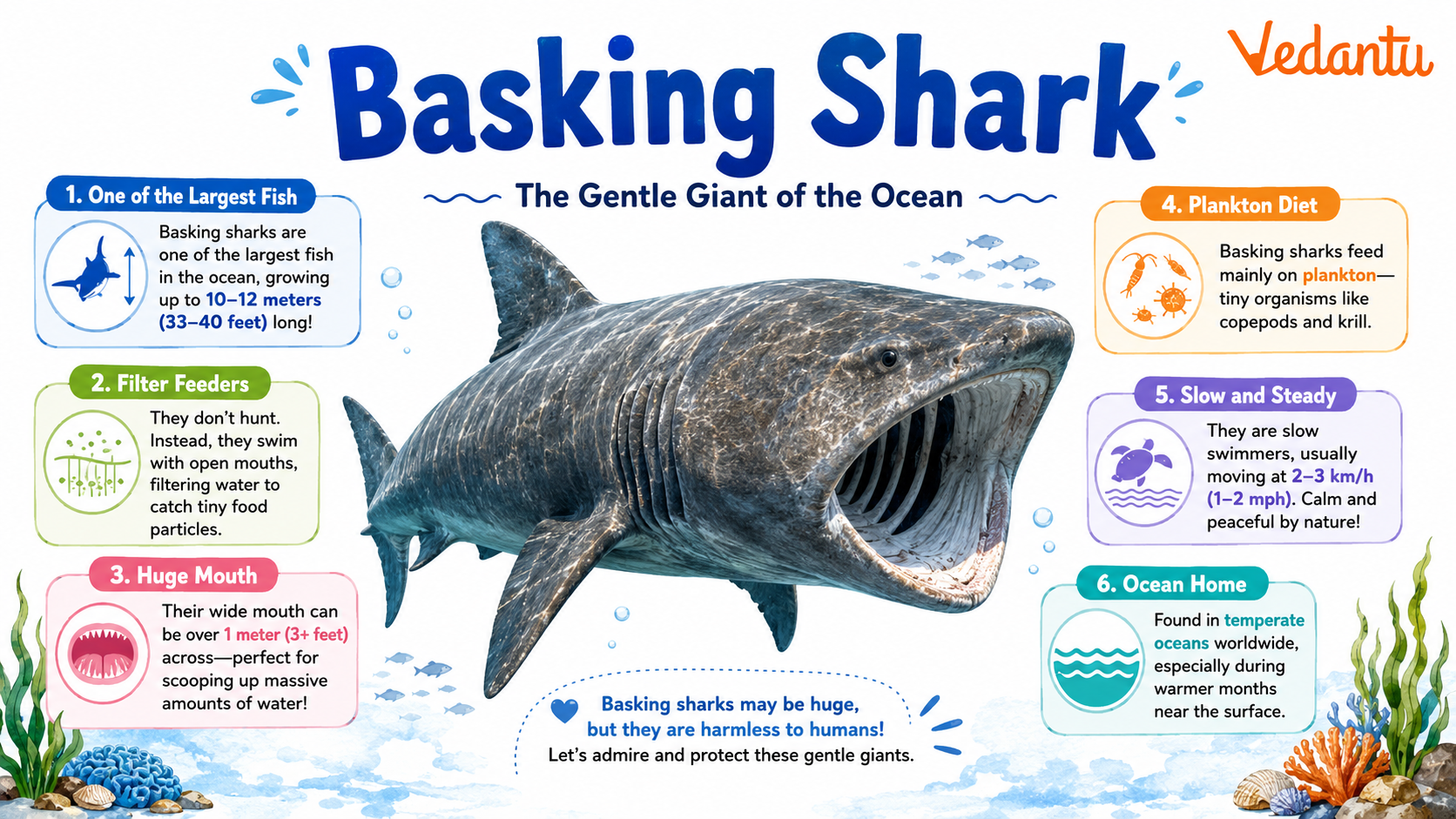
Quick Facts About Basking Shark
| Feature | Details |
|---|---|
| Common Name | Basking Shark |
| Scientific Name | Cetorhinus maximus |
| Animal Group | Fish (Cartilaginous Fish) |
| Size | Up to 10–12 metres long |
| Weight | Up to 5,000 kg or more |
| Diet | Plankton (tiny sea organisms) |
| Habitat | Cold and temperate oceans worldwide |
| Lifespan | About 50 years (estimated) |
| Conservation Status | Endangered |
Appearance and Physical Characteristics
- Very large, torpedo-shaped body.
- Grey-brown or dark grey skin.
- Huge mouth that can open over 1 metre wide.
- Five long gill slits that almost circle its head.
- Large triangular dorsal fin on its back.
- Strong tail fin for slow but powerful swimming.
Basking Shark Habitat and Distribution
- Found in the Atlantic, Pacific, and Indian Oceans.
- Prefers cold and temperate waters.
- Often seen near coastlines during summer.
- Swims near the surface while feeding.
- May move to deeper waters during winter.
Diet and Feeding Habits
What Does a Basking Shark Eat?
- Plankton
- Fish eggs
- Tiny crustaceans
- Small invertebrates
How Does It Feed?
- Swims slowly with its mouth wide open.
- Filters thousands of litres of water every hour.
- Traps plankton using gill rakers.
Behaviour and Lifestyle
- Generally solitary but sometimes seen in small groups.
- Slow swimmer compared to many other sharks.
- Non-aggressive and harmless to humans.
- Migrates seasonally to find food.
- May dive deep into the ocean when plankton levels are low.
Basking Shark Life Cycle
- Fertilisation: Internal fertilisation like other sharks.
- Development: Eggs hatch inside the mother’s body.
- Birth: Live young are born in the ocean.
- Growth: Young sharks grow slowly and take many years to mature.
- Adulthood: They can live up to 50 years or more.
What Makes the Basking Shark Special?
Only the Whale Shark is larger than the Basking Shark.
Its mouth can stretch very wide to filter food from water.
Unlike most sharks, it does not hunt big prey.
It is peaceful and rarely interacts with humans.
Importance and Role in Nature
Helps maintain balance in the marine food chain.
Plays a role in maintaining healthy marine ecosystems.
Their presence shows healthy plankton-rich waters.
Adds to the diversity of ocean life.
Amazing Basking Shark Facts
- It is the second-largest living fish in the world.
- Its liver can make up about 25% of its body weight.
- It can filter thousands of litres of seawater every hour.
- Its gill slits almost circle its entire head.
- It may migrate long distances across oceans.
- It has very small teeth compared to its body size.
- It has been known to leap partially out of the water.
Interesting Facts About Basking Shark
Fun Facts for Kids
- The Basking Shark looks scary but is actually gentle.
- It swims slowly like it is floating.
- It eats tiny sea creatures, not big fish.
- It can grow longer than a school bus!
- It loves plankton-rich waters.
FAQs on Basking Shark: The Gentle Giant of the Ocean
1. What is a Basking Shark?
The Basking Shark is a giant, slow-moving shark that feeds on tiny plankton in the ocean.
- It is the second-largest shark in the world after the Whale Shark.
- Its scientific name is Cetorhinus maximus.
- It swims with its mouth wide open to filter food from the water.
- It is often seen near the surface of temperate oceans.
2. How big can a Basking Shark grow?
A Basking Shark can grow up to 40 feet (12 meters) long, making it one of the largest fish on Earth.
- Average length: 20–26 feet.
- Weight: Up to 5 tons.
- Size is similar to a school bus.
- Despite its size, it eats tiny zooplankton.
3. Are Basking Sharks dangerous to humans?
No, Basking Sharks are harmless and not dangerous to humans.
- They are filter feeders, not hunters.
- They eat plankton, fish eggs, and tiny crustaceans.
- They have small teeth that are not used for biting people.
- Many divers safely swim near them.
4. What do Basking Sharks eat?
The Basking Shark eats tiny sea creatures called plankton by filtering seawater.
- Main food: zooplankton.
- Also eats fish larvae and small crustaceans.
- Can filter thousands of tons of water each hour.
- Uses special gill rakers to trap food.
5. Where do Basking Sharks live?
Basking Sharks live in cool and warm temperate oceans around the world.
- Found in the Atlantic Ocean and Pacific Ocean.
- Common near the United Kingdom, Canada, and California.
- Prefer coastal waters during feeding season.
- Migrate to deeper waters in winter.
6. Why do Basking Sharks swim with their mouths open?
Basking Sharks swim with their mouths open to filter-feed on plankton.
- They take in large amounts of seawater.
- Gill rakers trap tiny food particles.
- Water flows out through the gills.
- This feeding method is called filter feeding.
7. How long do Basking Sharks live?
A Basking Shark can live for around 50 years or more.
- They grow slowly over many years.
- Reach maturity at about 12–16 years.
- Long lifespan is similar to other large sharks.
- Scientists are still studying their exact age range.
8. Are Basking Sharks endangered?
Yes, the Basking Shark is listed as Endangered in many regions.
- Threatened by overfishing in the past.
- Sometimes caught accidentally in fishing nets (bycatch).
- Protected by wildlife laws in several countries.
- Conservation efforts aim to protect their habitats.
9. How are Basking Sharks different from Great White Sharks?
Basking Sharks are gentle filter feeders, while Great White Sharks are powerful predators.
- Basking Shark: Eats plankton, harmless to humans.
- Great White Shark: Hunts fish and seals.
- Basking Sharks have huge open mouths for filtering.
- Great Whites have sharp teeth for hunting prey.
10. How do Basking Sharks reproduce?
Basking Sharks reproduce by giving birth to live young after eggs hatch inside the mother.
- This method is called ovoviviparous reproduction.
- Gestation may last over 1 year.
- Pups are born fully formed and able to swim.
- They likely have small litters compared to other fish.
